
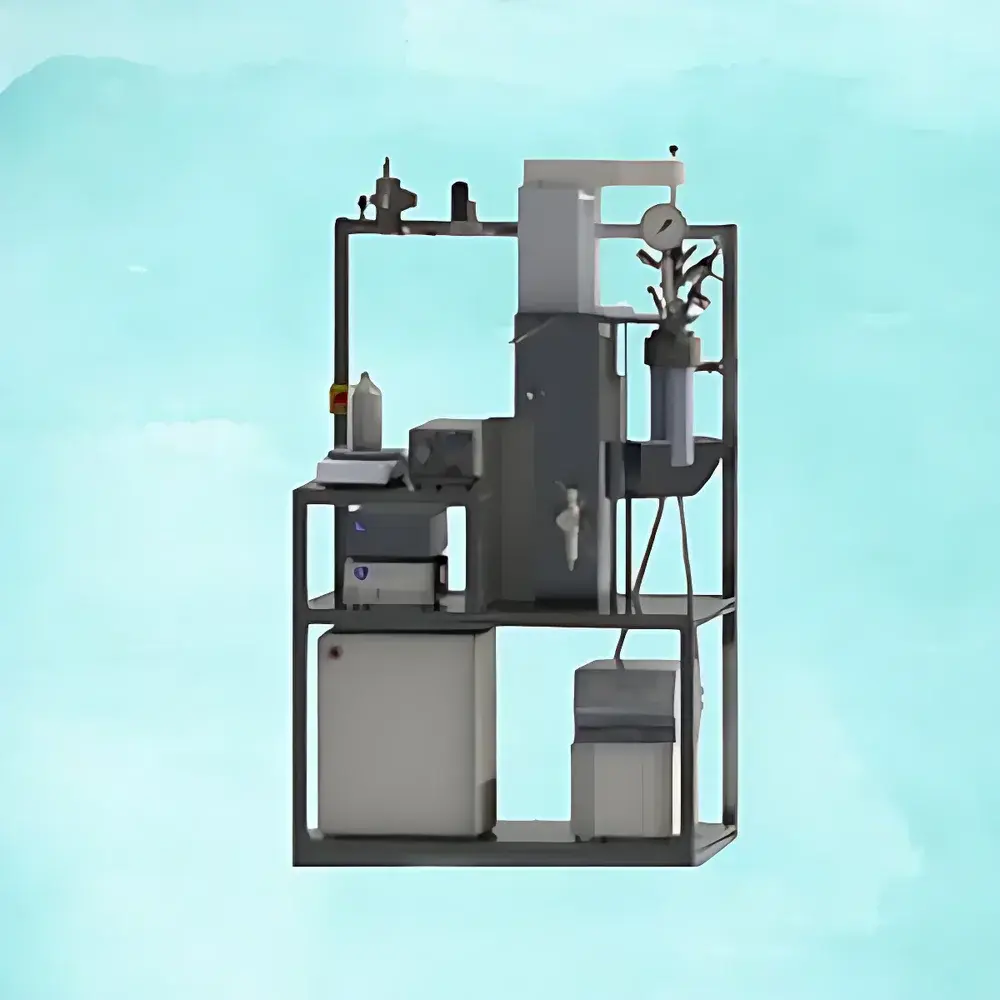
Parr Power Compensation Reaction Calorimeter
| Brand | SUSS (Germany) |
|---|---|
| Origin | USA |
| Manufacturer Type | Authorized Distributor |
| Origin Category | Imported |
| Model | Parr |
| Measurement Mode | Isothermal Calorimetry |
| Instrument Type | Oxygen-Bomb Calorimeter |
| Automation | Fully Automated |
| Control System | Parr 4871 Process Controller |
| Reactor Configuration | Jacketed Vessel with Integrated Thermostatic Circulating Bath |
| Heating Compensation | Precision DC-Powered Compensation Heater |
Overview
The Parr Power Compensation Reaction Calorimeter is a precision-engineered thermal analysis instrument designed for quantitative, real-time measurement of heat flow during chemical reactions under controlled isothermal conditions. Unlike traditional adiabatic or heat-flow calorimeters, this system employs a power compensation principle: it dynamically adjusts electrical power supplied to a dedicated compensation heater surrounding the reaction vessel to maintain constant temperature—thereby directly quantifying reaction enthalpy as electrical energy input. This method delivers high reproducibility and eliminates thermal lag artifacts common in indirect heat-transfer-based systems. The calorimeter is purpose-built for laboratory-scale process safety evaluation, reaction kinetics characterization, and thermal hazard assessment in pharmaceutical, fine chemical, and academic R&D environments.
Key Features
- Power compensation architecture enabling direct, model-free heat flow measurement with sub-milliwatt resolution and ±0.5% full-scale accuracy under ISO 11357-7 and ASTM E1269-compliant operation.
- Integrated jacketed reactor vessel (standard 100–2000 mL capacity) coupled with a high-stability thermostatic circulating bath (±0.02 °C temperature control over 0–150 °C range).
- Dedicated DC-powered compensation heater with low thermal inertia and fast response time (<1 s), ensuring minimal overshoot during exothermic transients.
- Parr 4871 Process Controller providing synchronized regulation of temperature, agitation speed, dosing sequences, pressure monitoring (up to 200 bar), and real-time calorimetric data acquisition at 10 Hz sampling rate.
- Robust mechanical design compliant with ASME BPVC Section VIII Div. 1 for pressure containment; includes redundant safety interlocks, rupture disc protection, and gas purge capability for oxygen-sensitive chemistry.
Sample Compatibility & Compliance
The system accommodates heterogeneous and homogeneous reaction mixtures—including slurries, viscous solutions, catalytic suspensions, and gas-liquid systems—without compromising thermal uniformity or measurement fidelity. Vessel materials include 316 stainless steel, Hastelloy C-276, and glass-lined options for corrosion resistance. All hardware and firmware comply with IEC 61508 (SIL2) for functional safety and support GLP/GMP documentation requirements. Data integrity is maintained per FDA 21 CFR Part 11 through electronic audit trails, user access controls, and non-modifiable raw data storage in .csv and .tdms formats.
Software & Data Management
Acquisition and analysis are performed using Parr’s proprietary CalorSoft™ platform, which provides real-time visualization of heat flow, cumulative enthalpy, temperature deviation, and power compensation profiles. The software supports automated baseline correction, stoichiometric heat balance validation, and kinetic modeling via built-in Arrhenius and nth-order fitting modules. Exported datasets are compatible with MATLAB, Python (NumPy/Pandas), and commercial process simulation tools (e.g., AspenTech, gPROMS). Raw data files retain full metadata—including timestamped controller logs, sensor calibration IDs, and environmental ambient readings—for regulatory submission readiness.
Applications
- Reaction endpoint determination and completion verification in batch and semi-batch synthesis.
- Quantitative kinetic profiling—including activation energy, reaction order, and heat of reaction—for mechanistic studies and scale-up modeling.
- Cooling capacity requirement analysis to inform jacket sizing, chiller selection, and emergency relief system design.
- Thermal runaway screening per RC1e, ARSST, and DSC cross-validation protocols.
- Process safety qualification for QbD (Quality by Design) submissions under ICH Q5, Q7, and Q9 frameworks.
FAQ
How does power compensation differ from heat-flow calorimetry?
Power compensation measures heat evolution by maintaining isothermal conditions via dynamic electrical heating—yielding direct enthalpy values without reliance on heat transfer coefficients or calibration standards.
Can the system operate under inert or reactive gas atmospheres?
Yes—the reactor head is equipped with dual gas inlet/outlet ports, pressure transducers, and automatic purge cycles compatible with N₂, Ar, H₂, O₂, and Cl₂ up to 200 bar.
Is third-party software integration supported?
CalorSoft™ provides OPC UA and REST API interfaces for bidirectional communication with DCS, LIMS, and MES platforms.
What validation documentation is provided?
Each unit ships with Factory Acceptance Test (FAT) reports, IQ/OQ protocols aligned with ASTM E1981, and NIST-traceable calibration certificates for all primary sensors.
Does the system meet requirements for regulatory audits?
Yes—full electronic records, role-based authentication, and immutable audit trails satisfy FDA 21 CFR Part 11, EU Annex 11, and MHRA GxP expectations.



