
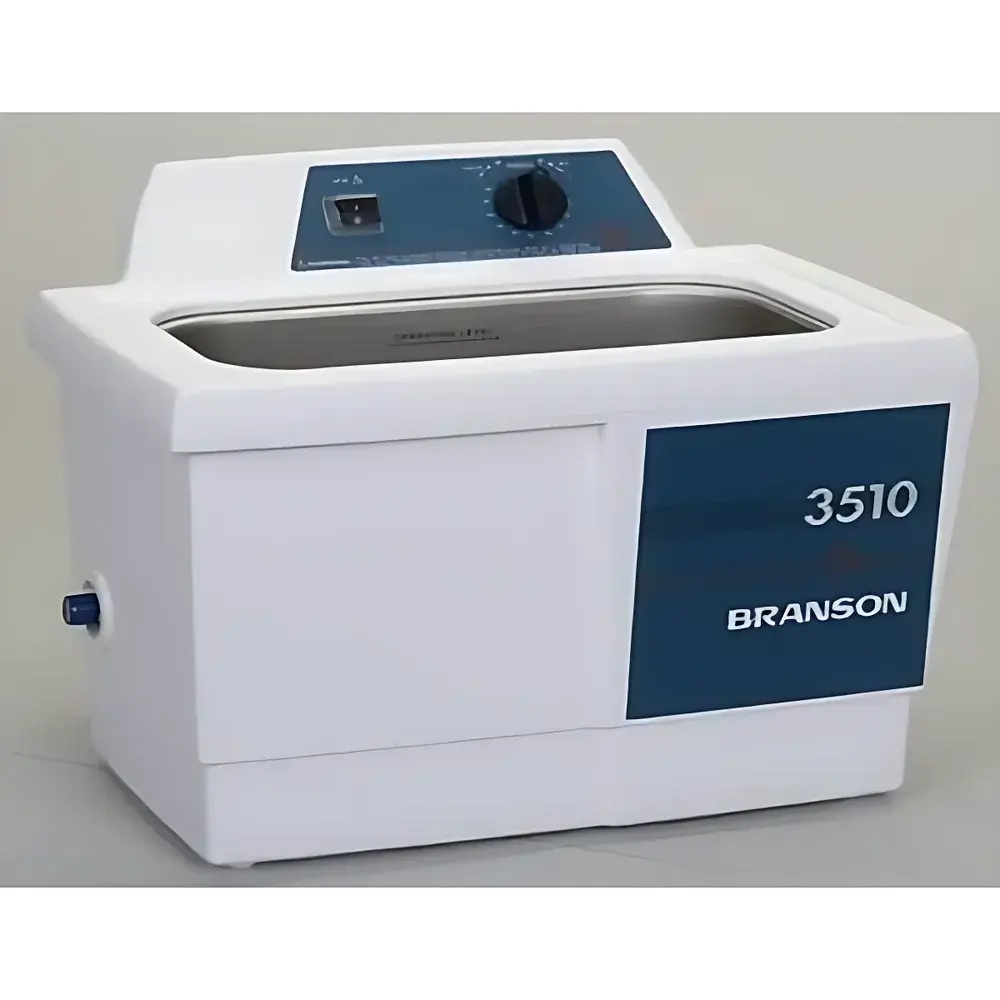
Branson B3510E-DTH Ultrasonic Cleaner
| Brand | Branson |
|---|---|
| Origin | USA |
| Model | B3510E-DTH |
| Tank Capacity | 5.7 L |
| Ultrasonic Frequency | 40 kHz |
| Ultrasonic Power Output | 130 W |
| Adjustable Power | Yes |
| Adjustable Temperature | 0–70 °C |
| Adjustable Timer | 0–60 min |
| Sound-Dampening Lid | Included |
| Manual Fill/Drain | Yes |
Overview
The Branson B3510E-DTH Ultrasonic Cleaner is a benchtop, solid-state ultrasonic cleaning system engineered for precision and reliability in laboratory, medical device reprocessing, industrial maintenance, and fine instrumentation cleaning environments. It operates on the principle of acoustic cavitation—generating high-frequency pressure waves (40 kHz) through piezoelectric transducers bonded to the tank bottom, which induce controlled microbubble formation and collapse in aqueous or compatible non-flammable cleaning solutions. This physical mechanism enables effective removal of particulate contaminants, light oils, oxides, and organic residues from complex geometries—including blind holes, threaded surfaces, and microchannels—where conventional wiping or rinsing proves insufficient. Designed for continuous-duty operation under GLP-aligned workflows, the unit integrates a corrosion-resistant polypropylene (PP) housing and a seamless, welded stainless-steel tank to eliminate crevices that could harbor biofilm or residue—a critical requirement for ISO 13485-compliant medical device cleaning validation.
Key Features
- Robust 130 W ultrasonic power output with frequency-stabilized 40 kHz transduction, delivered via Langevin-type metal-ceramic transducers mounted with epoxy-bonded fixation for consistent energy transfer and long-term resonance stability.
- Digital temperature control (0–70 °C) with real-time LED display of both setpoint and actual bath temperature—enabling optimization of cleaning efficacy for thermally sensitive substrates or surfactant-activated formulations.
- Precise timer functionality (0–60 minutes) with audible end-of-cycle alert; supports extended dwell times required for stubborn contaminant dissolution without operator intervention.
- Integrated sound-dampening hinged lid, constructed from impact-resistant polymer, doubles as a drip tray when flipped—reducing ambient noise by up to 15 dB(A) and preventing solvent evaporation during operation.
- Vertical PCB layout and sealed solid-state electronics minimize thermal stress and enhance electromagnetic compatibility (EMC), ensuring stable performance across variable line voltages (220 V, 50/60 Hz).
- Ergonomic control panel positioned above the tank for intuitive access; tactile, rubber-coated power switch improves safety in wet-lab conditions.
- Predefined fill line etched into the tank interior ensures optimal cavitation efficiency and reproducible cleaning results across operators and shifts.
Sample Compatibility & Compliance
The B3510E-DTH accommodates a wide range of substrates—including stainless steel surgical instruments, glassware, optical components, printed circuit boards (PCBs), dental tools, and jewelry—when used with Branson-certified aqueous detergents or low-toxicity, non-flammable solvents. Its seamless 304 stainless-steel tank (292 × 152 × 152 mm internal dimensions) complies with ASTM D2603 (Standard Test Method for Sonic Shear Stability of Lubricants) for ultrasonic exposure testing protocols. The unit supports cleaning process documentation per FDA 21 CFR Part 11 when integrated with validated external data loggers, and its construction meets IEC 61010-1 requirements for electrical safety in laboratory equipment. No internal welds or porous gaskets are present—facilitating routine cleaning verification and microbial monitoring per USP Analytical Instrument Qualification guidelines.
Software & Data Management
While the B3510E-DTH operates as a standalone analog-digital hybrid instrument without embedded firmware or network connectivity, its parameter settings (time, temperature, and ultrasonic activation) are fully repeatable and operator-documentable. For regulated environments, users may pair the unit with external calibrated thermistors and time-stamped video recording systems to satisfy audit requirements for cleaning validation (e.g., AAMI TIR30, ISO 15883). All operational parameters remain stable across voltage fluctuations, eliminating drift-related variability—a key factor in maintaining inter-laboratory reproducibility in QC/QA applications.
Applications
- Pre-analytical sample preparation: Degassing HPLC vials, cleaning pipette tips, and decontaminating centrifuge rotors prior to sterility testing.
- Medical device reprocessing: Removal of proteinaceous soil and bioburden from laparoscopic instruments, endoscopes accessories, and orthopedic implant fixtures.
- Electronics manufacturing: Flux residue removal from SMT assemblies and solder paste stencil cleaning prior to AOI inspection.
- Research laboratories: Cleaning quartz cuvettes, NMR tubes, and MEMS devices without mechanical abrasion or surface scratching.
- Jewelry and watchmaking: Gentle yet effective removal of polishing compounds and organic adhesives from precious metal components.
FAQ
Is the B3510E-DTH suitable for use with flammable solvents?
No. This unit is designed exclusively for aqueous or non-flammable cleaning solutions. Flammable solvents pose explosion hazards under ultrasonic cavitation and are incompatible with the unit’s electrical architecture.
Can the ultrasonic power be reduced below 130 W?
Yes. The unit features continuously variable ultrasonic intensity control, allowing users to optimize energy delivery for delicate substrates such as thin-walled glassware or coated optics.
Does the tank include a drain valve?
No. Drainage is manual via tilting or siphoning; the design prioritizes structural integrity and leak prevention over integrated plumbing.
What is the expected service life of the transducers?
Under normal operating conditions and proper solution maintenance, Branson Langevin transducers typically exceed 10,000 hours of cumulative runtime before requiring recalibration or replacement.
Is calibration documentation provided with the unit?
Factory calibration certificates for temperature and timer accuracy are available upon request and traceable to NIST standards; user-performed periodic verification is recommended per ISO/IEC 17025 internal quality procedures.



