
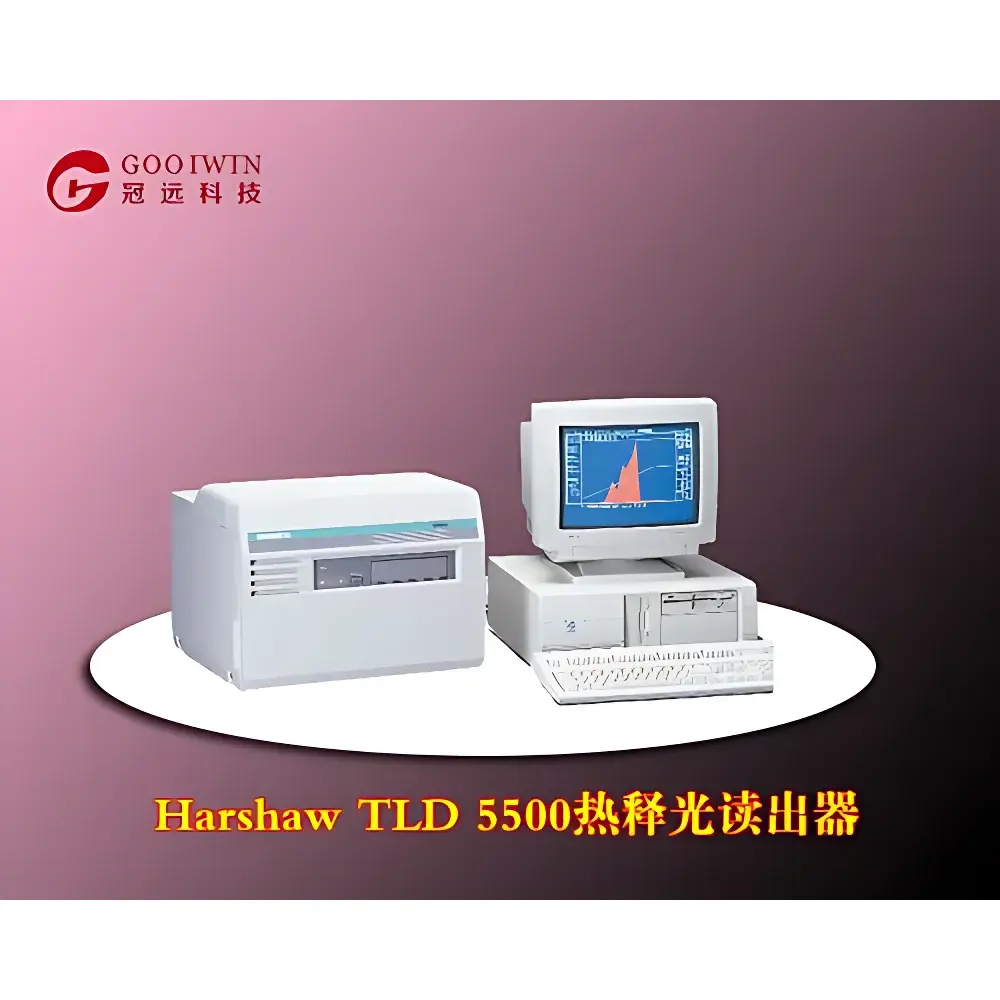
Harshaw TLD 5500 Thermoluminescence Dosimeter Reader
| Brand | UNION |
|---|---|
| Origin | Germany |
| Model | 55S00 |
| Heating Method | Gas-heated Linear Ramp (TTP) |
| Max Temperature | 600 °C |
| Sample Capacity | 50 TLD Elements per Cycle |
| Readout Time | 30 s per Element (Standard TTP) |
| Photomultiplier Tube Cooling | Integrated Peltier Cooler |
| Dynamic Range | 7 decades |
| Linearity Error | <1% |
| Dark Current Equivalent Dose | <50 mGy (Cs-137) |
| High Voltage Range | 500–1200 V |
| Stability | ±0.005% |
| Dose Units | nC, gU, mrad, mrem, mGy, Gy, μSv, mSv, Sv |
| MTBF | >10,000 h |
| Operating Temp | 0–40 °C |
| Storage Temp | −10–60 °C |
| Preheat Time | 30 min |
Overview
The Harshaw TLD 5500 Thermoluminescence Dosimeter Reader is a high-precision, gas-heated linear ramp (TTP) thermoluminescence reader engineered for quantitative radiation dose assessment in regulatory, research, and quality control environments. It operates on the fundamental principle of thermoluminescence: when crystalline dosimetric materials (e.g., LiF:Mg,Ti, CaSO₄:Dy) previously exposed to ionizing radiation are heated under controlled conditions, trapped electrons recombine with lattice defects, emitting photons proportional to the absorbed dose. The instrument captures this luminescent signal via a low-noise, Peltier-cooled photomultiplier tube (PMT), enabling trace-level detection across seven decades of dynamic range. Designed for compliance-driven workflows—including food irradiation verification, environmental monitoring, retrospective accident dosimetry, and geological/archaeological dating—the TLD 5500 delivers metrologically traceable results without chemical reagents or sample digestion. Its architecture meets foundational requirements for GLP-compliant laboratories, supporting audit-ready data integrity through hardware-level stability (±0.005%) and intrinsic calibration traceability.
Key Features
- Automated batch processing of up to 50 TLD elements per readout cycle, minimizing operator intervention and inter-sample variability.
- Programmable linear temperature ramp (TTP) heating profile with integrated preheat and post-readout annealing stages—ensuring reproducible thermal stimulation and element reset.
- Gas-heated furnace capable of reaching 600 °C with precise thermal gradient control, eliminating hot-spot artifacts common in resistive heaters.
- Peltier-cooled PMT system reducing thermal noise and enhancing signal-to-noise ratio—critical for low-dose measurements in food matrix screening.
- Real-time automatic background subtraction using simultaneous dark count and chamber blank acquisition, improving measurement fidelity across heterogeneous sample types.
- Onboard screening mode: fully standalone operation with fixed threshold logic; results delivered within 15 seconds—no PC required.
- Comprehensive self-diagnostic suite including HV stability checks, PMT gain verification, heater calibration validation, and firmware integrity verification.
- Robust mechanical design optimized for transport between field sites and multi-user lab environments, with shock-absorbing chassis and sealed optical path.
Sample Compatibility & Compliance
The TLD 5500 accommodates standard planchet-style TLD elements (e.g., Harshaw 8810, 8840, or equivalent LiF-based chips) as well as powdered or granular food matrices placed directly in reusable quartz or aluminum sample holders—no solvent extraction, derivatization, or enzymatic treatment needed. This makes it uniquely suited for rapid irradiated food verification per ISO/IEC 17025-accredited methods (e.g., EN 1788:2021, ASTM F1646-22). Instrument performance aligns with IEC 62387-1:2012 for passive dosimetry systems and supports FDA 21 CFR Part 11 compliance when used with validated software modules. All firmware and calibration records are timestamped and immutable, satisfying GMP/GLP documentation requirements for dose record retention and traceability.
Software & Data Management
When interfaced with the optional UNION TLD Control Suite (Windows-based), the TLD 5500 enables full parameter customization: adjustable heating rate (0.1–20 °C/s), dwell time, integration window, and photon counting thresholds. Software features include automated PSL (photo-stimulated luminescence) cross-check for ambiguous screening outcomes, real-time dark current trending, chamber contamination alerts via blank-count deviation analysis, and PMT sensitivity drift compensation. Raw photon count data, thermal profiles, and dose reports are exportable in CSV and XML formats compliant with LIMS integration standards. Audit trails log all user actions, parameter changes, and calibration events—meeting ALCOA+ principles for data integrity.
Applications
- Irradiated Food Authentication: Detection of gamma-, X-ray-, or electron-beam-treated spices, herbs, dried fruits, and frozen seafood per EU Directive 1999/2/EC and Codex Alimentarius Standard 106-1983.
- Retrospective Accident Dosimetry: Reconstruction of accidental exposure doses using household ceramics, bricks, or dental enamel—validated in IAEA TECDOC-1797 protocols.
- Archaeological & Geological Dating: Luminescence dating of sediments and fired artifacts with sub-decadal resolution in controlled laboratory settings.
- Radiation Research: Characterization of TL glow curve kinetics, trap depth analysis, and dose-response linearity studies under ISO 21909:2020 guidelines.
- Environmental Monitoring: Long-term ambient dose mapping using deployed TLD badges in nuclear facilities, medical radiotherapy departments, and waste storage sites.
FAQ
Does the TLD 5500 require daily calibration?
No—its internal reference source and auto-diagnostic routines verify system stability before each batch; full calibration is recommended annually or after maintenance.
Can it distinguish between natural background and irradiation-induced TL signals?
Yes—through differential glow curve analysis, preheat protocol optimization, and comparative blank-subtracted net counts, enabling discrimination at ≤1 kGy thresholds.
Is the instrument compatible with non-UNION TLD materials?
It supports all industry-standard TLD phosphors (LiF, CaF₂, CaSO₄) provided they conform to ANSI N13.32-2020 dimensional and spectral response specifications.
What safety certifications does it hold?
CE marked per IEC 61010-1:2010 (Safety Requirements for Electrical Equipment), EMC compliant to EN 61326-1:2013, and RoHS 2011/65/EU compliant.
How is data integrity ensured during offline screening mode?
All screening results include embedded metadata (timestamp, firmware version, element ID, ambient temp/humidity), stored in non-volatile memory with SHA-256 checksum validation.






