
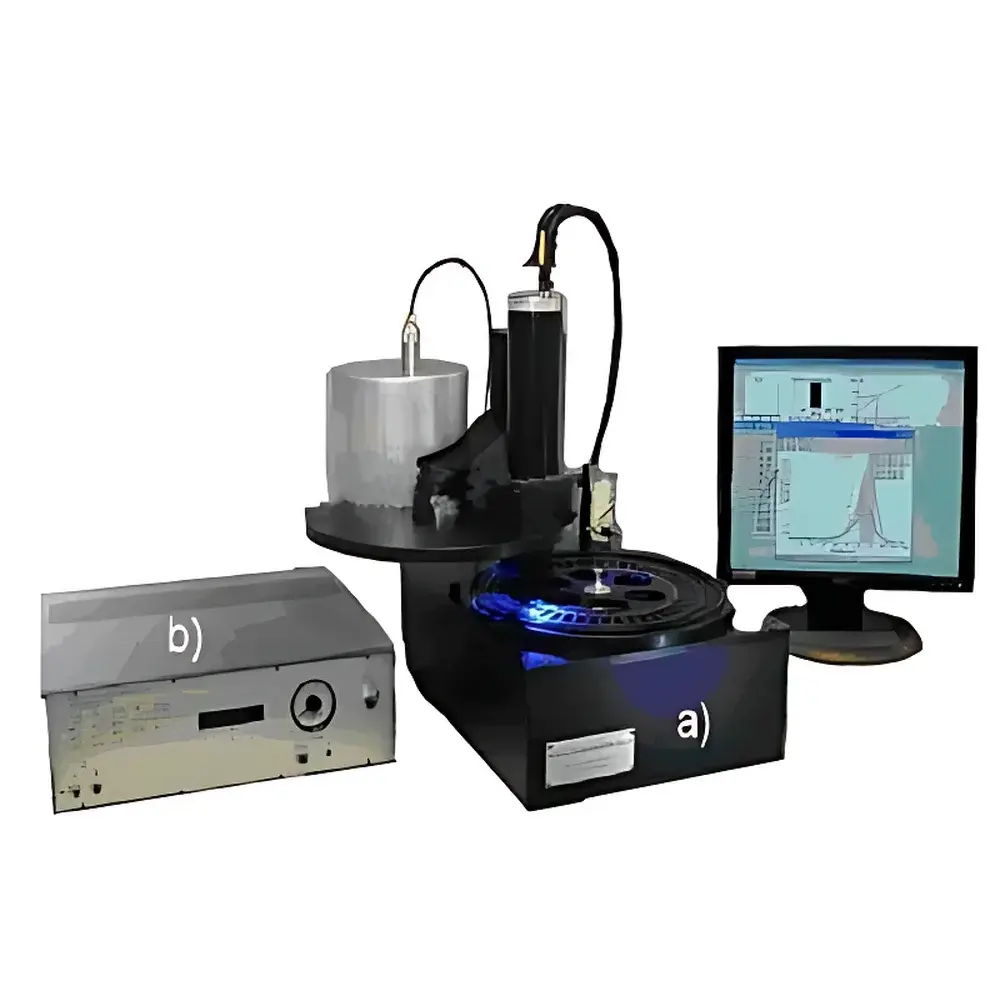
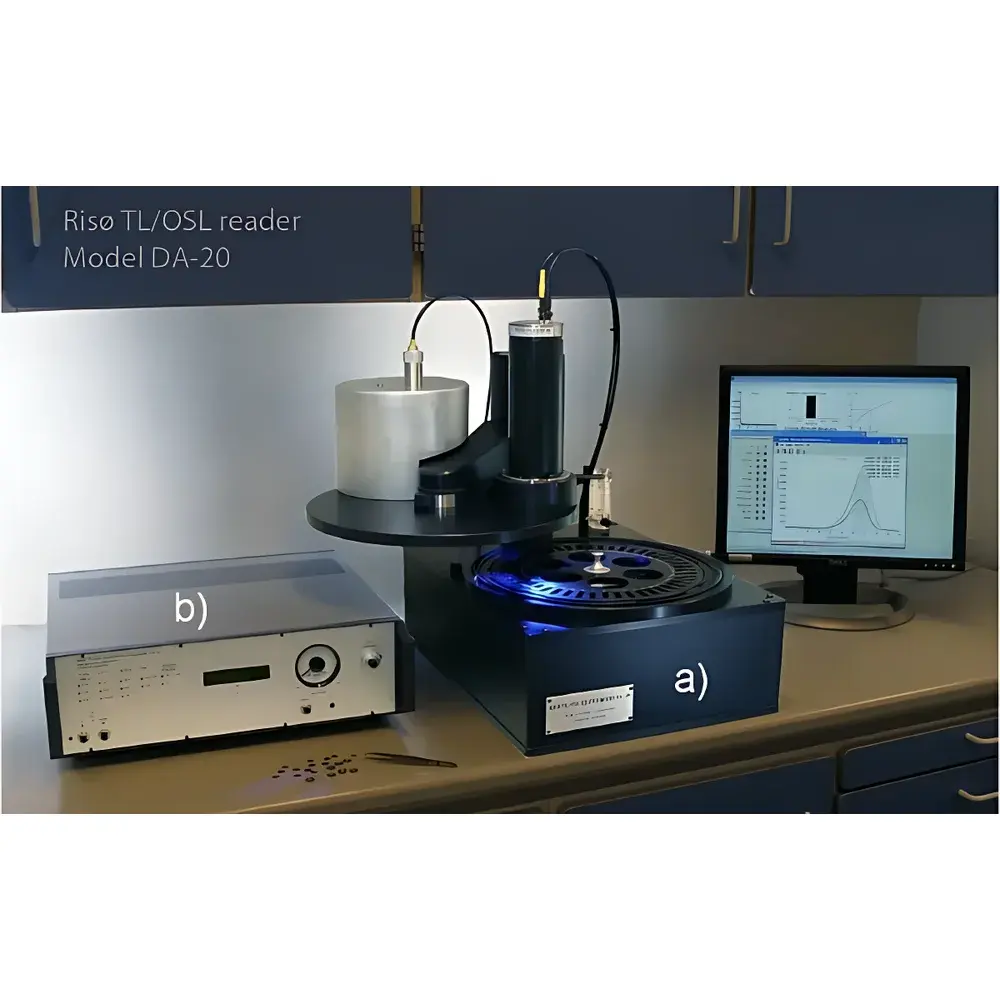
Risø TL/OSL-DA20 C/D Thermoluminescence and Optically Stimulated Luminescence Dating System
| Origin | Denmark |
|---|---|
| Manufacturer Type | Authorized Distributor |
| Origin Category | Imported |
| Model | TL/OSL-DA20 C/D |
| Price Range | USD 0–7,200 (est. based on ¥0–50,000) |
Overview
The Risø TL/OSL-DA20 C/D is a high-precision, dual-mode luminescence dating system engineered for archaeological and geological chronology. Developed by the Risø National Laboratory (Technical University of Denmark), it implements both thermoluminescence (TL) and optically stimulated luminescence (OSL) measurement principles—based on the controlled release and quantification of trapped charge carriers in crystalline mineral lattices (e.g., quartz and feldspar) following thermal or photon stimulation. The system operates on the fundamental premise that natural radiation exposure accumulates electron-hole pairs in crystal defects over time; subsequent laboratory stimulation liberates these charges, producing measurable luminescence proportional to the integrated dose—and thus, the burial age—of the sample. Its modular architecture integrates excitation, detection, irradiation, and thermal control subsystems within a single, vacuum-compatible measurement chamber, enabling rigorous dose-response calibration, reproducible signal acquisition, and compliance with international luminescence dating protocols (ISO/IEC 17025, ASTM D7250).
Key Features
- Dual-mode operation: Simultaneous support for TL, CW-OSL, LM-OSL (linearly modulated), and pulsed OSL measurements
- 48-position automated sample carousel with programmable sequence execution and real-time status monitoring
- Programmable heating: 20 °C to 700 °C range; ramp rates adjustable from 0.1 to 10 K/s; isothermal TL capability at any setpoint
- Dual LED stimulation sources: 470 nm blue LEDs (≥50 mW/cm²) and 870 nm infrared LEDs (≥140 mW/cm²), each with closed-loop optical feedback for intensity stability
- Optional single-grain module: Integrated 532 nm green laser (50 W/cm²) and 830 nm IR laser (~500 W/cm²) for micro-sample analysis
- Vacuum-capable sample chamber with computer-controlled N₂ purge for rapid post-heating cooling and oxygen-free TL measurement environments
- Triple irradiation options: β-source (⁹⁰Sr/⁹⁰Y, 1.48 GBq), α-source (²⁴¹Am, 10.7 MBq), and X-ray tube (Varian VF-50J, 50 kV/1 mA), all software-selectable and independently gated
Sample Compatibility & Compliance
The DA20 C/D accommodates standard 9.7 mm diameter aluminum planchets, custom multi-well trays, and single-grain mounts. It supports routine analysis of quartz, feldspar, pottery sherds, bricks, sediments, and volcanic tephra—materials widely used in Quaternary geochronology and artifact authentication. All irradiation and readout workflows adhere to IAEA TRS-430 guidelines for luminescence dosimetry. The system’s hardware design and firmware logic are structured to support audit-ready data integrity: full electronic logbooks, user-access-level controls, and timestamped parameter records meet GLP requirements. Optional 21 CFR Part 11-compliant software modules provide electronic signatures, audit trails, and secure data archiving for regulated laboratories.
Software & Data Management
Control and analysis are performed via the proprietary Risø Analyst software suite (v.6.x), which provides end-to-end workflow management—from experimental protocol definition (e.g., SAR, MAAD, TT-OSL sequences) to raw photon counting, background subtraction, dose–response curve fitting (using exponential, saturating exponential, or general-order kinetic models), and age calculation (with uncertainty propagation per Galbraith & Roberts, 2012). Data export is supported in ASCII, CSV, and XML formats; batch processing enables parallel analysis of multi-sample datasets. Raw photon counts are stored with metadata including stimulation parameters, temperature history, irradiation dose, and PMT gain settings—ensuring full traceability and inter-laboratory comparability.
Applications
- Archaeological dating of ceramics, burnt flint, and fired clay structures (e.g., kilns, hearths)
- Quaternary sediment chronology for paleoenvironmental reconstruction and tectonic studies
- Accident dosimetry using building materials (tiles, bricks) as retrospective radiation monitors
- Food irradiation verification via OSL signal detection in silicate contaminants (e.g., salt, spices)
- Fundamental luminescence physics research—including trap depth analysis, thermal quenching behavior, and recombination dynamics
FAQ
What is the difference between TL and OSL measurement modes?
TL measures light emitted during controlled heating, releasing thermally unstable trapped charges; OSL uses light stimulation (blue or IR) to release optically unstable charges—enabling repeated measurement of the same sample aliquot.
Can the DA20 C/D perform single-aliquot regenerative-dose (SAR) protocols?
Yes—the system fully supports ISO/IEC 17025-aligned SAR protocols for quartz and feldspar, including preheat optimization, test-dose correction, and recycling ratio assessment.
Is vacuum operation required for TL measurements?
Vacuum is optional but recommended for high-temperature TL (>500 °C) to prevent oxidation of the heater filament and minimize thermal quenching artifacts.
How is dose rate calibrated across irradiation sources?
Each source is factory-calibrated against traceable standards (NPL, PTB); users perform routine checks using reference quartz samples with known laboratory doses.
Does the system support third-party software integration?
Raw data files are format-open; Python and MATLAB toolboxes (e.g., ‘Luminescence’ R package, ‘analyst’ Python library) provide interoperability for advanced statistical modeling and Bayesian age estimation.




