
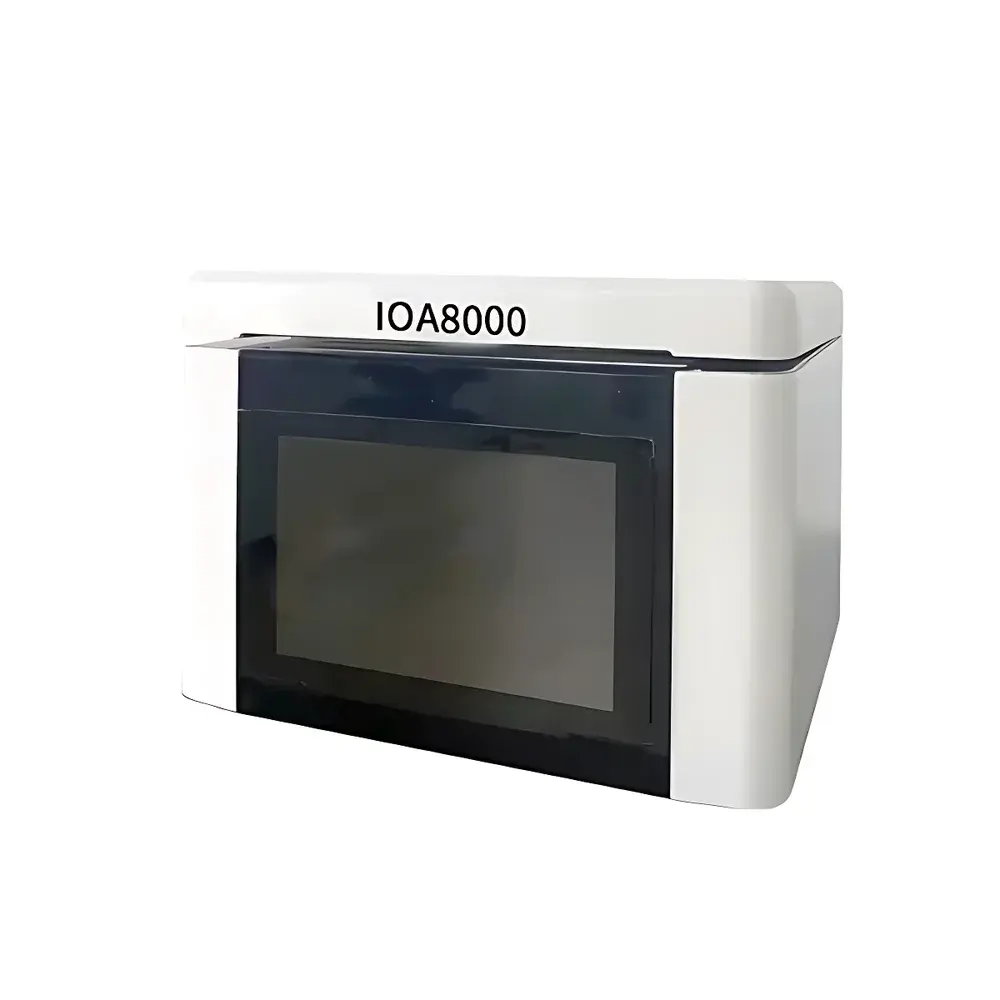
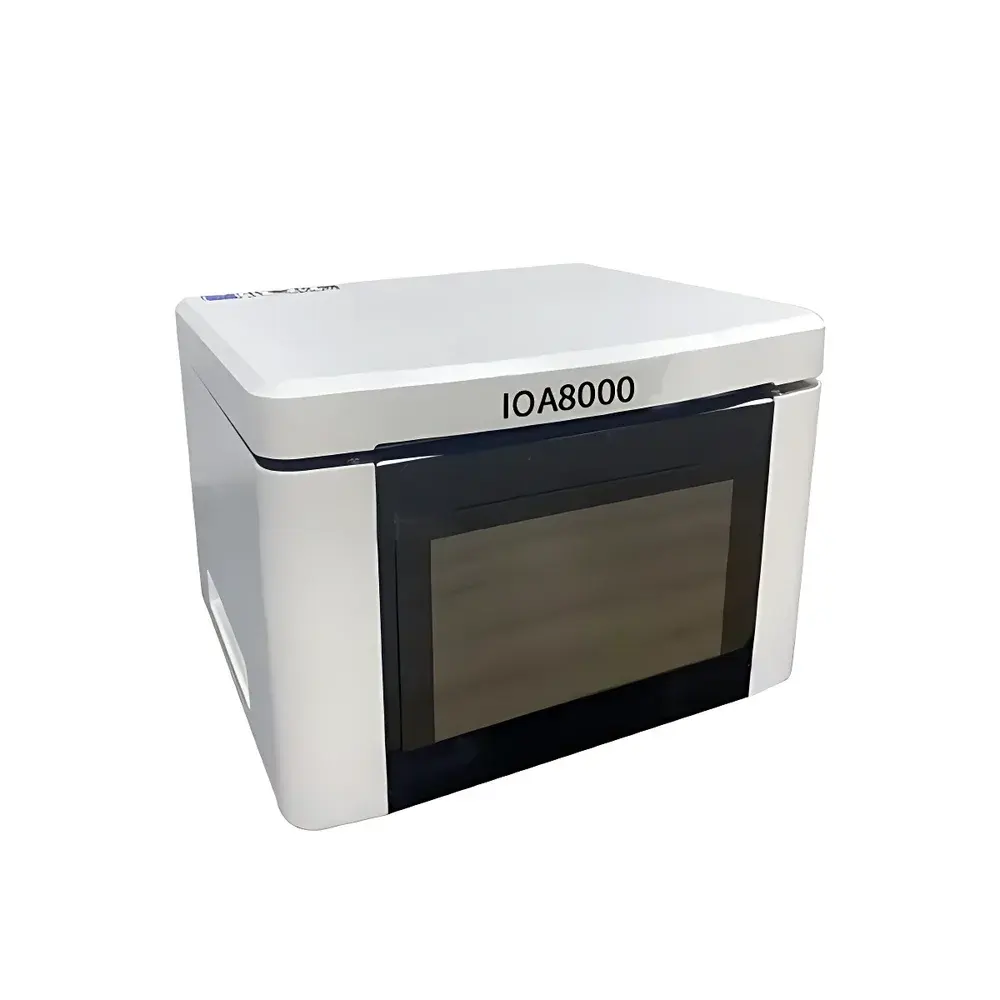
SOOHOW INSTRUMENT IOA8000 Intelligent Oil Analysis Analyzer
| Brand | SOOHOW INSTRUMENT |
|---|---|
| Origin | Jiangsu, China |
| Manufacturer Type | Direct Manufacturer |
| Country of Origin | China |
| Model | IOA8000 |
| Detection Target | Total Sulfur |
| Portability | Portable |
| Detection Principle | Energy-Dispersive X-ray Fluorescence (ED-XRF) |
| Detection Limit | 10 ppm / 2 ppm for S in fuel |
| Analysis Time | 30–300 s |
| Measurement Range | 2 ppm – 99.99% |
| Elemental Range | Mg to U |
| Detector | Silicon Drift Detector (SDD), resolution ≤130 eV (Fast SDD option: ≤125 eV) |
| Operating Temperature | −10 °C to +50 °C |
| Operating Humidity | <90% RH |
| Dimensions | 400 mm × 332 mm × 272 mm |
| Weight | 4.6 kg |
Overview
The SOOHOW INSTRUMENT IOA8000 Intelligent Oil Analysis Analyzer is a field-deployable, energy-dispersive X-ray fluorescence (ED-XRF) spectrometer engineered for rapid, non-destructive elemental analysis of petroleum-based fluids and lubricants. Designed specifically for operational maintenance environments—including rail transit fleets (locomotives, metro systems), marine vessels, and heavy-duty mobile equipment—the IOA8000 enables on-site quantification of total sulfur, wear metals (e.g., Fe, Cu, Si), additive elements (e.g., Zn, Ca, P), contaminants (e.g., Cl, Na), and trace impurities without sample digestion, dilution, or solvent extraction. Its core measurement principle relies on excitation of sample atoms via primary X-rays, followed by detection of characteristic secondary X-ray emissions using a high-resolution silicon drift detector (SDD). The instrument’s optimized optical path—featuring a High-Angle Pyrolytic Graphite (HAPG) polarizing monochromator—enhances light-element sensitivity (particularly for S, Cl, P, and Ca), ensuring reliable low-concentration detection in complex hydrocarbon matrices.
Key Features
- True portable form factor (4.6 kg, battery-compatible operation) enabling deployment directly at gearboxes, hydraulic reservoirs, or fuel tanks—no lab transfer required.
- Direct solid/liquid analysis: grease, oil, fuel, and sludge samples loaded into standardized sample cups; no heating, acid digestion, or filtration needed.
- Automated single-button workflow with preloaded, application-specific calibration curves—optimized for railway lubricants (e.g., axle bearing grease, traction motor grease, diesel engine oil) and aviation/jet fuels.
- High spectral resolution (≤130 eV standard, ≤125 eV with Fast SDD option) ensures baseline separation of overlapping Kα lines (e.g., S Kα at 2.307 keV vs. Pb Mα at 2.346 keV).
- Robust environmental tolerance: functional across −10 °C to +50 °C ambient temperature and up to 90% relative humidity—validated for under-hood, depot, and shipboard use.
- Low consumables footprint: no gases, no vacuum pumps, no X-ray tube replacements within typical service life; minimal sample cup usage.
- Integrated safety design: fully shielded X-ray path, interlocked sample chamber, and compliance with IEC 61010-1 for electrical safety and radiation protection.
Sample Compatibility & Compliance
The IOA8000 accepts liquid fuels (diesel, jet A-1, biodiesel blends), used lubricating oils (SAE 10W-40, ISO VG 46), greases (lithium-complex, polyurea), crude fractions (naphtha, vacuum gas oil), and solid residues (filter debris, wear particles). It conforms to ASTM D7039 (ED-XRF determination of sulfur in light hydrocarbons), ISO 8754 (XRF determination of sulfur in petroleum products), and supports method development aligned with ASTM D6443 (additive element analysis in lubricants). While not certified for regulatory reporting per US EPA Method 7200B or ISO 20847, its performance meets internal QC thresholds for condition-based oil monitoring programs under ISO 4406 (particle contamination) and ISO 17359 (integrated machinery health assessment). Data integrity safeguards include audit-trail logging and user-access controls compatible with GLP-aligned workflows.
Software & Data Management
Controlled via an embedded Linux-based interface with touchscreen GUI, the IOA8000 software provides real-time spectrum visualization, peak deconvolution, and quantitative reporting in ppm or wt%. Calibration models support both fundamental parameter (FP) and empirical curve-fitting approaches. Pre-installed method packages include: (1) Railway Lubricant Wear Monitoring (Fe, Cu, Al, Si, Cr, Pb, Sn); (2) Fuel Sulfur Compliance (S in diesel/biodiesel per EN 590 or ASTM D975); (3) Additive Depletion Profiling (Zn, Ca, Mg, P, Ba). All results export to CSV, PDF, or XML formats; optional cloud synchronization enables fleet-wide trend analysis via secure HTTPS API. Software architecture supports 21 CFR Part 11–compatible electronic signatures when deployed with external identity management systems.
Applications
- Railway maintenance depots: trending Fe/Cu/Si ratios in axle gearbox oil to predict bearing or gear tooth wear before catastrophic failure.
- Marine engineering teams: verifying sulfur content in bunker fuel against IMO 2020 cap (<0.50% m/m) during port state control inspections.
- Power generation facilities: monitoring Zn and P depletion in turbine oils to schedule additive replenishment.
- Aviation ground support: rapid screening of jet fuel for chloride contamination (Cl > 10 ppm indicates tank corrosion or seawater ingress).
- Refinery QC labs: incoming crude assay verification for S, Ni, V, and Ca prior to distillation unit feed.
- Independent lubricant reclamation centers: assessing residual additive package integrity in re-refined base oils.
FAQ
Does the IOA8000 require external cooling or vacuum pumping?
No. It operates with air-cooled SDD detection and atmospheric-pressure measurement—no cryogens, pumps, or purge gases are needed.
Can it distinguish between organic sulfur and inorganic sulfate species?
No. ED-XRF measures total sulfur regardless of chemical speciation; complementary techniques (e.g., GC-SCD or UV fluorescence) are required for speciation.
Is operator radiation safety training required?
Yes. While the device meets Class I radiation safety standards (IEC 62495), local regulatory requirements for X-ray equipment operators must be fulfilled prior to deployment.
How often does calibration need verification?
Daily verification using a certified check standard (e.g., NIST SRM 2720a) is recommended; full recalibration every 6 months or after 500 analyses, whichever occurs first.
Does it support ASTM D7039-compliant reporting?
Yes—preconfigured reporting templates include all mandatory fields (instrument ID, analyst, date/time, uncertainty estimates per ISO/IEC 17025 Annex A.3) and can be exported for third-party review.






