
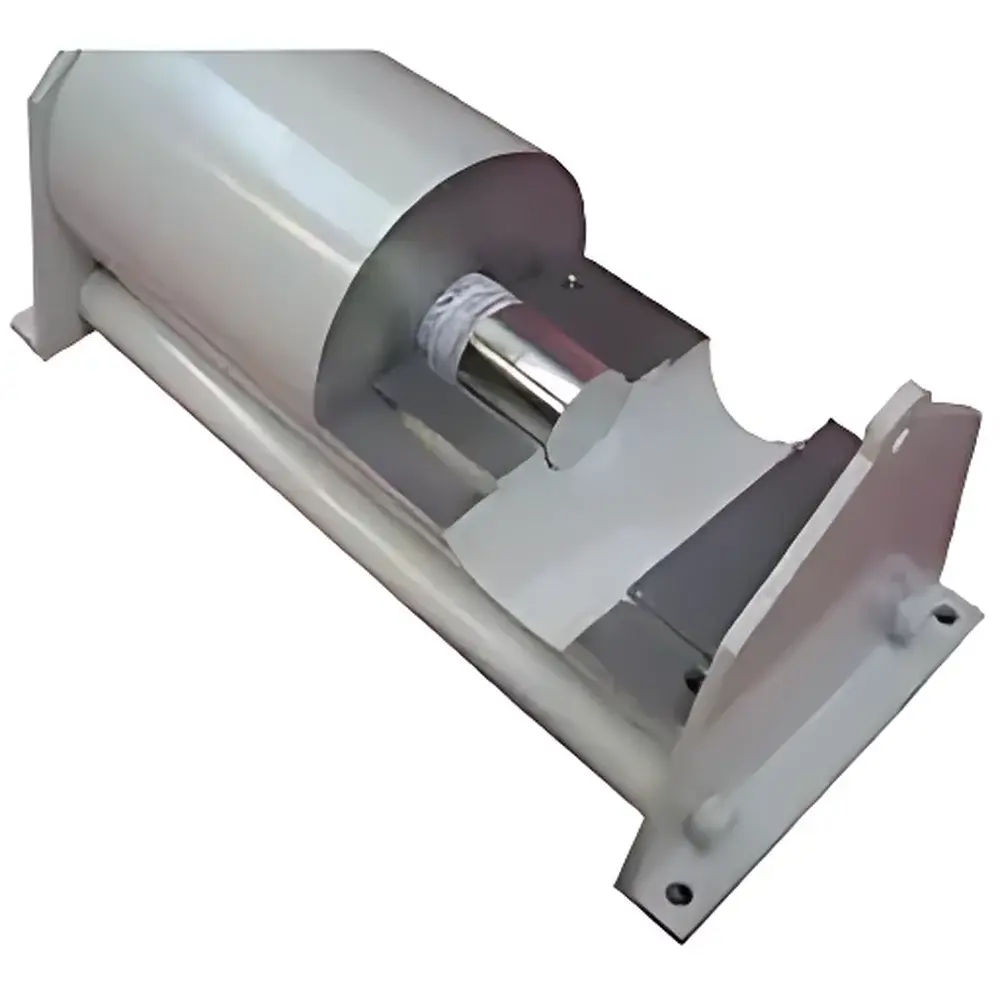
OLEM Radiation Dose Rate Monitor
| Origin | UK |
|---|---|
| Manufacturer Type | Authorized Distributor |
| Origin Category | Imported |
| Model | OLEM |
| Instrument Type | Radiation Dose Rate Meter |
| Detector Options | NaI(Tl) or CsI(Tl) Scintillation Crystal |
| Mounting Orientation | Horizontal or Vertical Pipe Integration |
| Shielding | Integrated Lead Collimator Assembly |
| Sample Interface | Non-invasive, No Fluid Sampling Required |
Overview
The OLEM Radiation Dose Rate Monitor is an industrial-grade, non-invasive gamma radiation measurement system engineered for continuous, real-time monitoring of radioactive isotopes—primarily 137Cs, 60Co, and other medium-to-high energy γ-emitters—in process piping environments. Operating on the principle of scintillation detection, the OLEM integrates a thallium-doped sodium iodide (NaI(Tl)) or cesium iodide (CsI(Tl)) crystal coupled to a photomultiplier tube (PMT) or silicon photomultiplier (SiPM), housed within a precision-machined lead collimator. This architecture enables high-sensitivity detection of gamma photons while rejecting background scatter and directional noise. Unlike traditional grab-sample or inline flow-cell systems, the OLEM requires no physical contact with the process stream, eliminating risks associated with fluid handling, corrosion, leakage, or cross-contamination. Its design conforms to IEC 60846-1:2014 (Radiation protection instrumentation — Ambient and/or directional dose equivalent (rate) meters and/or monitors for beta, X and gamma radiation) and supports compliance with ALARA (As Low As Reasonably Achievable) principles in nuclear medicine, radiochemical processing, and waste treatment facilities.
Key Features
- Non-invasive gamma detection: Measures radiation through pipe walls without sampling, tubing, or process interruption
- Modular lead shielding assembly: Optimized collimation geometry minimizes background interference and enhances signal-to-noise ratio; configurable for horizontal or vertical pipe orientation
- Detector flexibility: Field-selectable NaI(Tl) (higher light yield, optimal for 0.1–3 MeV range) or CsI(Tl) (superior temperature stability and hygroscopic resistance) scintillation crystals
- Configurable alarm logic: Programmable threshold-based dose rate alarms with relay outputs for integration into plant safety interlock systems (e.g., shutdown triggers or ventilation activation)
- Robust mechanical architecture: IP65-rated enclosure with stainless-steel mounting brackets and thermal-stable electronics for operation in ambient temperatures from −10 °C to +50 °C
- Low-maintenance operation: No consumables, no calibration gases, no moving parts—calibration traceable to UK National Physical Laboratory (NPL) standards via annual verification protocol
Sample Compatibility & Compliance
The OLEM is compatible with carbon steel, stainless steel, and lined process pipes (e.g., rubber- or glass-lined) with wall thicknesses up to 25 mm and nominal diameters ranging from DN50 to DN600. It does not require pipe modification, weld pads, or penetrations. Regulatory alignment includes adherence to EURATOM Basic Safety Standards Directive 2013/59/Euratom, UK Ionising Radiations Regulations 2017 (IRR17), and supports documentation for ISO 14001 environmental management audits. While not a personal dosimeter, its output meets requirements for area monitoring per IAEA Safety Standards Series No. RS-G-1.8 and can be integrated into facility-wide radiation protection programs compliant with ICRP Publication 103 recommendations.
Software & Data Management
The OLEM interfaces via 4–20 mA analog output or optional Modbus RTU (RS-485) for connection to DCS, SCADA, or standalone data loggers. Optional OEM software provides time-stamped dose rate logging (1-second resolution), spectral trending (when equipped with multi-channel analyser firmware), and audit-trail-enabled configuration history. All data exports comply with CSV and XML formats suitable for LIMS integration. Firmware updates are performed via secure USB interface, and device configuration adheres to principles outlined in FDA 21 CFR Part 11 for electronic records where used in regulated pharmaceutical or radiopharmaceutical manufacturing contexts.
Applications
- Real-time effluent monitoring in nuclear decommissioning and spent fuel reprocessing plants
- Continuous surveillance of radiopharmaceutical synthesis lines (e.g., 18F-FDG, 68Ga-DOTATATE production)
- Waste stream characterization in low- and intermediate-level radioactive waste (LILW) treatment facilities
- Gamma source integrity verification in industrial irradiators and teletherapy equipment support infrastructure
- Environmental release monitoring at licensed nuclear sites under Environment Agency (UK) permit conditions
FAQ
Does the OLEM require periodic recalibration?
Yes—annual traceable calibration against NPL-certified reference sources is recommended for regulatory compliance and metrological continuity.
Can the OLEM distinguish between different radionuclides?
In standard configuration, it measures total gamma dose rate. With optional MCA firmware and NaI(Tl) detector, basic spectral discrimination (e.g., 137Cs vs. 60Co) is achievable under controlled geometries.
Is the system suitable for explosive atmospheres?
Not intrinsically safe by default; ATEX/IECEx certification requires custom housing and barrier integration—available upon request for Zone 2 applications.
What is the minimum detectable dose rate?
Typical sensitivity is ≤0.1 µSv/h above natural background, dependent on pipe material, wall thickness, and source activity distribution.
How is installation verified post-mounting?
A commissioning test using a calibrated check source (e.g., 137Cs disc source) and documented response verification per ISO/IEC 17025 procedures is required before operational handover.
Related Products







