
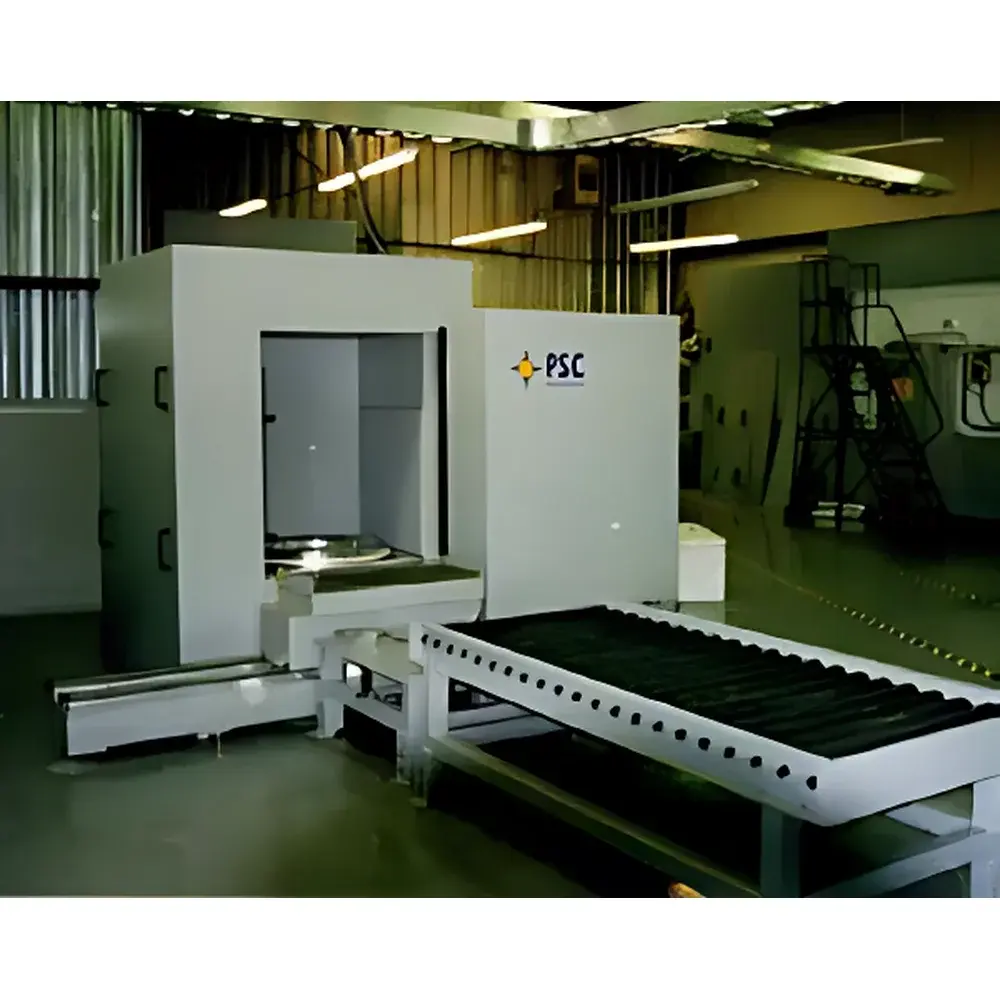
NDDA Active Neutron Differential Die-Away and Coincidence Imaging System
| Origin | USA |
|---|---|
| Manufacturer Type | Authorized Distributor |
| Origin Category | Imported |
| Model | NDDA |
| Pricing | Available Upon Request |
Overview
The NDDA Active Neutron Differential Die-Away and Coincidence Imaging System is a high-performance, non-destructive assay (NDA) instrument engineered for quantitative characterization of alpha-emitting transuranic radionuclides—particularly 235U, 239Pu, and 240Pu—in sealed waste containers. It integrates two complementary nuclear measurement principles: active neutron interrogation via pulsed 14 MeV neutrons, followed by time-resolved differential die-away analysis (DDA) of induced fission neutrons, and gamma-ray coincidence spectroscopy using high-purity germanium (HPGe) or scintillation detectors. This dual-modality architecture enables spatially resolved, matrix-corrected quantification of fissile material mass and total alpha activity, independent of container geometry, shielding configuration, or waste heterogeneity. Designed for regulatory-grade accountability, the NDDA system supports nuclear safeguards, waste classification per IAEA RS-G-1.7 and DOE Order 435.1, and criticality safety assessments in accordance with ANSI/ANS-8.1.
Key Features
- Active neutron interrogation with pulsed 14 MeV deuterium-tritium (D-T) neutron generator, delivering controlled, reproducible neutron flux for consistent fission yield
- Differential die-away analysis (DDA) with sub-microsecond timing resolution to discriminate prompt fission neutrons from background and capture gammas
- Coincidence gamma-ray imaging capability for isotopic identification and spatial mapping of 241Am, 239Pu, and 235U via 59.5 keV, 129 keV, and 185.7 keV emission lines
- Matrix-independent quantification enabled by iterative Monte Carlo–based forward modeling (e.g., MCNP6 or SCALE/ORIGEN coupling) calibrated against traceable standards
- Full-container scanning mode supporting 208-L drums, ISO freight containers, and custom shielded overpacks up to 2 m × 2 m × 2.5 m
- Integrated neutron/gamma shielding compliant with ANSI N13.1–2022 for operational dose rates ≤ 2 µSv/h at 30 cm during routine operation
- Modular detector array with configurable HPGe, NaI(Tl), and 3He proportional counters for optimized sensitivity across low-, medium-, and high-density waste matrices
Sample Compatibility & Compliance
The NDDA system accommodates heterogeneous waste forms—including combustibles (paper, plastics), metals (stainless steel, aluminum), sludges, and grouted solids—with densities ranging from 0.3 g/cm³ to >5.0 g/cm³. It maintains measurement fidelity across non-uniform distributions (e.g., localized plutonium hotspots within concrete-filled drums) through adaptive voxel-based attenuation correction. Regulatory compliance includes alignment with IAEA Nuclear Security Series No. 11-G, ASTM C1490–22 (Standard Guide for Nondestructive Assay of Radioactive Waste), and U.S. NRC Regulatory Guide 4.15. Data acquisition and reporting meet GLP/GMP requirements, with full audit trail support for 21 CFR Part 11–compliant electronic records.
Software & Data Management
The proprietary NDDA Control & Analysis Suite (NCAS) provides real-time pulse processing, spectral deconvolution, and automated nuclide-specific quantification. It features a validated calibration library covering >120 waste matrix compositions and implements uncertainty propagation per ISO/IEC Guide 98-3 (GUM). Measurement reports are exportable in XLSX format with embedded metadata (operator ID, timestamp, detector efficiency, neutron fluence, and covariance matrices). NCAS supports secure network deployment with role-based access control, encrypted data-at-rest (AES-256), and optional integration with facility-wide LIMS or nuclear material accounting systems (e.g., NMMSS, WASTE).
Applications
- Radioactive waste characterization for disposal pathway determination (e.g., LLW vs. TRU vs. HLW classification)
- Decommissioning and decontamination (D&D) verification of legacy facilities, including glovebox and hot cell residue assays
- Nuclear criticality safety evaluation through fissile mass inventory confirmation prior to repackaging or transport
- IAEA and national safeguards verification of declared nuclear material inventories in fuel cycle facilities
- Transportation compliance screening per IAEA SSR-6 (Rev.1) and 10 CFR Part 71 for Type B(U) package certification
- Transuranic waste certification per DOE M 435.1-1 and EPA 40 CFR Part 191 for WIPP acceptance
FAQ
What isotopes can the NDDA system quantify with traceable accuracy?
The system delivers certified quantification of 235U, 239Pu, 240Pu, 241Pu, 241Am, and total alpha-emitting actinides, with detection limits as low as 10 mg 239Pu in 208-L drums.
Does the NDDA require reference standards for each waste type?
No—matrix-independent quantification is achieved via physics-based modeling; however, periodic validation using NIST-traceable standards (e.g., CRM 163, CRM 164) is recommended per ANSI N42.23.
Can the system be integrated into an existing radiation protection program?
Yes—the NDDA interfaces with facility radiation monitoring networks (e.g., RadNet, EPICS) and supports alarm-level triggering based on pre-defined isotopic thresholds.
Is operator training and method validation support available?
Comprehensive on-site training, SOP development assistance, and ISO/IEC 17025-compliant method validation documentation are provided by the authorized distributor under contractual service agreement.
Related Products







