
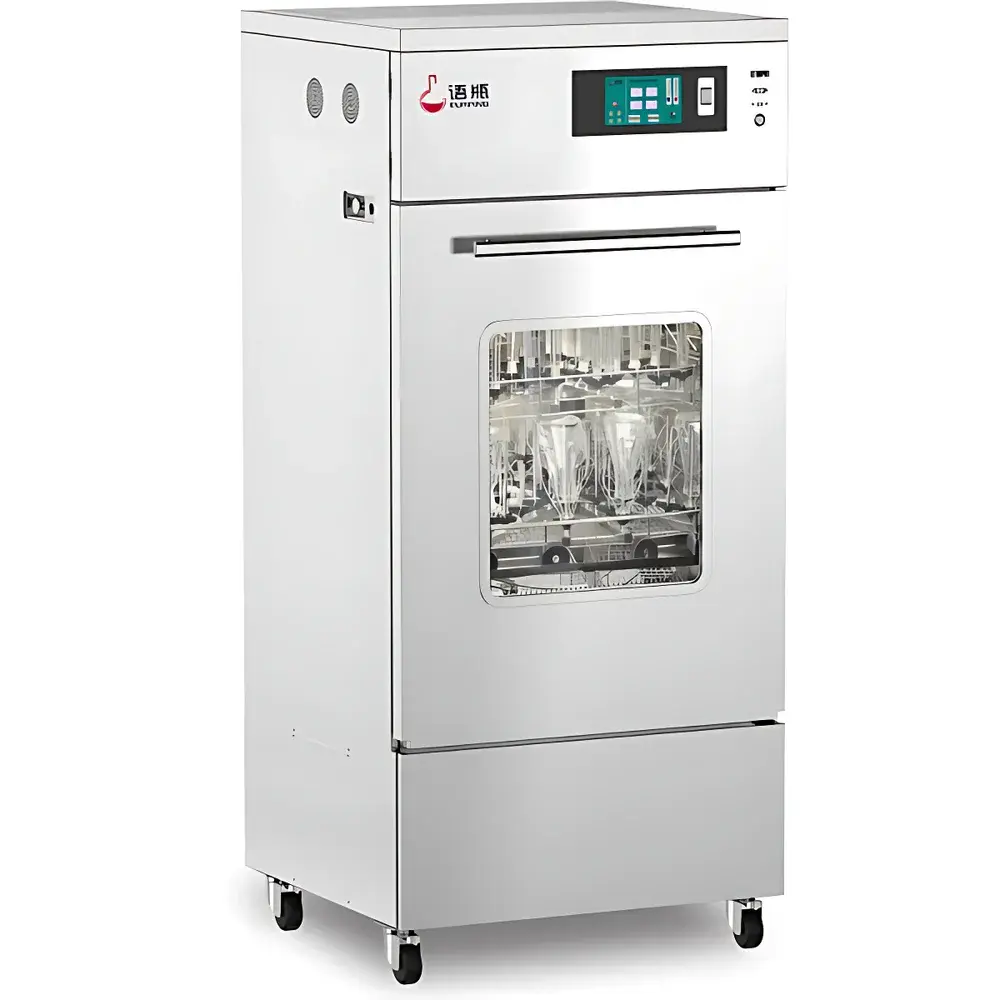
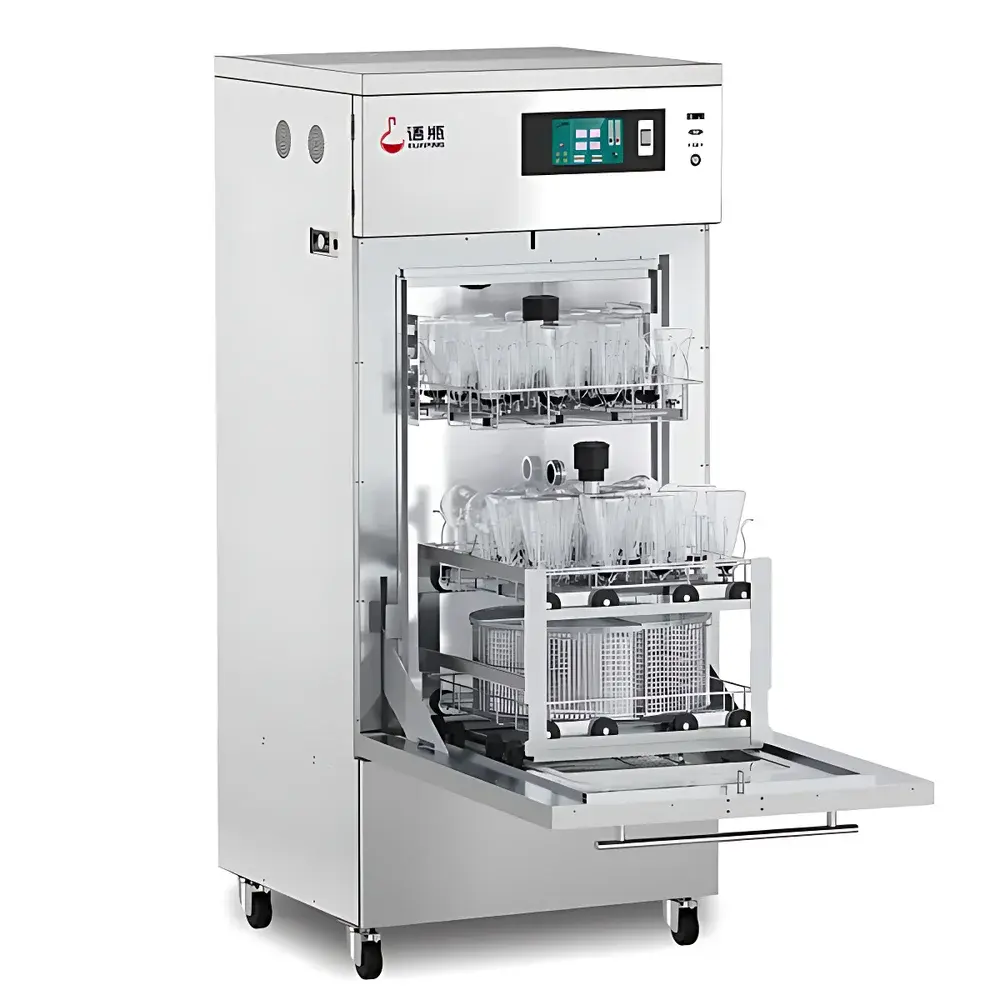
EURPING Q950 Fully Automated Laboratory Bottle Washer
| Brand | EURPING |
|---|---|
| Origin | Tianjin, China |
| Manufacturer Type | Direct Manufacturer |
| Product Category | Domestic (China-Made) |
| Model | Q950 Bottle Washer |
| Cavity Volume | 291 L |
| Heating Power | 9 kW |
| Maximum Wash Temperature | 95 °C |
| Compatible Detergent Types | Acidic, Alkaline, and Neutral Detergents |
| External Dimensions (L×W×D) | 790 × 760 × 1750 mm |
Overview
The EURPING Q950 Fully Automated Laboratory Bottle Washer is an engineered solution for high-throughput, traceable, and GxP-compliant cleaning of laboratory glassware and reusable instrumentation. Designed for ISO 17025-accredited labs, pharmaceutical QC/QA facilities, and GLP-regulated research environments, the Q950 employs a closed-loop, programmable aqueous cleaning process based on controlled thermal hydrolysis, precise detergent dosing, and validated rinse-dry cycles. Its core architecture integrates microprocessor-based control with real-time sensor feedback—enabling reproducible cleaning outcomes across diverse vessel geometries (e.g., HPLC vials, volumetric flasks, burettes, pipettes, and large-capacity beakers up to 5 L). Unlike batch-style ultrasonic cleaners or manual rinsing, the Q950 delivers full-cycle validation readiness through embedded data logging, hardware-level safety interlocks, and regulatory-aligned operational transparency.
Key Features
- Microcontroller-based operation with imported U.S.-sourced IC chips and opto-isolated circuitry for electromagnetic noise immunity and long-term signal integrity.
- Full-color protected capacitive touch panel with tempered glass overlay; intuitive interface supporting 30 pre-installed wash programs (e.g., “Grease,” “Bio-Residue,” “Lubricant,” “Fast Cycle”) and 100 user-definable protocols.
- Variable-frequency soft-start circulation pump (0–800 L/min), eliminating hydraulic shock during startup to protect delicate glassware from mechanical stress.
- Radially symmetric 12-port spray manifold (30° angular spacing) ensures uniform water column pressure distribution—eliminating proximal/distal flow imbalance common in side-fed systems.
- Integrated “Black Box” event logger: records timestamped status of all critical components (pump, heater, solenoid valves, door lock, temperature sensors) throughout each cycle; supports post-cycle audit via RS232-printed report or exported CSV log.
- Dual-stage drying system: twin compressors generate ≥220 m³/h recirculated hot air at vacuum pressure of 110 mbar; internal injection nozzles deliver heated airflow directly into vessel interiors for complete moisture removal (dry temp range: ambient to 120 °C; dry time: 0–300 min).
- Triple independent detergent delivery channels (acidic/alkaline/neutral), each with precision peristaltic pumps and integrated level sensors; internal storage for three 5-L detergent containers.
- Comprehensive safety architecture: electro-mechanical door lock activated during operation; automatic door inhibition at elevated temperatures (>50 °C); leak detection, low-detergent alert, dry-run prevention, and dual redundant temperature monitoring (PT100 + thermistor).
Sample Compatibility & Compliance
The Q950 accommodates heterogeneous labware loads—including 460 × 2 mL HPLC vials, 172 × 100 mL Class A volumetric pipettes (vertical orientation), or dual-tier racks holding up to eight 5 L borosilicate beakers per cycle. Its 291 L stainless-steel chamber (316L inner tank, passivated; 304 outer casing) resists corrosion from aggressive alkaline and acidic formulations. All wetted surfaces comply with USP material classification standards. The system meets FDA 21 CFR Part 11 requirements for electronic record integrity via password-protected access (three-tier authentication), immutable cycle logs, and tamper-evident timestamping. It supports ALCOA+ data principles (Attributable, Legible, Contemporaneous, Original, Accurate) and aligns with ISO 15883-1 for washer-disinfector validation frameworks.
Software & Data Management
Cycle parameters—including temperature profiles, dwell times, detergent volumes, rinse conductivity thresholds, and drying setpoints—are stored in non-volatile memory and retained across power interruptions. Real-time water inflow is monitored via built-in turbine flowmeter and displayed dynamically on the HMI. RS232 serial interface enables direct connection to dot-matrix printers for hard-copy cycle reports compliant with internal SOPs or external inspection requirements (e.g., ANVISA, MHRA, NMPA). Exported datasets include full parameter metadata, sensor readings at 5-second intervals, and fault-event diagnostics—facilitating root-cause analysis and periodic revalidation per ICH Q5A and ASTM E2856-22.
Applications
The Q950 serves analytical laboratories requiring residue-free preparation of containers used in elemental analysis (ICP-MS, AAS), chromatography (GC, HPLC, UPLC), clinical diagnostics (ELISA, PCR), and environmental testing (EPA Method 500 series). It is routinely deployed in pharmaceutical manufacturing cleanrooms (Grade C/D) for cleaning of sampling vessels prior to sterility testing (USP ) and endotoxin assay (USP ). Its programmability supports method-specific cleaning validation per ISO 15883-5 and PDA Technical Report No. 68, making it suitable for cleaning verification studies involving swab recovery, TOC quantification, and visual inspection under controlled lighting.
FAQ
Does the Q950 support automated validation documentation?
Yes—the integrated Black Box system captures all operational events and generates printable, time-stamped cycle reports meeting FDA 21 CFR Part 11 and EU Annex 11 expectations.
Can the Q950 operate without external pure water pressure?
Yes—it includes an internal booster pump that maintains consistent inlet pressure regardless of facility supply fluctuations.
Is the drying system ventless?
Yes—the dynamic exhaust heat recovery system condenses steam internally using a 316L stainless cold trap, eliminating need for external ducting while reducing energy consumption by up to 35% versus conventional vented dryers.
What safety mechanisms prevent accidental door opening during operation?
A dual-redundant locking system engages automatically when temperature exceeds 50 °C or pressure rises above ambient; unlocking requires explicit program suspension and manual confirmation.
How does the Q950 ensure detergent dosage accuracy?
Each of the three detergent channels uses calibrated peristaltic pumps with gravimetric verification capability; dose volume is cross-checked against flow duration and calibrated pulse counts.



