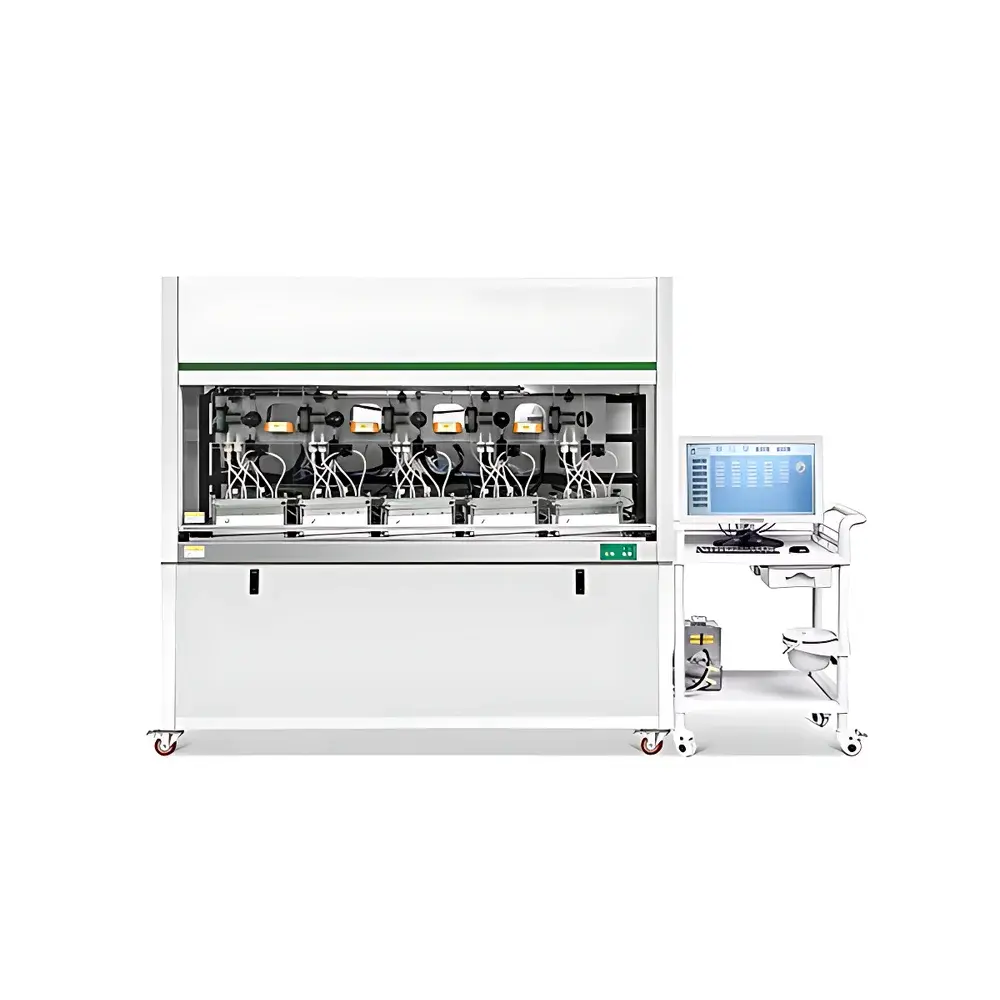
Huironhe HRH-CES3996 Multi-Concentration Air-Liquid Interface (ALI) Cell Exposure System
| Brand | Huironhe |
|---|---|
| Origin | Beijing, China |
| Model | HRH-CES3996 |
| Exposure Configuration | 3 Concentrations + 1 Control Group |
| Parallel Replicates per Concentration | ≥3 |
| ALI-Compatible Inserts | 6-well and 12-well Transwell® formats |
| Aerosol Flow Rate per Port | 5–20 mL/min |
| Flow Control Accuracy | ±1% F.S. |
| On-line Aerosol Concentration Monitoring | Yes |
| Temperature Control (Water Bath) | ±0.3°C |
| QCM Integration | Compatible |
| Enclosure Options | Laminar Flow Hood or Class II Biosafety Cabinet |
Overview
The Huironhe HRH-CES3996 Multi-Concentration Air-Liquid Interface (ALI) Cell Exposure System is an engineered in vitro platform designed for reproducible, physiologically relevant inhalation toxicology studies. It operates on the principle of air-liquid interface (ALI) culture—where differentiated respiratory epithelial cells (e.g., Calu-3, BEAS-2B, primary human bronchial/tracheal epithelial cells) are maintained at ALI to preserve ciliogenesis, mucus production, tight junction integrity, and metabolic competence. Unlike submerged exposure methods, ALI exposure enables direct delivery of aerosolized test agents—including cigarette smoke condensate, diesel exhaust particles, engineered nanomaterials, pesticides, volatile organic compounds (VOCs), and bioaerosols—to the apical surface under controlled flow and humidity conditions. The system supports simultaneous multi-concentration exposure (three graded doses plus one sham-exposed control) within a single experimental run, ensuring inter-group comparability through shared aerosol generation and distribution pathways.
Key Features
- True multi-concentration ALI exposure architecture: Enables concurrent delivery of three distinct aerosol concentrations and one clean-air control group in one operational cycle.
- Precision mass-flow-controlled exposure ports: Each of the four independent exposure channels delivers 5–20 mL/min with ±1% full-scale accuracy, ensuring consistent deposition kinetics across replicates.
- Real-time aerosol concentration monitoring: Integrated optical or gravimetric sensors provide continuous feedback on delivered dose metrics (e.g., mass concentration in µg/m³ or particle number/cm³), supporting dose–response modeling.
- Thermally stabilized exposure chamber: Water-jacketed design maintains culture temperature at 37.0 ± 0.3°C—critical for preserving cell viability and barrier function during extended exposures (up to 72 h).
- Transwell® insert compatibility: Supports standard 6-well and 12-well permeable supports with polyester or collagen-coated membranes (0.4 µm pore size), enabling TEER measurement pre- and post-exposure.
- Quartz Crystal Microbalance (QCM) integration-ready interface: Allows real-time quantification of deposited mass on sensor surfaces adjacent to cell inserts, facilitating correlation between physical dose and biological response.
- Modular biosafety integration: Designed for seamless installation inside certified laminar flow hoods or Class II biological safety cabinets to maintain sterility and operator protection during handling.
Sample Compatibility & Compliance
The HRH-CES3996 accommodates a broad spectrum of inhalable test substances, including but not limited to: tobacco smoke aerosols (whole smoke or mainstream/nose-only fractions), combustion-derived particulate matter (PM2.5, PM10), metal oxide nanoparticles (TiO2, ZnO), carbon nanotubes, fungal spores, bacterial endotoxin aerosols, and industrial vapors (e.g., formaldehyde, acrolein). Its operational parameters align with internationally recognized regulatory testing guidelines, including OECD Test Guidelines 403 (Acute Inhalation Toxicity), 436 (Acute Toxicity Hierarchical Approach), 412 (28-Day Subacute Inhalation), and 413 (90-Day Subchronic Inhalation). While the system itself is not GLP-certified hardware, its design supports GLP-compliant study execution when used within validated SOPs, calibrated instrumentation, and auditable data capture workflows.
Software & Data Management
The system operates via a dedicated Windows-based control interface that logs time-stamped records of flow rates, temperature setpoints, aerosol sensor outputs, and alarm events. All raw data files are saved in CSV and SQLite formats for traceability and third-party analysis. Audit trails meet minimum requirements for FDA 21 CFR Part 11 compliance when deployed with user authentication, electronic signatures, and immutable log archiving—though full Part 11 validation requires site-specific configuration and documentation per institutional QA policies. Exported datasets integrate directly with common toxicokinetic modeling tools (e.g., MPPD v3.04, ISSX PBPK models) and statistical packages (R, GraphPad Prism).
Applications
- In vitro assessment of nanoparticle translocation and oxidative stress responses in human airway epithelium.
- Dose–response characterization of pesticide-induced barrier disruption and cytokine release (e.g., IL-6, IL-8, TNF-α).
- Mechanistic studies of COPD and lung cancer pathogenesis using chronic low-dose smoke exposure regimens.
- Comparative toxicity screening of alternative tobacco products (e.g., e-cigarette aerosols vs. combustible cigarettes).
- Regulatory submission support for REACH, TSCA, and PMN dossiers requiring non-animal inhalation hazard data.
- Development and validation of adverse outcome pathways (AOPs) anchored to ALI-relevant molecular initiating events.
FAQ
What cell types are validated for use with the HRH-CES3996?
Primary human bronchial epithelial cells (HBECs), immortalized lines (Calu-3, 16HBE14o−), and co-cultures incorporating macrophages or dendritic cells have been successfully exposed. Validation data for specific cell batches should be established per laboratory SOP.
Can the system generate aerosols internally, or does it require external generators?
The HRH-CES3996 is an exposure chamber only—it requires integration with external aerosol generation systems (e.g., nebulizers, dry powder dispersers, cigarette smoking machines, or custom-built thermal vaporizers) compatible with its inlet port specifications.
Is remote monitoring supported?
Yes—Ethernet-enabled controllers allow secure remote access via VPN for real-time parameter viewing and emergency shutdown, subject to local IT security policies.
How is humidity controlled during exposure?
Relative humidity (RH) is maintained between 90–95% using integrated humidified gas mixing; RH sensors are optional add-ons calibrated per ISO 8573-3.
What maintenance intervals are recommended?
Daily visual inspection of tubing and seals; monthly calibration of mass flow controllers per ISO/IEC 17025-accredited procedures; annual verification of temperature uniformity across all exposure ports.