
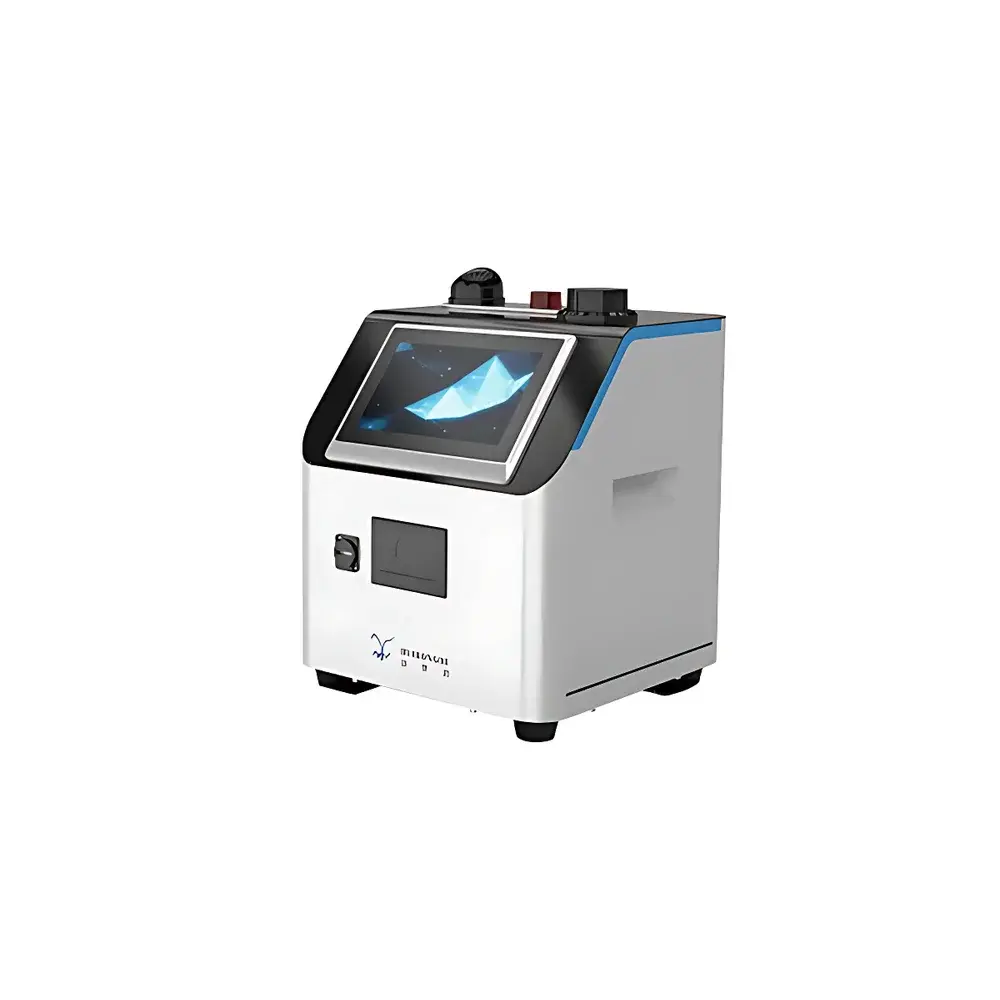
HuRongHe HRH-Y-200V Dry-Mist Hydrogen Peroxide Sterilizer
| Brand | HuRongHe |
|---|---|
| Origin | Beijing, China |
| Model | HRH-Y-200V |
| Hydrogen Peroxide Dosage Range | 0–5000 mL |
| Airflow Rate | 190 m³/h |
| Maximum Sterilization Volume | ≤600 m³ |
| Vaporization Temperature | Ambient (no heating required) |
| Dehumidification Capacity | None (pre-conditioning required) |
| Filter Class | G4 |
| Sterilant | Aqueous Hydrogen Peroxide Solution (8% w/w) |
| Log Reduction | ≥6-log (≥99.9999% kill rate for Geobacillus stearothermophilus spores) |
| Power Supply | 220 V / 50 Hz |
| Operating Temperature | 5–40 °C |
| Reservoir Capacity | 4.5 L |
| Dimensions (W×D×H) | 280 × 280 × 370 mm |
| Weight | <10 kg |
| Max. Liquid Consumption | ≤2 L/h |
| Minimum Effective Dose | 6 mL/m³ |
| Nozzle | 360° Rotating |
| Display | Touchscreen Interface |
| Data Logging | Onboard with USB export |
| Remote Control & Network Integration | Supported |
| Alarms | Visual/Audible + Low-Level/Environmental Anomaly Alerts |
| Compliance Reference | Chinese Disinfection Technical Specifications (2002 Edition) |
Overview
The HuRongHe HRH-Y-200V Dry-Mist Hydrogen Peroxide Sterilizer is an engineered solution for non-thermal, residue-free room-scale decontamination of critical environments. It operates on the principle of dry-mist vaporized hydrogen peroxide (VHP®-equivalent) generation—atomizing a stabilized 8% aqueous hydrogen peroxide solution into sub-5 µm droplets via high-velocity pneumatic shearing (jet velocity ≈ 100 m/s), without thermal phase change. Unlike heated vaporization systems, this ambient-temperature process eliminates thermal stress on sensitive equipment and avoids condensation-related corrosion risks. The resulting dry mist achieves uniform spatial distribution and rapid surface adsorption, enabling validated microbial inactivation across complex geometries—including under benches, behind cabinets, and within HVAC ductwork interfaces. Designed for integration into controlled environments, it supports repeatable, auditable sterilization cycles compliant with ISO 14644-1 cleanroom classification requirements and aligns with core principles of ISO 14937 (sterilization of health care products) and USP <1072> (hydrogen peroxide as a sterilant).
Key Features
- Ambient-temperature dry-mist generation: Eliminates need for pre-heating or post-cycle aeration delays; cycle times reduced by up to 40% vs. thermal VHP systems.
- 360° dynamically rotating nozzle: Ensures isotropic dispersion across ceiling-to-floor volume, validated via tracer gas mapping (SF₆) in representative 600 m³ enclosures.
- Intelligent dose modulation: Real-time adjustment of liquid delivery (0–5000 mL total) and airflow (190 m³/h) enables precise dosing at 6 mL/m³—the minimum effective concentration verified for ≥6-log reduction of Bacillus atrophaeus and Geobacillus stearothermophilus spores.
- G4 pre-filter integrated upstream of mist generator: Captures particulates >5 µm to protect internal fluidic pathways and ensure consistent aerosol size distribution.
- Onboard environmental monitoring: Integrated temperature and relative humidity sensors trigger automatic cycle suspension if ambient RH exceeds 60%—a critical parameter for H₂O₂ efficacy and material compatibility.
- Touchscreen HMI with multi-level user authentication: Supports role-based access control (operator, supervisor, administrator) and enforces audit-trail logging per FDA 21 CFR Part 11 requirements.
Sample Compatibility & Compliance
The HRH-Y-200V is validated for use in environments requiring Grade A/B/C/D cleanroom integrity (per EU GMP Annex 1), GLP-compliant analytical laboratories, BSL-2/BSL-3 containment suites, and healthcare facility isolation rooms. Its low-concentration (8%) hydrogen peroxide formulation is classified as non-hazardous under UN GHS Category 4 (skin irritation), exempting it from strict hazardous chemical transport regulations (e.g., ADR/RID/IMDG). All sterilization cycles generate full electronic records—including start/end timestamps, environmental parameters, delivered dosage, nozzle rotation status, and alarm events—retained onboard for ≥10,000 cycles and exportable via USB to CSV or PDF. The system conforms to the technical framework outlined in the Chinese Disinfection Technical Specifications (2002 Edition), and its operational logic reflects ISO/IEC 17025 clause 7.7 (validation of non-standard methods) when deployed for method-specific qualification.
Software & Data Management
Firmware v3.2+ includes embedded cycle management software supporting both manual and programmable automated sequences. Each run generates a unique digital signature containing operator ID, cycle ID, environmental logs, and checksum-verified dose data. Exported reports include ISO 13485-aligned metadata fields (device ID, firmware version, calibration date). Remote operation is enabled via Ethernet/Wi-Fi using TLS 1.2-secured API endpoints, permitting centralized fleet management across multi-site GMP facilities. Audit trails are immutable: no record deletion or modification is permitted post-execution, satisfying ALCOA+ (Attributable, Legible, Contemporaneous, Original, Accurate, Complete, Consistent, Enduring, Available) data integrity criteria.
Applications
- Decontamination of ISO Class 5–8 cleanrooms between production batches in pharmaceutical aseptic manufacturing.
- Routine terminal sterilization of biosafety cabinets, isolators, and laminar flow hoods prior to maintenance.
- Emergency response disinfection in hospital operating theatres, emergency departments, and airborne infection isolation rooms (AIIRs).
- Pre-occupancy treatment of academic research labs, museum artifact storage vaults, and archival document repositories.
- Validation support for media fill simulations and process simulation studies (e.g., ISO 14644-3 Annex B.6).
FAQ
Does the HRH-Y-200V require external dehumidification prior to operation?
Yes. Optimal performance requires ambient relative humidity ≤60%. Built-in sensors enforce automatic interlock if RH exceeds threshold.
Is hydrogen peroxide residue testing required post-cycle?
Residue levels remain below 1 ppm after standard 30-minute aeration; catalytic decomposition filters are optional for accelerated clearance in occupied spaces.
Can the device be integrated into a facility’s BMS or MES?
Yes—via Modbus TCP or RESTful API with configurable webhooks for event-driven notifications (e.g., cycle completion, alarm escalation).
What spore strains are used for routine biological indicator validation?
Standard validation uses Geobacillus stearothermophilus ATCC 7953 strips placed at worst-case locations; log reduction is confirmed via membrane filtration and TSA incubation per ISO 11138-3.
How often does the G4 filter require replacement?
Every 200 operational hours or quarterly—whichever occurs first—documented via maintenance log in the onboard system.



