
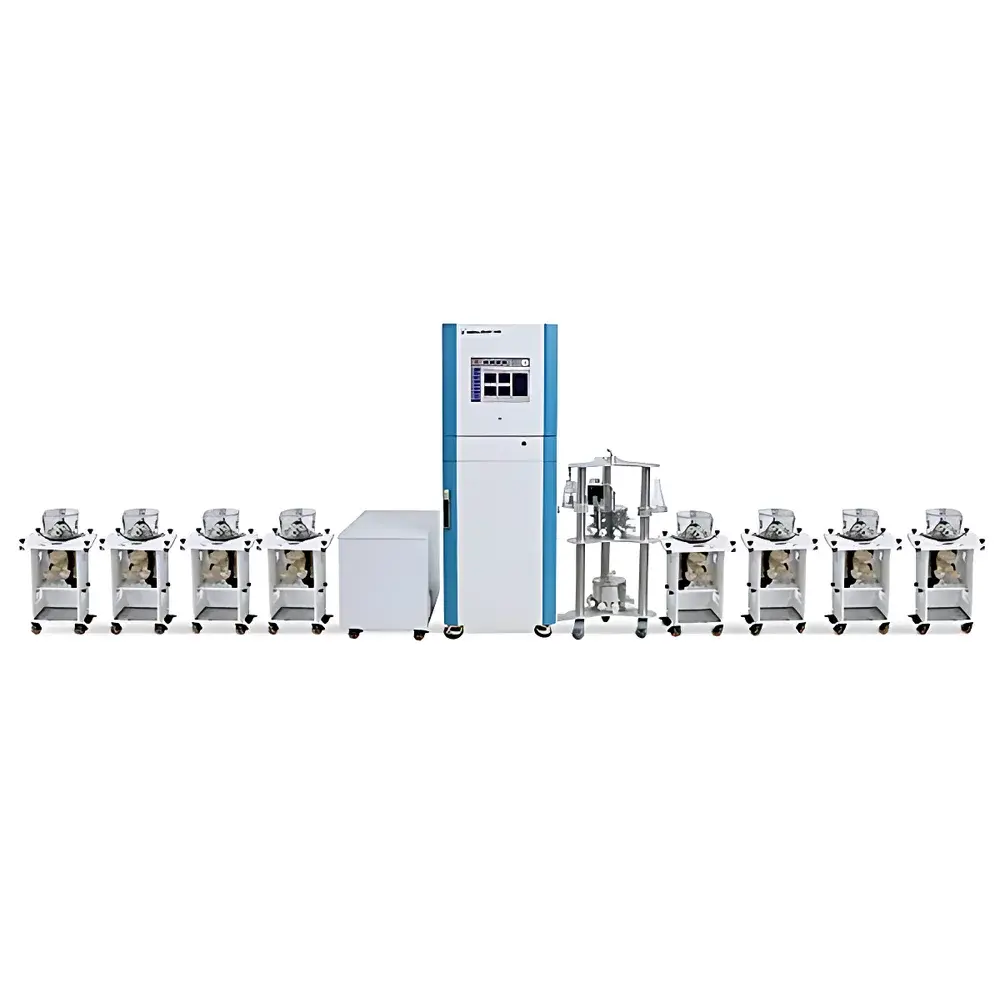
Huironhe HRH-LMNE1198 Non-Invasive Oronasal Inhalation Exposure System for Non-Human Primates
| Brand | Huironhe |
|---|---|
| Model | HRH-LMNE1198 |
| Origin | Beijing, China |
| Construction | Stainless Steel Dual Static-Pressure Chamber |
| Animal Capacity | 6–10 Non-Human Primates Simultaneously |
| Aerosol Uniformity (Gas/Vapor) | ±8% |
| Liquid Aerosol Uniformity | ±10% |
| Dust/Nanoparticle Aerosol Uniformity | ±20% |
| Exhaust Filtration | HEPA + Activated Carbon + Optional Scrubber |
| Compliance | OECD TG 403, 412, 413, 436 |
| Safety Monitoring | Real-time Differential Pressure, Temperature, and Leak Detection with Audible/Visual Alarm |
Overview
The Huironhe HRH-LMNE1198 Non-Invasive Oronasal Inhalation Exposure System is a purpose-engineered platform designed to conduct regulatory-compliant inhalation toxicology studies in non-human primates (NHPs). It operates on the principle of controlled oronasal exposure—where test atmospheres are delivered directly to the animal’s nose and mouth without intubation or restraint-induced stress—enabling physiologically relevant dosimetry for gases, vapors, liquid aerosols, dry powders, engineered nanoparticles, and combustion-generated smoke. The system integrates dual static-pressure stainless steel chambers to maintain precise atmospheric stability during acute (24 h), subacute (28-day), subchronic (90-day), and chronic (≥6-month) exposure regimens. Its architecture supports dynamic flow control, real-time environmental monitoring, and fail-safe containment—critical for high-biohazard or radioisotope applications in GLP-regulated laboratories.
Key Features
- Stainless steel dual-chamber design with independent pressure regulation ensures stable, low-turbulence airflow and minimizes cross-contamination between exposure ports.
- Primate-specific oronasal masks fabricated from medical-grade silicone provide ergonomic sealing and allow unrestricted respiration, feeding, and behavioral observation during exposure.
- Multi-modal aerosol generation compatibility: integrated interfaces for nebulizers (liquid aerosols), thermal vaporizers (volatile organics), fluidized bed dry powder dispersers, and nanoparticle synthesis reactors (e.g., spark ablation, flame spray pyrolysis).
- Real-time mass concentration uniformity maintained within ±8% for gases/vapors, ±10% for liquid aerosols, and ±20% for dust/nanoparticle aerosols across all exposure ports—validated per OECD TG 412 Annex 3 and GB/T 15670.12–2017.
- Exhaust treatment train comprising pre-filter, HEPA H14 (99.995% @ 0.3 µm), activated carbon adsorption column, and optional acid/base scrubber meets China’s GB 16297–1996 emission standards for laboratory exhaust.
- Redundant safety interlocks monitor chamber differential pressure, ambient temperature, and seal integrity; automatic shutdown and audible/visual alarms activate upon deviation beyond preset thresholds (e.g., ΔP > ±15 Pa, T > 32°C, leak rate > 0.5 L/min).
Sample Compatibility & Compliance
The HRH-LMNE1198 accommodates a broad spectrum of test agents under standardized exposure conditions: volatile organic compounds (VOCs), pharmaceutical aerosols (e.g., inhaled corticosteroids), pesticide formulations, metal oxide nanoparticles (TiO₂, ZnO), carbon nanotubes, diesel exhaust particles, and radiolabeled tracers (e.g., 99mTc-DTPA aerosols). All operational protocols align with internationally accepted regulatory frameworks—including OECD Test Guidelines 403 (acute), 412 (28-day), 413 (90-day), and 436 (stepwise acute)—as well as Chinese national standards GB/T 15670.6–2017 through GB/T 15670.26–2017 for pesticide toxicology registration. The system supports full audit trails required under GLP (OECD Principles) and facilitates documentation traceability for FDA 21 CFR Part 58 submissions.
Software & Data Management
Control and data acquisition are managed via a dedicated Windows-based application compliant with IEC 62304 Class B software safety requirements. The interface logs time-stamped records of flow rates (L/min), chamber pressure (Pa), temperature (°C), relative humidity (%RH), and real-time photometric or gravimetric aerosol concentration (mg/m³ or #/cm³). Raw datasets export in CSV and .xlsx formats; metadata fields include operator ID, protocol version, calibration certificate numbers, and instrument maintenance logs. Audit trail functionality satisfies ALCOA+ principles (Attributable, Legible, Contemporaneous, Original, Accurate, Complete, Consistent, Enduring, Available) and supports 21 CFR Part 11 electronic signature readiness when paired with validated identity management modules.
Applications
- Regulatory inhalation toxicity assessment for pharmaceutical candidates, agrochemicals, and industrial chemicals under OECD and MHLW guidelines.
- Immunomodulation studies involving mucosal adjuvant delivery (e.g., TLR agonists) via aerosolized formulations.
- Respiratory disease modeling: COPD, asthma, pulmonary fibrosis, and SARS-CoV-2 pathogenesis using NHP-relevant challenge agents.
- Radiation health physics: internal dose estimation of inhaled radionuclides (e.g., 239PuO₂, 90SrCl₂) and evaluation of decorporation therapeutics.
- Military and aerospace medicine: assessment of chemical warfare agent simulants, spacecraft cabin air contaminants, and hypobaric/hyperoxic inhalation stressors.
FAQ
What species are supported by the HRH-LMNE1198 system?
The system is specifically engineered for non-human primates, including cynomolgus macaques, rhesus macaques, and African green monkeys. Mask sizing kits accommodate head circumference ranges from 28–42 cm.
Can the system be validated for GMP-compliant manufacturing environments?
Yes—the hardware design, sensor calibration intervals, and software architecture support IQ/OQ/PQ validation protocols aligned with ISO 13485 and EU Annex 11 requirements for medical device-related inhalation product development.
Is remote monitoring capability available?
Standard Ethernet and RS-485 interfaces enable integration into centralized facility SCADA systems; optional LTE module provides encrypted cloud telemetry for off-site oversight during long-duration studies.
How is aerosol size distribution characterized during operation?
The system includes dedicated ports for inline sampling with cascade impactors (e.g., MOUDI, NGI) or optical particle sizers (OPS, SMPS); size distribution data can be synchronized with exposure logs via TTL-triggered acquisition.
Does the system meet biosafety level (BSL) containment requirements?
When configured with negative-pressure isolation enclosures, HEPA-filtered supply air, and effluent decontamination (e.g., UV-C + thermal oxidation), the platform supports BSL-2 and select BSL-3 inhalation challenges under institutional biosafety committee approval.
Related Products



