
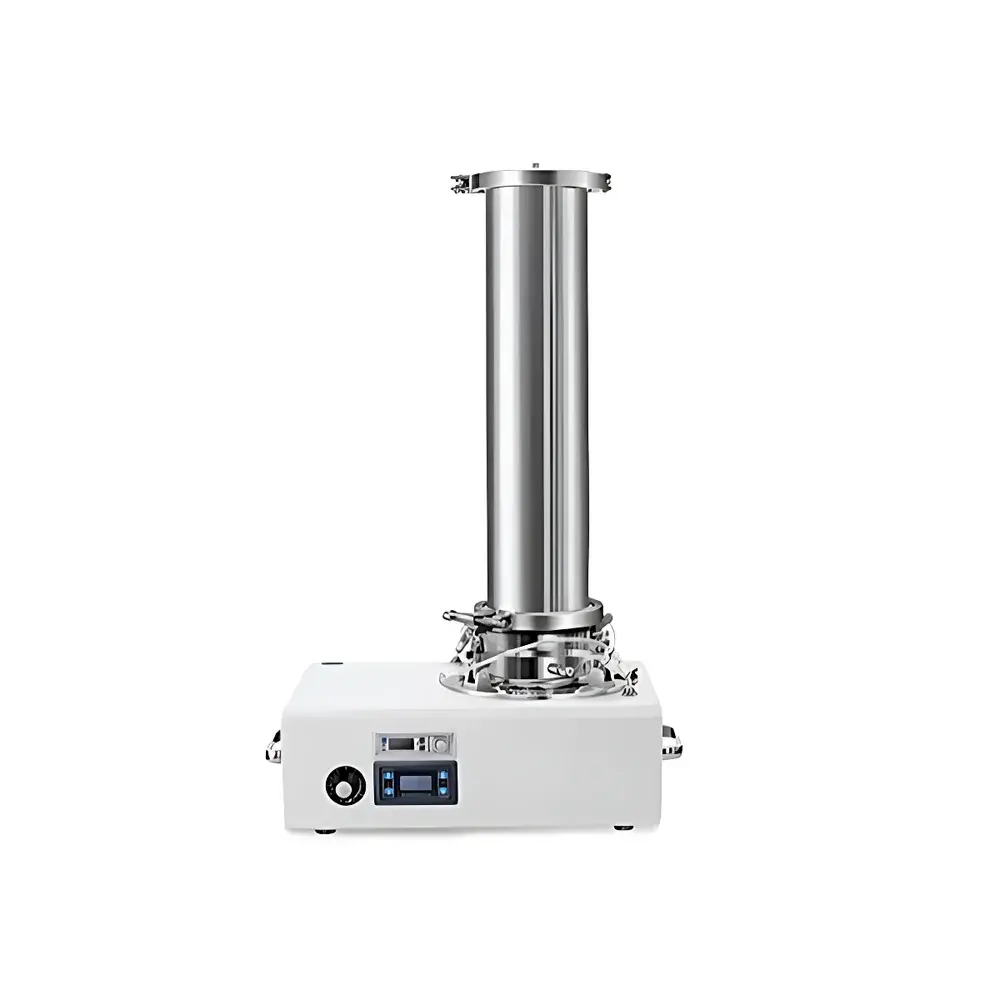
Huironhe HRH-AG07M Micro-Dose Dry Powder Aerosol Generator
| Brand | Huironhe |
|---|---|
| Origin | Beijing, China |
| Manufacturer Type | Authorized Distributor |
| Country of Origin | China |
| Model | HRH-AG07M |
| Price | Upon Request |
| Particle Material | Non-cohesive dry powders |
| Particle Size Range | 0–60 µm |
| Powder Load Capacity | 500 mg–2 g (referenced to silica powder density of 2.33 g/cm³) |
| Mass Flow Rate | 0.8–20 µg/min (adjustable) |
| Volumetric Flow Rate | 0–25 L/min (adjustable) |
| Supply Air Pressure | <10 psi |
| Dimensions | 420 × 250 × 635 mm |
| Weight | ≤12 kg |
Overview
The Huironhe HRH-AG07M Micro-Dose Dry Powder Aerosol Generator is an engineered precision instrument designed for the controlled, continuous generation of stable, low-concentration dry powder aerosols from minute quantities of non-cohesive particulate material. It operates on two complementary physical principles: acoustic fluidization and vortex elutriation. Acoustic fluidization applies high-frequency vibrational energy to break interparticle cohesive forces in small powder beds, enabling uniform particle lift-off without mechanical agitation or thermal degradation. Vortex elutriation then separates and entrains particles into a carrier gas stream based on aerodynamic diameter, allowing fine control over aerosol concentration and size distribution. This dual-mechanism architecture ensures reproducible output across extended operation cycles—critical for inhalation toxicology studies, instrument calibration, and filtration efficiency validation where dose consistency and metrological traceability are paramount.
Key Features
- Micro-dose capability: Supports continuous aerosol generation from as little as 500 mg of precious or limited-availability dry powder—ideal for pharmaceutical API studies, nanomaterial exposure assessments, and rare environmental reference materials.
- Stable low-concentration output: Achieves mass concentrations below 20 mg/m³ with high temporal stability (<±5% RSD over 60 min), validated via gravimetric sampling and optical particle counters.
- Adjustable mass flow control: Precise regulation of aerosol mass delivery (0.8–20 µg/min) enables accurate dosing in subchronic and acute inhalation exposure protocols compliant with OECD TG 412 and ISO 10993-12.
- Carrier gas flexibility: Compatible with compressed air, nitrogen, or synthetic air; inlet pressure requirement ≤10 psi minimizes facility infrastructure demands and enhances lab safety.
- Compact benchtop design: Footprint of 420 × 250 mm and total weight ≤12 kg allow integration into biosafety cabinets, gloveboxes, or laminar flow hoods without structural reinforcement.
- No heating elements or solvent carriers: Eliminates thermal decomposition risk and residual solvent interference—essential for volatile organic compound (VOC)-free aerosol generation required in GLP-compliant toxicology laboratories.
Sample Compatibility & Compliance
The HRH-AG07M is validated for use with non-agglomerating, free-flowing dry powders exhibiting median aerodynamic diameters between 0.1 µm and 60 µm—including titanium dioxide, crystalline silica (Min-U-Sil®), lactose monohydrate, sodium chloride, and polystyrene latex microspheres. It is not suitable for hygroscopic, electrostatically charged, or fibrous materials. The generator conforms to key international standards governing aerosol generation for testing and research: ISO 16000-22 (indoor air quality—generation of test aerosols), ASTM D1498 (standard practice for generating dust for filter testing), and EN 1822-3 (high-efficiency air filters—part 3: determination of fractional efficiency). All operational parameters are documented per GLP Annex III requirements, supporting audit readiness for regulatory submissions to EMA, FDA, and NMPA.
Software & Data Management
While the HRH-AG07M operates via analog front-panel controls for mass and volumetric flow adjustment, it features calibrated analog outputs (0–5 V DC) for real-time logging of flow rates and pressure differentials. These signals integrate seamlessly with third-party data acquisition systems (e.g., LabVIEW, MATLAB, or industrial SCADA platforms) for synchronized recording alongside downstream instrumentation—such as APS, SMPS, or cascade impactors. Optional digital I/O modules (sold separately) provide RS-485 Modbus RTU interface for centralized control in multi-generator exposure chambers. All calibration certificates include NIST-traceable uncertainty budgets and are archived with instrument serial numbers to satisfy FDA 21 CFR Part 11 electronic record requirements when paired with compliant software environments.
Applications
- Inhalation toxicology: Generation of PM2.5-fractionated coal dust, mineral ore particulates, or engineered nanomaterials for nose-only or whole-body exposure studies in rodent models (OECD TG 413, ISO 10993-12).
- Optical diagnostics: Stable seeding of low-concentration aerosols for Laser Doppler Anemometry (LDA) and Laser Two-Focus (L2F) velocimetry in respiratory airflow modeling and inhaler plume characterization.
- Instrument calibration: Provision of monodisperse or polydisperse challenge aerosols for calibrating optical particle counters (OPCs), condensation particle counters (CPCs), and aerodynamic particle sizers (APS) per ISO 21501-4.
- Filtration performance testing: Quantitative assessment of filter media via gravimetric dust loading, fractional collection efficiency curves (0.3–10 µm), and dust-holding capacity evaluation per ISO 16890 and EN 779.
- Aerosol science research: Fundamental studies on particle resuspension dynamics, coagulation behavior under low-concentration regimes, and deposition efficiency in replicated airway geometries.
FAQ
What types of powders are compatible with the HRH-AG07M?
Non-cohesive, free-flowing dry powders with particle sizes between 0.1 µm and 60 µm and bulk densities ≥0.5 g/cm³. Avoid hygroscopic, fibrous, or highly electrostatic materials.
Can the HRH-AG07M generate aerosols for ISO 16890 filter testing?
Yes—when operated with standardized test dusts (e.g., ISO A2 Fine Test Dust) and integrated with certified flow controllers and gravimetric samplers, it meets the aerosol generation requirements of ISO 16890 Annex B.
Is the device suitable for GMP-regulated pharmaceutical inhalation studies?
It supports GMP-aligned workflows when used with documented calibration, maintenance logs, and change control records; however, final qualification must be performed per ICH Q5C and USP within the user’s specific facility context.
Does the generator require external vacuum or exhaust systems?
No—operation relies solely on positive-pressure carrier gas supply; optional exhaust connection is recommended only for containment in negative-pressure enclosures.
How often does the system require recalibration?
Annual recalibration of mass flow sensors and volumetric flow meters is recommended; full performance verification should accompany each major maintenance event or after 500 hours of cumulative operation.







