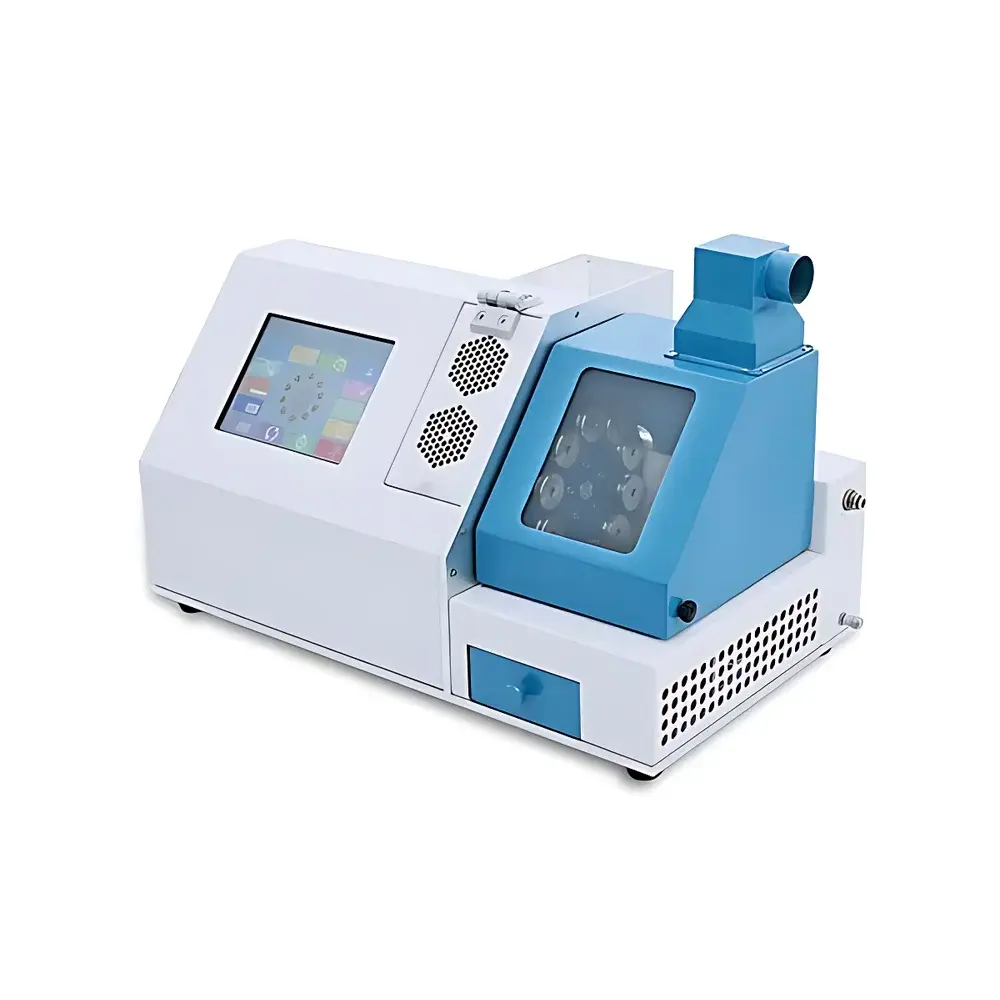
HRH-TSM610 Ten-Channel Rotary Cigarette Smoking Machine
| Brand | HRH |
|---|---|
| Origin | Beijing, China |
| Model | HRH-TSM610 |
| Smoke Channels | 10 |
| Puff Volume Range | 15–60 mL |
| Puff Interval | 30–240 s |
| Cigarette Magazine Capacity | 200 pcs |
| Puff Termination Mode | By Count or Filter Tip Length Detection |
| Puff Profile | Standard Bell-Shaped Curve or User-Defined Profile |
| Compliance | ISO 3308, ISO 4387 |
Overview
The HRH-TSM610 Ten-Channel Rotary Cigarette Smoking Machine is an automated, high-reproducibility exposure system engineered for standardized mainstream and sidestream cigarette smoke generation in preclinical toxicology and inhalation research. It operates on the principle of programmed pneumatic puffing—using independently actuated precision pistons to replicate human smoking topography under strictly controlled environmental and temporal parameters. Designed for integration into GLP-compliant laboratories, the system delivers consistent aerosol output across all ten parallel channels, enabling statistically robust inter-group comparisons in animal inhalation studies, respiratory pharmacology assays, and tobacco product assessment. Its mechanical architecture minimizes operator intervention while maintaining full traceability of puff sequence, volume, duration, and timing—critical for regulatory submissions under FDA, WHO TobReg, and OECD Test Guidelines.
Key Features
- Ten independent smoking channels with synchronized or asynchronous operation—each equipped with a servo-controlled linear actuator and calibrated pressure transducer for real-time puff volume verification.
- Automated cigarette handling system: robotic gripper-based loading, optical ignition, length-based burn termination (via integrated laser displacement sensor), automatic butt ejection, and ash containment.
- Programmable puff profile generator supporting ISO-standard bell-shaped waveform as well as user-defined temporal pressure curves (e.g., square, ramp, or multi-phase profiles) via embedded firmware interface.
- Modular cigarette magazine with 200-unit capacity and gravity-fed feed mechanism; supports standard 84 mm and 100 mm filter-tipped cigarettes without manual reorientation.
- Integrated environmental monitoring: ambient temperature (±0.5 °C), relative humidity (±3% RH), and barometric pressure logging synchronized with each puff event.
- Fail-safe interlocks including flame-out detection, over-pressure cutoff, and thermal shutdown to ensure operational integrity during unattended runs.
Sample Compatibility & Compliance
The HRH-TSM610 accommodates commercially available research-grade cigarettes, reference cigarettes (e.g., Kentucky 3R4F, CORESTA RM20), and prototype tobacco-heating products (THPs) with diameters between 7.0–8.2 mm. All hardware interfaces—including smoke collection ports, condenser traps, and aerosol dilution manifolds—are compatible with ISO 3308 (machine-smoking conditions) and ISO 4387 (determination of total and nicotine-free dry particulate matter) test protocols. The system meets mechanical accuracy requirements specified in ISO 20778 for puff volume tolerance (±2% of setpoint) and timing resolution (±0.1 s). Data acquisition logs are timestamped and stored in CSV/Excel-compatible format, supporting audit readiness for FDA 21 CFR Part 11 compliance when deployed with validated LIMS integration.
Software & Data Management
Control and monitoring are executed via HRH-SMControl v3.x—a Windows-based application featuring dual-mode operation: wizard-driven protocol setup for routine ISO-compliant runs and advanced scripting mode for custom exposure regimens (e.g., variable puff intervals, staggered channel activation, or dose escalation sequences). All parameter changes are logged with user ID, timestamp, and reason-for-change fields. Raw puff data—including instantaneous flow rate, vacuum pressure, and thermocouple readings—is streamed at 100 Hz and archived with metadata tags (protocol ID, operator, chamber ID, calibration certificate number). Export options include ANSI/ISO-standardized report templates aligned with OECD TG 412 (Subacute Inhalation Toxicity) and TG 413 (Subchronic Inhalation Toxicity).
Applications
- Inhalation toxicology studies in rodents and non-human primates requiring reproducible cigarette smoke exposure across multiple treatment groups.
- Respiratory disease modeling—including COPD, emphysema, and asthma exacerbation—using whole-body or nose-only exposure chambers coupled to the TSM610’s aerosol output.
- Comparative assessment of reduced-risk tobacco products (RRTPs), e-cigarette aerosols, and heated tobacco emissions under harmonized regulatory test conditions.
- Method validation for analytical chemistry workflows targeting carbonyls, volatile organic compounds (VOCs), polycyclic aromatic hydrocarbons (PAHs), and particulate-phase biomarkers in smoke condensate.
- Development and calibration of real-time aerosol sensors (e.g., SMPS, APS, CPC) using traceable, metrologically characterized smoke plumes.
FAQ
Does the HRH-TSM610 support sidestream smoke collection?
Yes—the system includes dedicated sidestream sampling ports adjacent to each smoking rod holder, configurable for gravimetric or chemical analysis per ISO 10315.
Can puff parameters be modified mid-experiment?
No—protocols are locked upon initiation to preserve experimental integrity; however, multi-stage protocols can be pre-programmed with distinct puff settings per phase.
What maintenance intervals are recommended for piston seals and ignition electrodes?
Piston O-rings require replacement every 5,000 puffs per channel; tungsten ignition electrodes are rated for ≥20,000 ignitions and should be inspected weekly for oxidation or tip deformation.
Is remote monitoring supported?
Yes—via optional Ethernet/IP interface with Modbus TCP support; live status dashboards and alarm notifications are accessible through secure HTTPS portal.
How is calibration traceability maintained?
Each unit ships with NIST-traceable calibration certificates for volumetric flow sensors and pressure transducers, updated annually using ISO/IEC 17025-accredited service providers.