
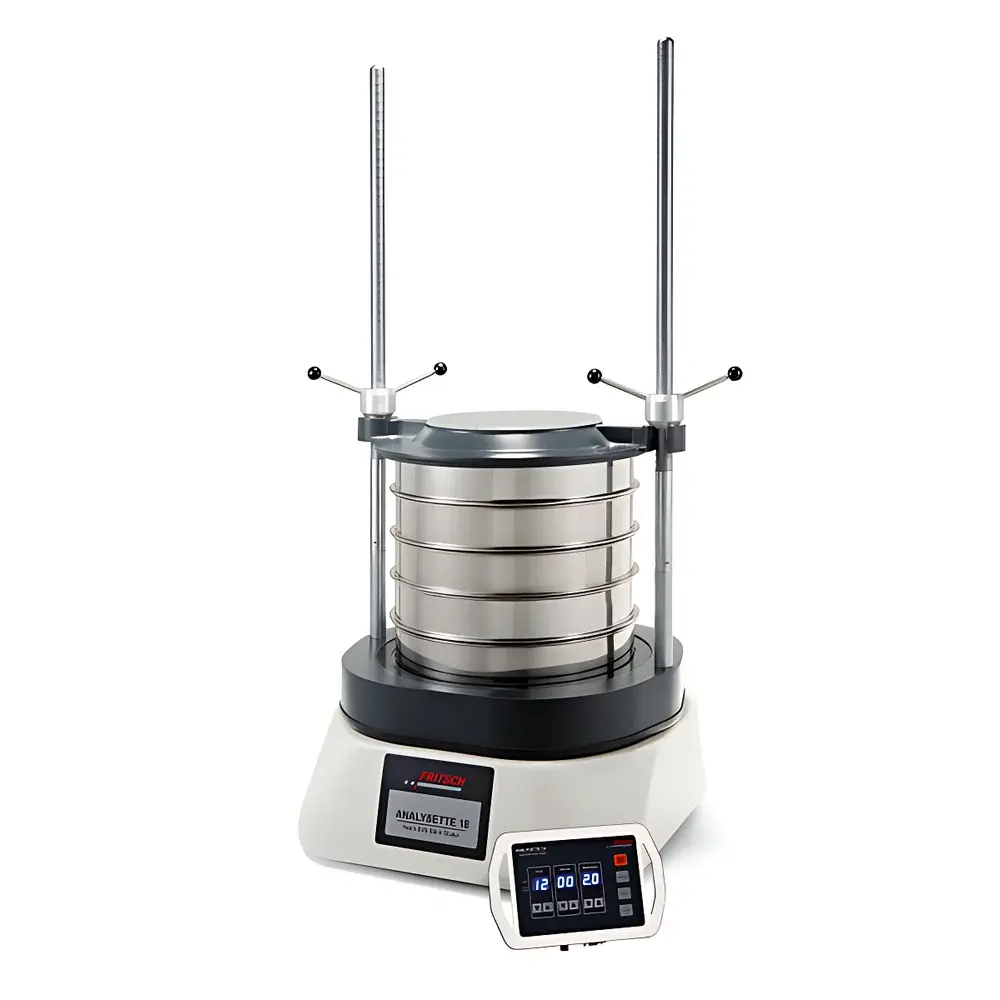
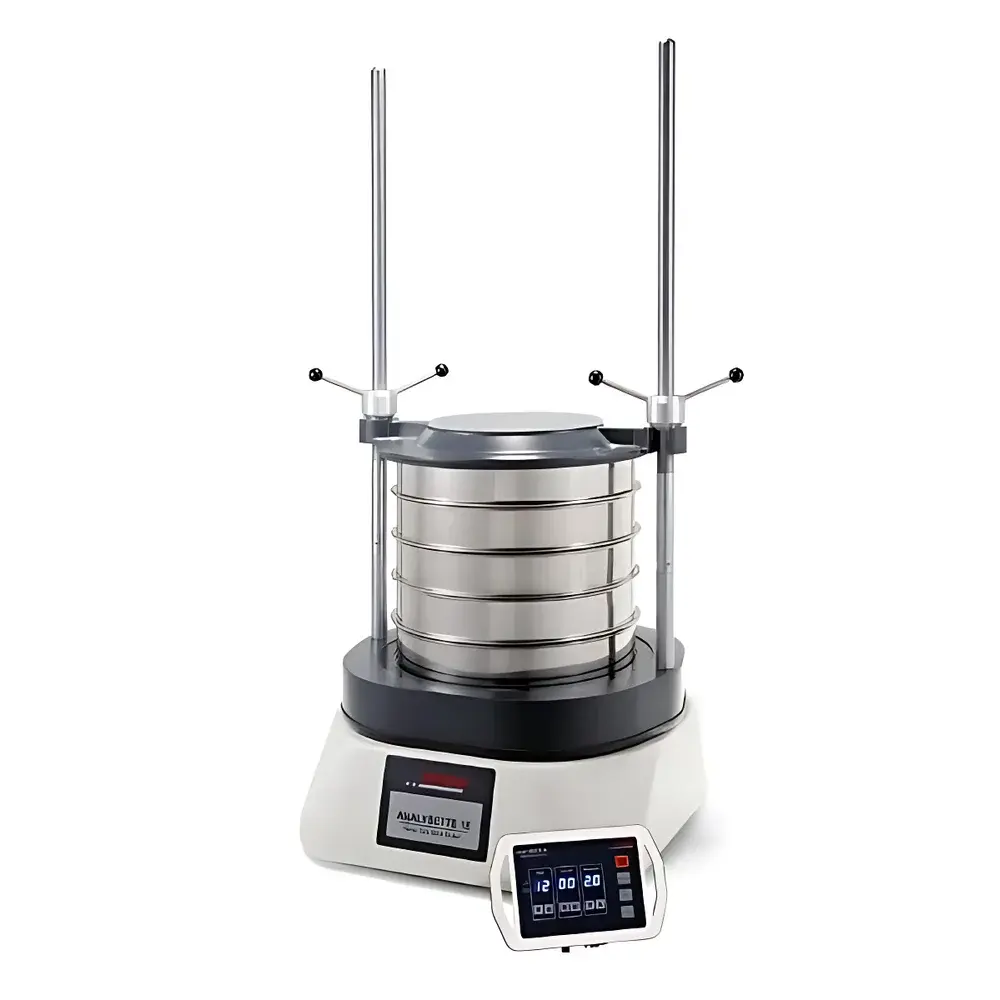
Fritsch A-18 Heavy-Duty Vibratory Sieve Shaker
| Brand | Fritsch |
|---|---|
| Origin | Germany |
| Manufacturer | Fritsch GmbH |
| Type | Imported Instrument |
| Model | A-18 |
| Principle | Vibratory Sieving |
| Measurement Range | 20 µm – 125 mm |
| Maximum Load Capacity | 42 kg |
| Number of Sieve Stages | 12 |
| Input Voltage | 230 V, 1~ |
| Frequency | 50–60 Hz |
| Power Consumption | 480 W |
| Max Sample Mass per Run | 6 kg |
| Sieving Time Range | 5–60 min |
| Base Dimensions (W×L×H) | 58 × 58 × 39 cm |
| Net Weight | 92 kg |
| Gross Weight | 129 kg |
| Sieve Diameter Compatibility | 350 mm, 400 mm, 450 mm, or 12", 16", 18" |
| Compliance | ISO 3310-1, ASTM E11-95, ISO 9000 traceable calibration |
Overview
The Fritsch A-18 Heavy-Duty Vibratory Sieve Shaker is an industrial-grade dry sieving instrument engineered for high-mass, high-reproducibility particle size distribution analysis in research laboratories, quality control environments, and pilot-scale production facilities. Based on the principle of controlled vibratory motion—specifically asymmetric dual-motor excitation—the A-18 generates simultaneous vertical and horizontal acceleration vectors across the sieve stack. This multi-directional kinematic profile ensures rapid stratification and efficient particle passage through defined mesh apertures, minimizing blinding, agglomeration, and segregation artifacts common in low-energy or unidirectional shakers. Unlike benchtop units limited to ≤1 kg loads, the A-18 accommodates up to 42 kg total mechanical load (including stacked sieves and sample), enabling robust operation under sustained duty cycles without thermal drift or mechanical resonance instability.
Key Features
- Asymmetric dual-motor drive system with precise angular counter-rotation, delivering optimized vibration amplitude and frequency stability across full load range
- Simultaneous vertical and horizontal acceleration profiles ensure dynamic reorientation of particles, enhancing separation efficiency and reducing required sieving time
- Motor stop synchronization guarantees repeatable endpoint control—critical for method transfer and regulatory compliance
- Modular support platform compatible with standard sieve diameters: 350 mm, 400 mm, 450 mm, and imperial equivalents (12″, 16″, 18″)
- Structural frame fabricated from reinforced cast aluminum and steel components, rated for continuous operation at maximum mechanical load
- Sealed, maintenance-free motors designed for long-term reliability in dusty laboratory environments
- Integrated locking mechanism ensures rigid fixation of sieve stacks during high-amplitude vibration
- Compliance-ready design: supports ISO 9000 traceable calibration documentation and meets mechanical specifications outlined in ISO 3310-1 and ASTM E11-95 for test sieves
Sample Compatibility & Compliance
The A-18 is strictly designated for dry sieving applications and is unsuitable for wet, sticky, fibrous, or electrostatically cohesive materials without prior conditioning. It accepts free-flowing granular, crushed, milled, or naturally occurring particulates—including minerals, aggregates, pharmaceutical granules, metal powders, ceramics, and food-grade ingredients—within the validated size range of 20 µm to 125 mm. All sieve meshes used with the A-18 must conform to ISO 3310-1 (metal wire cloth) or ASTM E11-95 (woven wire test sieves) dimensional tolerances. The instrument’s mechanical repeatability supports GLP-compliant workflows when paired with documented calibration procedures and operator training records. While not intrinsically 21 CFR Part 11 compliant, its deterministic motor control and fixed timing logic enable audit-trail integration via external LIMS or ELN systems.
Software & Data Management
The A-18 operates as a standalone electromechanical system with no embedded microprocessor or digital interface. Timing is managed via a calibrated analog timer (5–60 minute range), ensuring immunity to firmware failure and electromagnetic interference. For traceable data capture, users integrate the A-18 into standardized SOPs that specify pre- and post-sieving mass measurements (using certified analytical balances), sieve stack configuration, ambient temperature/humidity logging, and operator identification. Fritsch provides optional Excel-based reporting templates aligned with ISO 13320 and USP guidance for particle size distribution documentation. Calibration certificates for individual sieve sets—including aperture verification reports per ISO/IEC 17025—are available upon request from accredited metrology partners.
Applications
- Quality assurance of bulk raw materials in cement, mining, and construction aggregate industries
- Pilot-scale batch characterization of ceramic green bodies and refractory powders
- Pharmaceutical excipient grading per USP and EP 2.9.31 requirements
- Validation of milling process endpoints in fine chemical synthesis
- Geotechnical soil classification per ASTM D6913 and ISO 14688-1
- Recycled material sorting verification in circular economy processing lines
- Research into particle packing density, flowability, and segregation behavior under controlled vibrational energy input
FAQ
Is the A-18 suitable for wet sieving?
No. The A-18 is engineered exclusively for dry sieving. Wet or slurry-based separation requires dedicated hydraulic or ultrasonic sieve analyzers.
Can the A-18 be integrated into automated laboratory workflows?
It lacks native digital I/O or Ethernet connectivity; however, it can be incorporated into semi-automated sequences using external programmable logic controllers (PLCs) or timed relay systems for start/stop coordination.
What sieve standards are supported?
ISO 3310-1 (metric mesh), ASTM E11-95 (imperial mesh), and DIN 4188 are fully supported. Custom mesh configurations outside these standards require mechanical validation prior to use.
Does Fritsch provide calibration services for the A-18 unit itself?
Fritsch certifies motor timing accuracy and mechanical amplitude consistency at factory acceptance testing. Full system calibration—including force vector mapping—is performed by third-party metrology labs accredited to ISO/IEC 17025.
What maintenance is required for long-term operation?
The dual-motor assembly is sealed and maintenance-free. Routine checks include fastener torque verification, vibration isolation pad integrity, and visual inspection of sieve frame wear every 500 operating hours.
Related Products



