
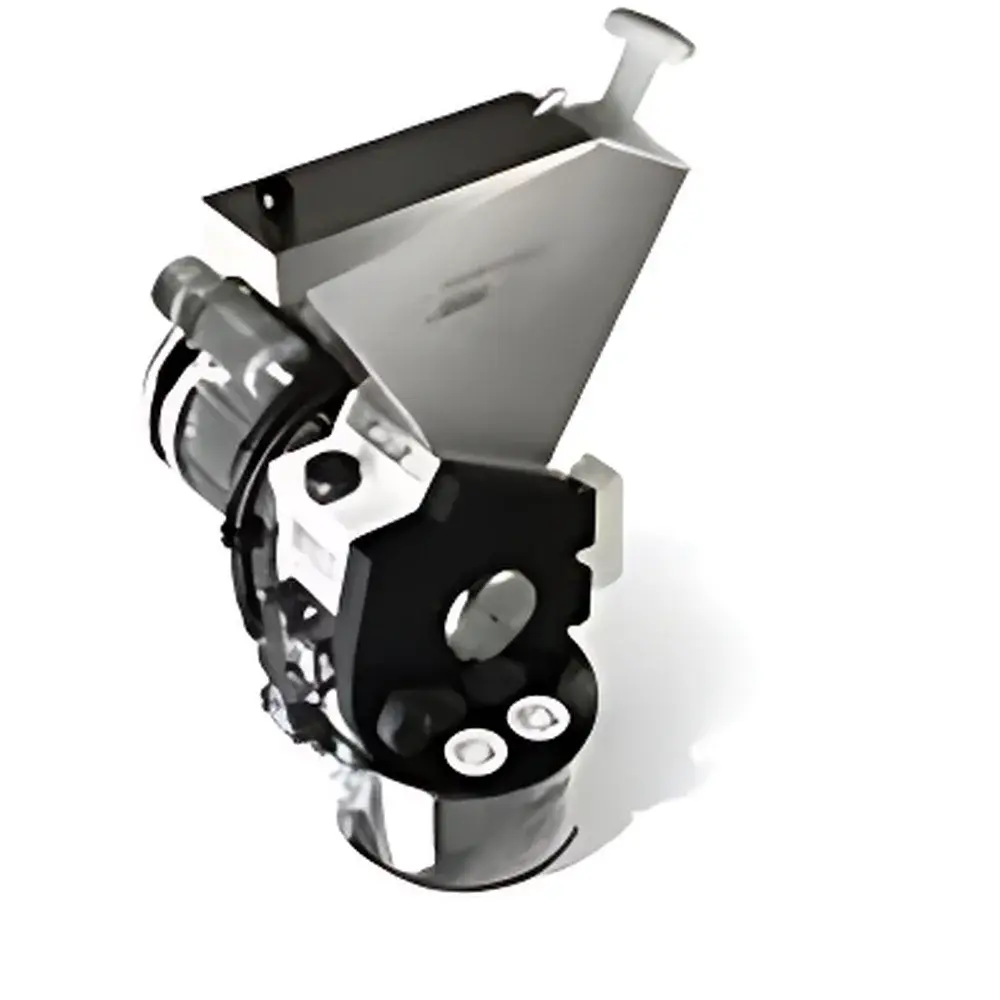
Fritsch P-15 Cutting Mill
| Brand | Fritsch |
|---|---|
| Origin | Germany |
| Manufacturer Type | Original Equipment Manufacturer (OEM) |
| Product Category | Imported Instrument |
| Model | P-15 |
| Instrument Type | Cutting Mill |
| Sample Suitability | Soft to medium-hard dry and fibrous materials |
| Feed Size | ≤ 70 mm |
| Final Particle Size | 0.01–0.5 mm (adjustable via interchangeable sieve inserts) |
| Throughput | Up to 50 L/h |
| Rotor Speed | 2800–3400 rpm |
| Net Weight | 42 kg |
| Gross Weight | 72 kg |
| Dimensions (W × D × H) | 42 × 48 × 69 cm |
| Construction | Stainless steel grinding chamber and rotor |
| Dust Extraction Interface | Yes |
| Compliance | CE, ISO 9001 certified manufacturing |
Overview
The Fritsch P-15 Cutting Mill is a high-performance, laboratory-scale cutting mill engineered for the reproducible size reduction of soft to medium-hard, dry, and fibrous materials. Operating on the principle of high-speed mechanical shearing, the P-15 utilizes a precisely engineered rotating cutting rotor equipped with hardened stainless-steel blades arranged at optimized geometrical angles. As material enters the grinding chamber through the feed funnel, it is subjected to repeated impact and shear forces between the rotating blades and stationary counter-cutting edges—effectively fracturing, slicing, and comminuting samples without excessive heat generation or structural degradation. Unlike impact or disc mills, the P-15’s cutting mechanism preserves sample integrity for applications where particle morphology, fiber length retention, or low thermal load are critical. Its design adheres to fundamental principles of mechanical comminution theory, ensuring consistent energy input per unit mass and high batch-to-batch reproducibility—key requirements in QC laboratories, R&D facilities, and regulated environments such as pharmaceutical pre-formulation and food safety testing.
Key Features
- Quick-access grinding chamber secured by only two knurled screws—enabling full exposure of internal components within seconds
- Motorized hinged lid with push-button actuation for safe, ergonomic operation and unobstructed cleaning access
- Stainless-steel grinding chamber and rotor assembly with optional chromium-free (Cr-free) cutting tools and sieve inserts—compliant with heavy-metal-free sample preparation protocols (e.g., USP /, ICH Q3D)
- Interchangeable stainless-steel sieve inserts (mesh sizes from 0.01 mm to 6.00 mm) for precise control over final particle size distribution
- Externally adjustable cutting gap—allowing fine-tuning of cut quality and throughput without disassembly
- Dust extraction port compatible with standard industrial vacuum systems—ensuring continuous airflow for sample cooling and operator safety (OSHA 29 CFR 1910.94 compliant)
- Robust cast-aluminum housing with vibration-dampening feet; configurable for benchtop mounting or standalone pedestal installation
- Long-life hardened stainless-steel blades—re-sharpenable multiple times to maintain cutting efficiency over extended service life
- Feed funnel with integrated polymeric pusher for controlled, hands-free sample introduction and reduced risk of jamming
- Smooth-surface, crevice-free chamber geometry facilitating rapid wet or dry cleaning—validated for multi-product use under GMP/GLP conditions
Sample Compatibility & Compliance
The P-15 demonstrates broad compatibility with organic and inorganic matrices that exhibit low to moderate mechanical strength and high fibrous or elongated morphology. Validated sample types include natural polymers (rubber, leather, cork, straw), botanicals (herbs, tobacco, roots, leaves), agricultural products (grains, malt, corn, feed pellets), processed foods (noodles, confectionery, dried meat), pharmaceutical solids (tablets, capsules, excipients), and recyclables (plastics, textiles, paperboard, wood chips, metal swarf). It is not intended for abrasive, ultra-hard (e.g., quartz, ceramics), or highly elastic materials. All P-15 units are manufactured in Germany under ISO 9001-certified processes and bear CE marking per Machinery Directive 2006/42/EC. Optional Cr-free tooling meets EU RoHS 2011/65/EU and REACH Annex XVII requirements—essential for elemental impurity testing in pharmaceutical and food-grade applications.
Software & Data Management
The P-15 operates as a stand-alone electromechanical instrument without embedded digital controls or proprietary software. However, its mechanical design supports full integration into traceable laboratory workflows. The absence of programmable logic controllers simplifies 21 CFR Part 11 compliance when paired with external electronic lab notebooks (ELNs) or LIMS platforms—eliminating audit-trail complexity associated with firmware-based instruments. Operators record key parameters (sieve insert ID, rotor speed setting, feed rate, ambient temperature) manually or via barcode-scanned SOPs. Routine maintenance logs—including blade sharpening cycles, sieve replacement dates, and calibration verification of feed geometry—are retained per GLP Annex 11 and ISO/IEC 17025:2017 clause 7.7. Documentation packages include full traceability of raw materials, weld certifications, and factory test reports—all archived for ≥15 years per Fritsch’s quality policy.
Applications
The P-15 serves as a primary sample preparation tool across regulated and research-intensive domains. In pharmaceutical development, it enables uniform particle sizing of tablet blends prior to dissolution testing (USP ) or content uniformity analysis (USP ). In food safety labs, it homogenizes heterogeneous feedstock (e.g., pet food, cereal grains) for mycotoxin extraction (AOAC 2005.02) or heavy metal digestion (EPA Method 3050B). Environmental testing labs use it to prepare soil amendments, compost, or biomass for proximate analysis (ASTM D3172) or calorific value determination (ASTM D5865). Materials science groups employ it for controlled fiber liberation from composites prior to SEM-EDS or tensile testing. Its ability to process long, narrow specimens—such as rods, stems, or strips—without pre-cutting makes it uniquely suited for botanical authentication, forensic fiber analysis, and circular economy studies of post-consumer waste streams.
FAQ
What types of materials are unsuitable for the P-15?
Materials with Mohs hardness >5.5 (e.g., alumina, silicon carbide), highly elastic polymers (e.g., thermoplastic elastomers), or moisture-sensitive hygroscopic powders requiring inert atmosphere handling are not recommended.
Can the P-15 be used for cryogenic grinding?
No—the P-15 is not designed for liquid nitrogen cooling or sub-zero operation. For cryo-milling, consider Fritsch’s Planetary Micro Mill PULVERISETTE 7 premium or Cryomill systems.
Is routine calibration required?
While no metrological calibration is mandated, users must verify sieve insert dimensions annually using NIST-traceable micrometers and document rotor speed consistency via tachometer validation per SOP.
How is compliance with GMP/GLP maintained during operation?
Through documented SOPs covering cleaning validation (swab recovery studies), tooling change logs, and preventive maintenance records—all stored electronically or in bound logbooks with dual-signature approval.
Does Fritsch provide application support for method development?
Yes—Fritsch Application Laboratories in Idar-Oberstein offer free feasibility testing, particle size distribution analysis (via laser diffraction), and SOP drafting services for qualified customers.



