
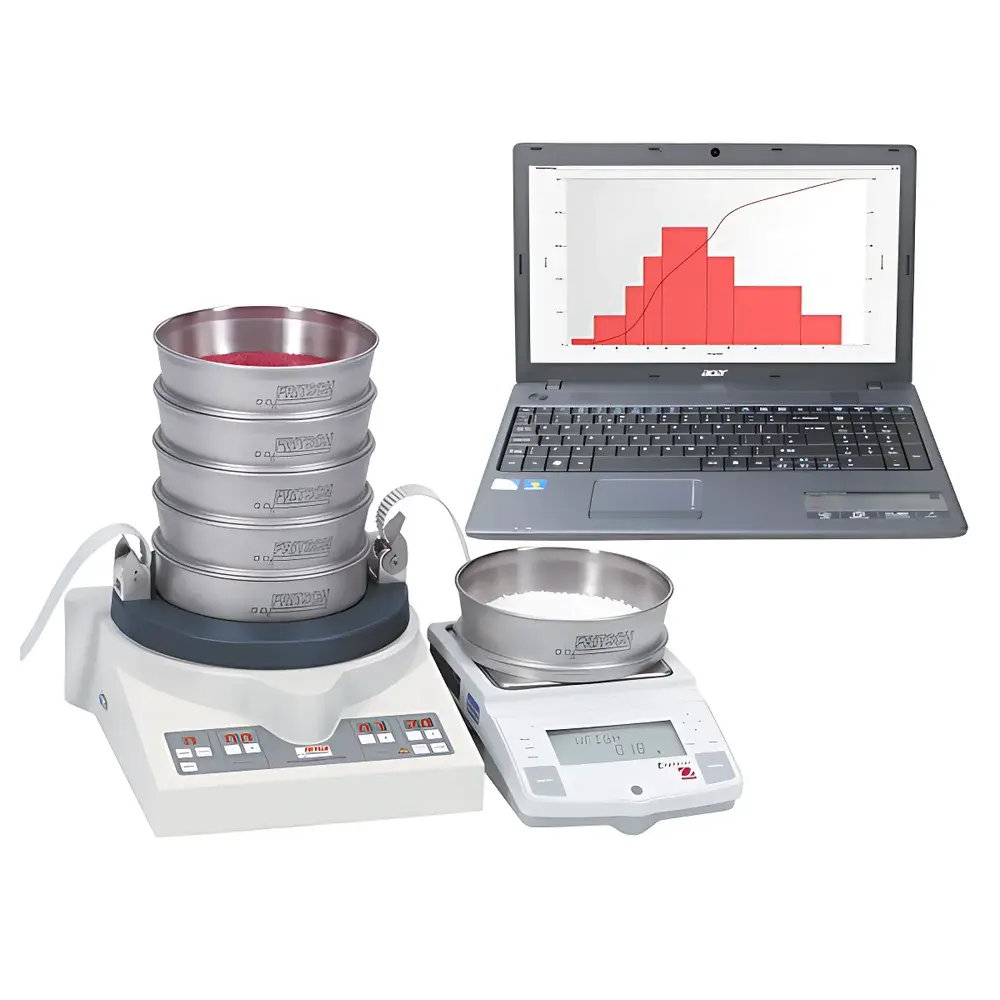
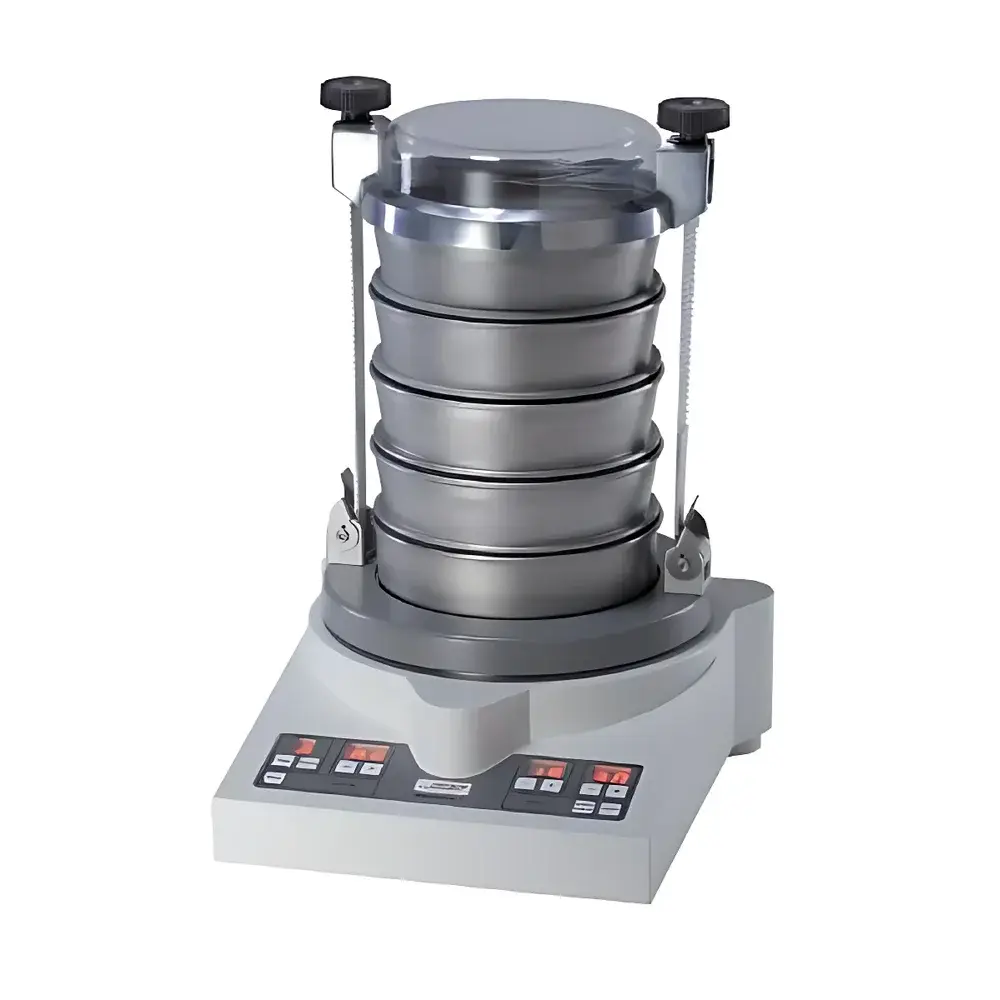
Fritsch A-3 Pro Digital Vibratory Sieve Shaker
| Brand | Fritsch |
|---|---|
| Origin | Germany |
| Manufacturer Type | Original Equipment Manufacturer (OEM) |
| Product Category | Imported Instrument |
| Model | A-3 Pro |
| Principle | Vertical vibratory sieving with adjustable amplitude up to 3 mm |
| Measurement Range | Dry method: 32 µm – 63 mm |
| Wet method | 20 µm – 10 mm |
| Micro-sieve option | 5 µm – 100 µm |
| Sample Capacity | Dry ≤100 g (for <100 µm), ≤1 kg (for <25 mm) |
| Wet | 20–100 g |
| Micro-sieve | 0.2–0.5 g |
| Sieving Time | Dry: 3–20 min |
| Wet | 3–10 min |
| Micro-sieve | 30–60 min |
| Max Stackable Sieves | 10 × 50 mm diameter sieves or 16 × 25 mm diameter sieves |
| Sieve Standards | ISO 3310-1/-2, ASTM E11 |
| Compliance Certificates | EN 10204 3.1B, DIN 66165 repeatability validation, ISO 9000-compatible calibration traceability |
| Weight | Net 21 kg, Gross 26 kg |
| Software Interface | AUTOSIEVE PC software (included), supports automated process control, result evaluation, and cross-platform data correlation with laser diffraction particle size analyzers |
Overview
The Fritsch A-3 Pro Digital Vibratory Sieve Shaker is a precision-engineered laboratory instrument designed for standardized, reproducible dry and wet sieve analysis of granular and powdered materials. Operating on the principle of controlled vertical vibration—driven by an electromagnetic excitation system with programmable amplitude (up to 3 mm) and frequency—the A-3 Pro achieves high-fidelity particle size distribution (PSD) separation in accordance with internationally recognized mechanical sieving methodologies. Its architecture complies with the fundamental physical requirements of ISO 565, ISO 3310-1/-2, and ASTM E11 for test sieves, ensuring metrological integrity across routine QC, R&D, and regulatory submissions. The device is not a single-point analyzer but a modular platform: its base unit serves as the mechanical foundation for both sieving and cryogenic grinding when coupled with Fritsch’s P0 RoHS-compliant cryo-mill module—enabling seamless transition between sample size reduction and subsequent particle classification without reconfiguration of core drive electronics.
Key Features
- Microprocessor-controlled digital interface with full-function LCD display, enabling real-time monitoring of amplitude, duration, pause intervals, and cycle count.
- Programmable memory for up to nine independent sieving protocols—including customized time/amplitude profiles for dry, wet, and micro-sieve applications.
- Patented torque-based clamping system automatically aligns and secures stacked sieves in the horizontal plane, minimizing lateral displacement and eliminating operator-induced variability.
- Modular sieve stack compatibility: accommodates up to ten 50 mm-diameter sieves (height 50 mm) or sixteen 25 mm-diameter sieves (height 25 mm) per run—maximizing throughput without sacrificing resolution.
- Interchangeable sieve support trays for multiple standard formats: 200 × 50 mm, 200 × 25 mm, 100 × 40 mm, and 8″ × 2″ (203 × 51 mm), all certified to ISO 3310 and ASTM E11 tolerances.
- Integrated safety interlock and overload protection circuitry compliant with IEC 61000-6-2/6-4 EMC standards and CE marking requirements for laboratory equipment.
Sample Compatibility & Compliance
The A-3 Pro supports both dry and wet sieving protocols, accommodating diverse material classes including pharmaceutical actives and excipients, catalyst powders, metal alloys, ceramic precursors, pigments, and polymer granules. Dry sieving is validated for particles ranging from 32 µm to 63 mm; wet sieving extends low-end resolution to 20 µm (with appropriate dispersion and filtration setup); and the optional micro-sieve kit enables high-resolution fractionation from 5 µm to 100 µm—ideal for fine chemical and nanomaterial characterization. All sieve meshes undergo individual certification per EN 10204 3.1B, with traceable calibration against ISO 9000-certified reference sieves. Repeatability performance meets DIN 66165 Class A specifications (< ±2% relative standard deviation for replicate runs under identical conditions), supporting GLP and GMP-aligned documentation workflows.
Software & Data Management
The included AUTOSIEVE software provides native Windows-based control via USB connection, enabling fully automated execution of stored methods, real-time parameter logging, and post-run statistical evaluation (e.g., cumulative undersize %, d10/d50/d90, span). Data export is supported in CSV, PDF, and XML formats—compatible with LIMS integration and 21 CFR Part 11-compliant audit trail configurations when deployed with validated electronic signature modules. Critically, AUTOSIEVE permits direct cross-correlation of sieve-derived PSDs with complementary laser diffraction data (e.g., from Fritsch ANALYSETTE 22 or equivalent instruments), generating unified reporting templates that satisfy multi-technique particle characterization requirements outlined in USP , EP 2.9.31, and ISO 13320.
Applications
- Pharmaceutical manufacturing: verification of milled API particle size prior to tableting or inhalation formulation development.
- Coatings & pigments: QC of titanium dioxide, zinc oxide, and organic pigment batches for consistency in opacity and dispersion stability.
- Metallurgy & additive manufacturing: qualification of metal powder feedstocks (e.g., Ti-6Al-4V, Inconel 718) per ASTM B214 and ISO/ASTM 52907.
- Construction materials: gradation analysis of aggregates, cementitious fillers, and geopolymer precursors per ASTM C136 and EN 933-1.
- Academic research: method development for hierarchical sieving strategies, wet/dry comparison studies, and validation of computational PSD models.
FAQ
What standards does the A-3 Pro comply with for sieve calibration and result validation?
It conforms to ISO 3310-1/-2 (test sieves), ASTM E11 (standard specification for wire cloth and sieves), DIN 66165 (repeatability criteria), and EN 10204 3.1B (material test certificate requirements). Calibration traceability is maintained through ISO 9000-certified reference sieves.
Can the A-3 Pro be used for regulated environments requiring 21 CFR Part 11 compliance?
Yes—when operated with validated AUTOSIEVE software configuration, electronic signatures, and audit-trail-enabled database logging, it supports FDA-regulated workflows in pharmaceutical and medical device manufacturing.
Is wet sieving performed under closed-loop or open-system conditions?
Wet sieving is conducted using standardized rinse-and-collect methodology with optional vacuum-assisted filtration; no integrated fluid circulation pump is provided—users configure external peristaltic or gravity-fed systems per ASTM C136 Annex A3.
How does the torque clamping system improve measurement reproducibility?
By dynamically compensating for minor planar misalignment during stacking, the system ensures uniform force distribution across all sieve frames—eliminating edge loading, mesh distortion, and inconsistent particle passage rates observed in manually tightened assemblies.
Does the A-3 Pro require external cooling or ventilation during extended operation?
No—its brushless electromagnetic drive and thermally optimized housing enable continuous operation up to 60 minutes without thermal derating or forced air assistance. Ambient operating temperature range is 15–30 °C per IEC 61010-1.



