
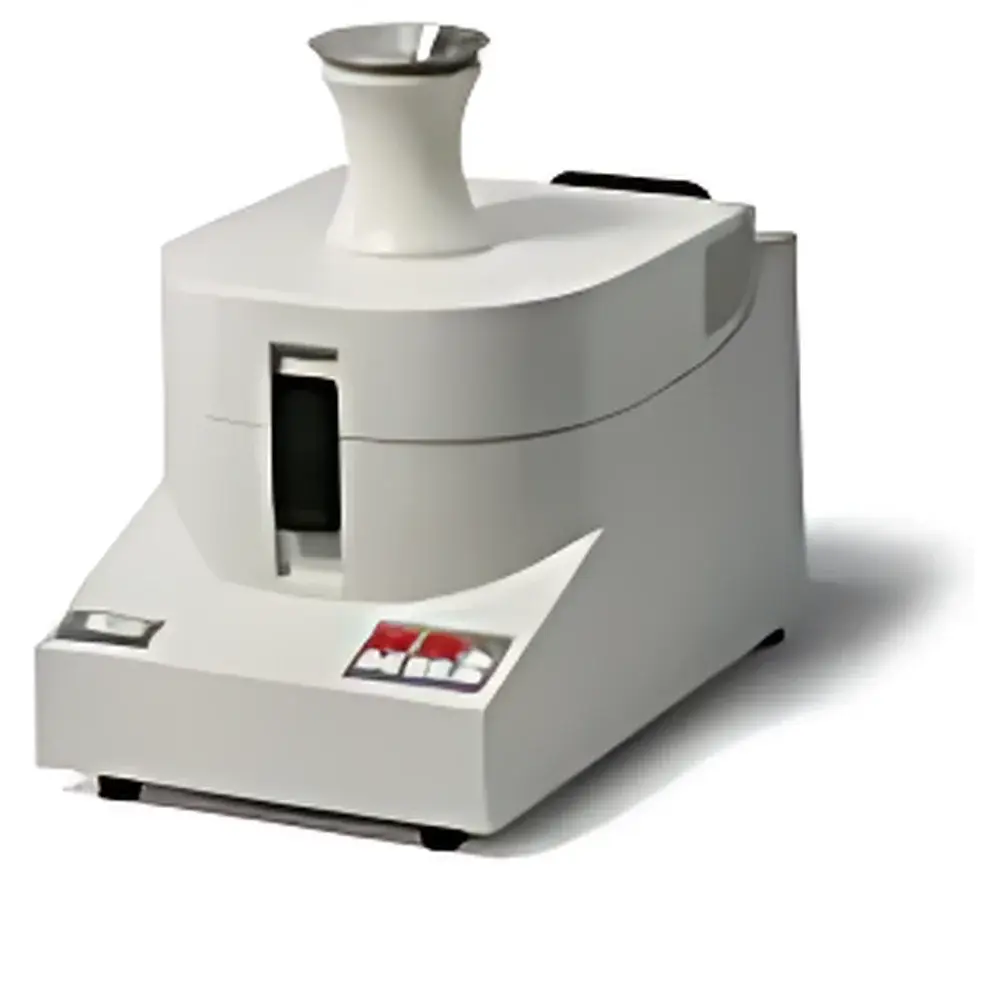
FRITSCH P-14 classic Variable-Speed High-Speed Rotational Crusher
| [Brand | FRITSCH |
|---|---|
| Origin | Germany |
| Manufacturer | FRITSCH GmbH |
| Model | P-14 classic |
| Sample Type | Soft to medium-hard materials |
| Max. Feed Size | ≤10 mm |
| Throughput | 0.05–5 L/h |
| Final Particle Size | 40 µm (typical), adjustable down to 0.01 mm |
| Rotor Speed | 6,000–20,000 rpm |
| Power Supply | 200–240 V, 1-phase, 50–60 Hz, 1150 W |
| Motor Output | 550 W (VDE 0530 / EN 60034 compliant) |
| Net Weight | 23 kg |
| Dimensions (W×H×D) | 31×48×47 cm |
| Compliance | RoHS-compliant design, CE-marked] |
Overview
The FRITSCH P-14 classic is a high-precision, variable-speed rotational crusher engineered for reproducible, contamination-controlled size reduction of soft to medium-hard laboratory samples. Operating on the principle of high-speed rotor-sieve interaction—where centrifugal force drives sample material against a fixed perforated ring—this instrument delivers consistent mechanical shearing, impact, and friction-based comminution. Designed in accordance with EU Directive 2011/65/EU (RoHS), the P-14 classic eliminates elemental contamination risks through optional titanium or tungsten carbide rotor assemblies, making it suitable for regulatory-compliant sample preparation in environmental, pharmaceutical, food, and polymer testing laboratories. Its compact benchtop footprint and robust cast-aluminum housing support integration into GLP- and ISO/IEC 17025-aligned workflows where traceability, repeatability, and operator safety are critical.
Key Features
- Digitally adjustable rotor speed from 6,000 to 20,000 rpm, enabling precise control over energy input and particle size distribution.
- Interchangeable hardened tool steel, pure titanium, or tungsten carbide rotors—selected based on sample abrasiveness and contamination sensitivity requirements.
- Modular sieve ring system with standardized aperture options (e.g., 0.01 mm to 0.5 mm), allowing granulometric tailoring without hardware modification.
- Integrated collection tray with optional filter bag attachment for dust-free, high-throughput operation up to 5 L/h—ideal for batch processing of heterogeneous organic or polymeric matrices.
- Intuitive front-panel push-button interface with real-time speed display; no external PC required for basic operation.
- Compliance-ready engineering: CE-marked, RoHS-conformant construction, VDE 0530 / EN 60034 certified motor, and IP20-rated enclosure for standard laboratory environments.
Sample Compatibility & Compliance
The P-14 classic accommodates a broad spectrum of non-metallic, non-fibrous, and low-moisture samples—including thermoplastics (PP, PVC, PE), botanical tissues (leaves, roots, grains), pharmaceutical tablets and capsules, animal feed, soils (rock-free), clays (kaolin), coal, textiles, and foodstuffs. It is explicitly validated for RoHS-relevant polymer screening, where absence of regulated heavy metals (Pb, Cd, Hg, Cr⁶⁺, Br) must be assured during sample homogenization. The instrument meets essential requirements of ISO 13320 (laser diffraction particle sizing) for upstream sample conditioning and supports ASTM D5630 (plastic ash content) and USP <725> (pharmaceutical particle size analysis) preparatory steps. All wetted components are chemically inert and autoclavable; routine cleaning follows ISO 17025 Annex A.3 guidelines for cross-contamination mitigation.
Software & Data Management
While the P-14 classic operates as a standalone unit, its operational parameters (speed setpoint, runtime, rotor type) are manually logged per batch in accordance with GLP documentation standards. When integrated with FRITSCH’s L-24 vibratory feeder, the system supports semi-automated feeding sequences compatible with laboratory information management systems (LIMS) via analog signal output (0–10 V). Audit trails for maintenance, calibration, and usage history are maintained externally per FDA 21 CFR Part 11 principles—though native electronic recordkeeping is not embedded. Calibration certificates for speed accuracy (±1% full scale) and dimensional verification of sieve rings are supplied with each unit and traceable to PTB (Physikalisch-Technische Bundesanstalt).
Applications
- Preparation of polymer pellets and recycled plastics for FTIR, XRF, or pyrolysis-GC/MS analysis under RoHS compliance protocols.
- Homogenization of herbal medicines and botanicals prior to HPLC or ICP-MS quantification of active constituents or heavy metals.
- Routine grinding of soil and sediment samples for particle-size distribution (PSD) analysis by laser diffraction or sieving.
- Standardized comminution of pharmaceutical dosage forms (coated tablets, gelatin capsules) to assess dissolution uniformity or content homogeneity per USP <905>.
- Feedstock conditioning for additive manufacturing powder characterization (e.g., flowability, apparent density, morphology).
FAQ
What materials are compatible with the P-14 classic?
Soft to medium-hard non-metallic, non-fibrous, and low-moisture samples—including polymers, plant tissues, pharmaceuticals, soils, and foods. Avoid highly elastic, fibrous, or metallic materials.
Is the P-14 classic suitable for RoHS-compliant sample preparation?
Yes—when equipped with titanium or tungsten carbide rotor and sieve components, it eliminates elemental leaching and satisfies RoHS Directive 2011/65/EU requirements for plastic and electronic waste analysis.
Can the final particle size be precisely controlled?
Yes—final particle size distribution is determined by rotor speed, sieve aperture (0.01–0.5 mm), and sample residence time. Typical median particle size (d₅₀) ranges from 40 µm to 6 mm depending on configuration.
Does the instrument require external software or a computer?
No—basic operation is fully manual via front-panel controls. Optional L-24 feeder integration enables analog signal interfacing with external process controllers or LIMS.
How is cleaning and maintenance performed?
All grinding components are removable and cleanable with ethanol or isopropanol; stainless steel parts are autoclavable. Annual motor bearing inspection and speed calibration are recommended per FRITSCH Service Bulletin SB-P14-2023.



