
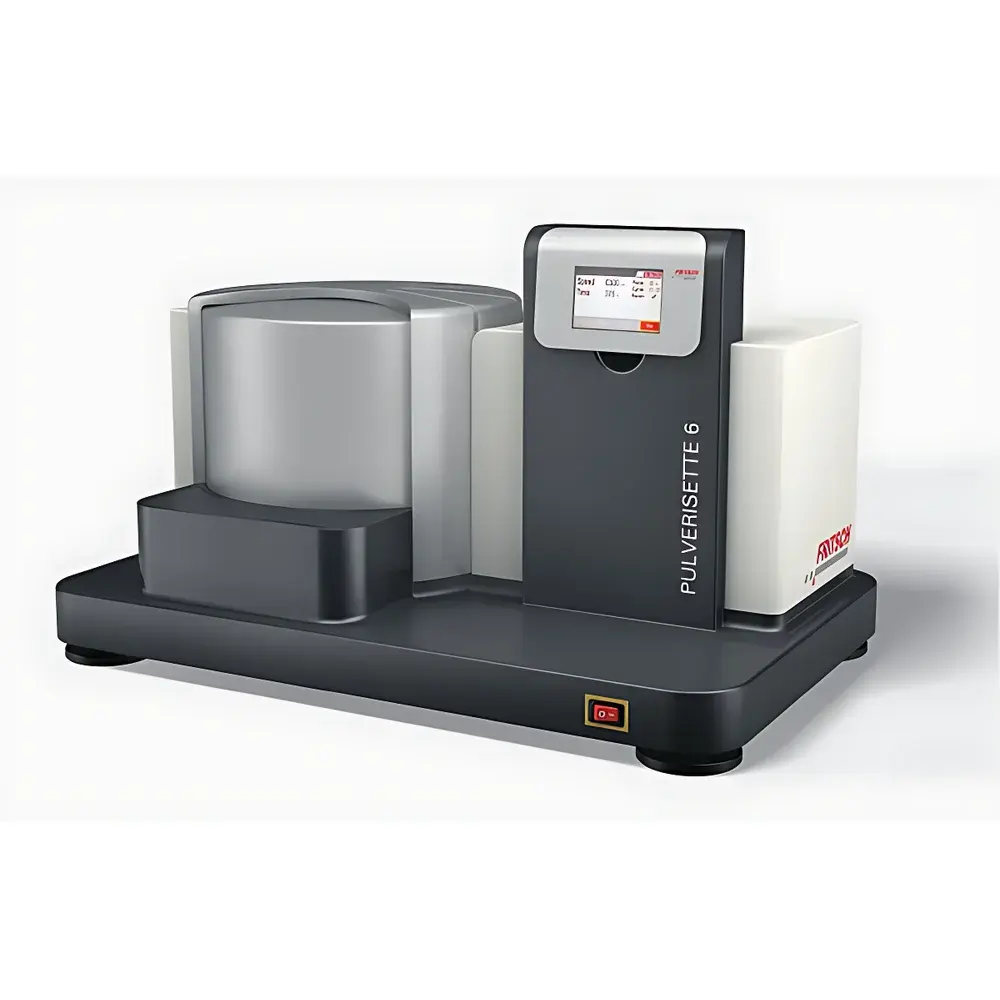
Fritsch P-5 Premium Dual-Drive Planetary Ball Mill
| Brand | Fritsch |
|---|---|
| Origin | Germany |
| Manufacturer Type | Direct Manufacturer |
| Origin Category | Imported |
| Model | P-5 Premium |
| Instrument Type | Planetary Ball Mill |
| Sample Suitability | Hard to brittle materials, suspensions |
| Feed Size | ≤ 10 mm |
| Final Particle Size | < 0.1 µm |
| Batch Capacity | 2 × 225 mL |
| Drive Power | 2.2 kW |
| Speed Range | 100–800 rpm |
| Acceleration | Up to 47 g |
| Grinding Methods | Dry & Wet |
| Atmosphere Control | Inert gas (N₂, Ar) compatible |
| Noise Level | ~70 dB(A) (with 250 mL bowl & 10 mm balls) |
| Dimensions (W×H×D) | 82 × 48 × 52 cm |
| Net Weight | 110 kg |
| Electrical Supply | 100–120 / 200–240 V, 1~ , 50–60 Hz, 2200 W |
Overview
The Fritsch P-5 Premium is a dual-drive planetary ball mill engineered for high-energy, reproducible comminution of solid and suspended samples in research and quality control laboratories. Operating on the principle of planetary motion—where grinding bowls rotate around a central sun gear while simultaneously revolving on their own axes—the instrument generates centrifugal accelerations up to 47 g, enabling intense impact and shear forces between grinding media and sample material. This kinematic design ensures rapid size reduction through combined friction, impact, and compression mechanisms, making it suitable for applications demanding nanoscale particle generation (< 0.1 µm), mechanical alloying, mechanochemical synthesis, and amorphization. First patented in 1962 and continuously refined over six decades, the P-5 Premium represents the culmination of Fritsch’s expertise in precision milling technology, with its dual-motor architecture delivering independent control over rotational speed and direction for enhanced process symmetry and thermal management.
Key Features
- Dual independent drive system with two synchronized 1.1 kW motors—one per grinding station—ensuring balanced load distribution, reduced vibration, and extended service life.
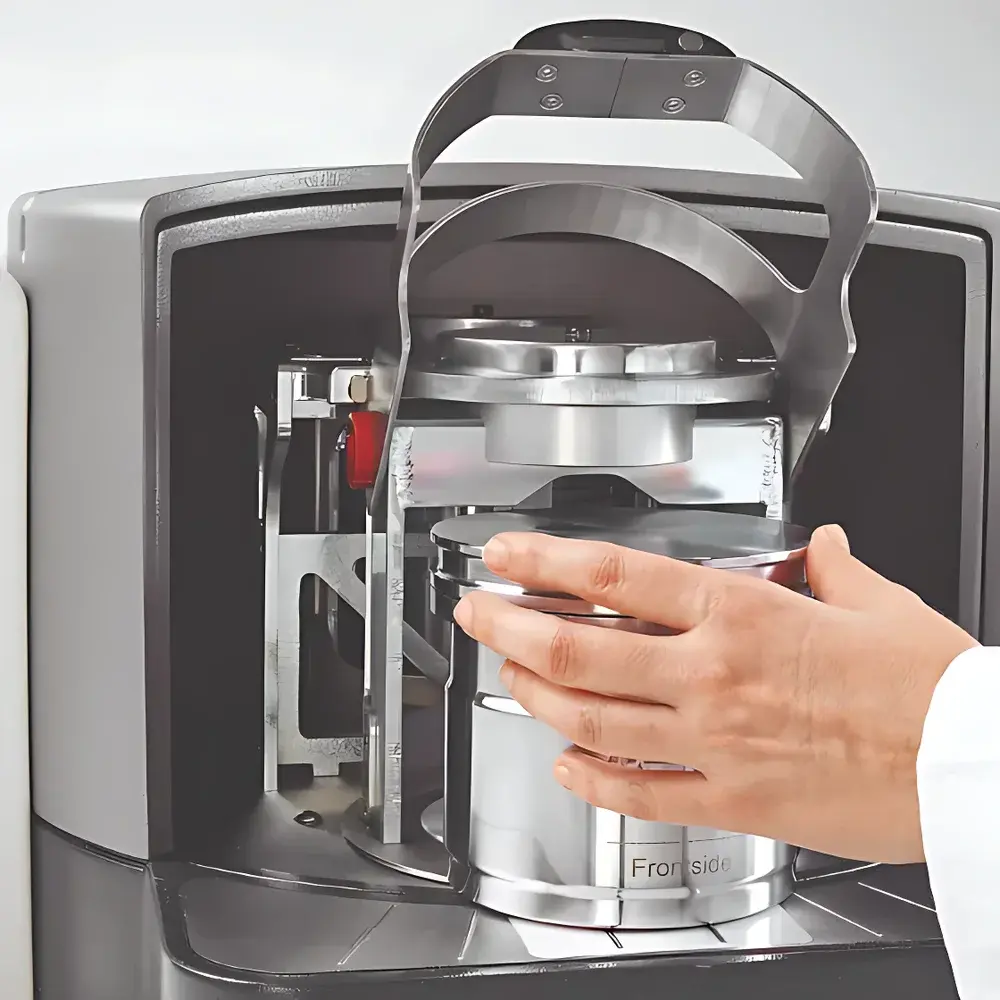
- ServoLOCK electric bowl clamping mechanism: eliminates manual torque application, guarantees repeatable sealing pressure, and prevents accidental bowl ejection during operation.
- Programmable time-controlled grinding cycles with resolution down to 1 second, including adjustable pause intervals and cooling phases to manage exothermic reactions and prevent thermal degradation.
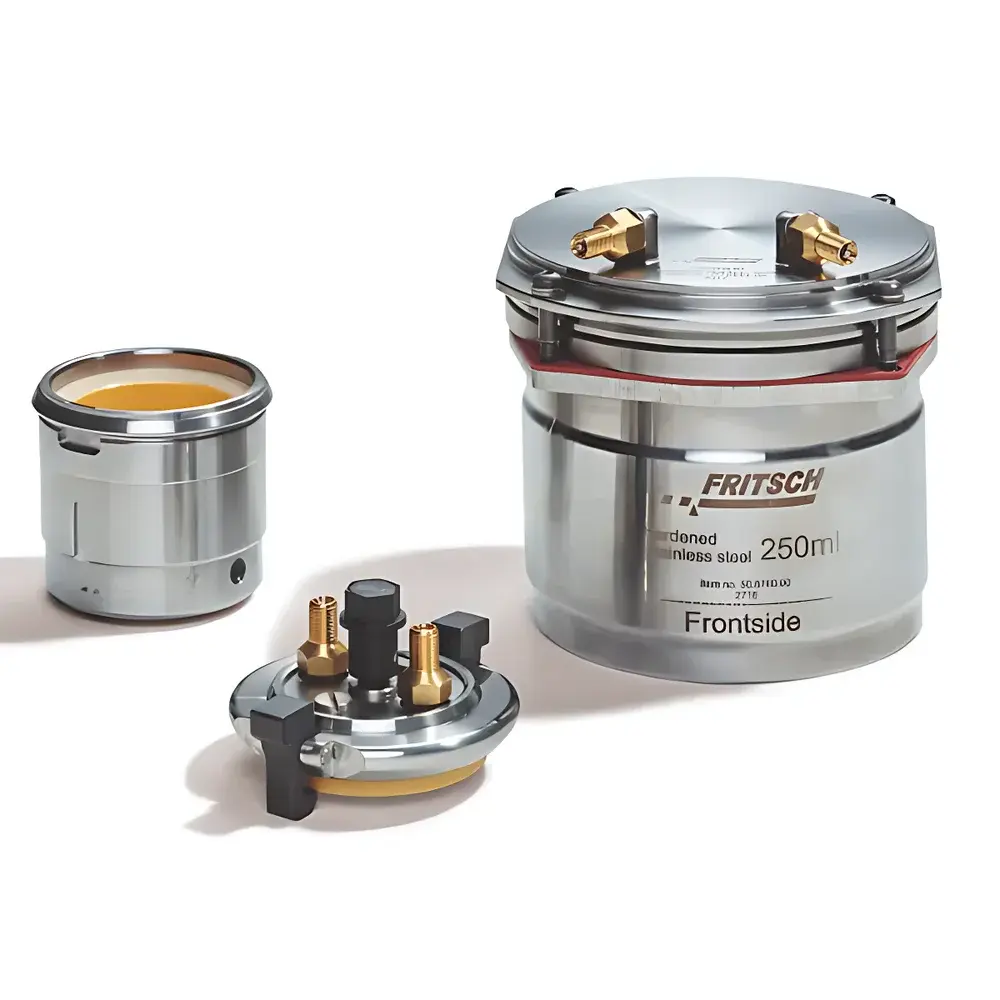
- Hermetically sealed grinding bowls rated for overpressure operation; compatible with inert gas purging (N₂, Ar) to suppress oxidation or moisture-sensitive reactions—fully compliant with ASTM E2906 and ISO 13320 recommendations for controlled-atmosphere milling.
- Seven standard grinding ball diameters (3–40 mm) and five bowl liner materials (agate, zirconia, stainless steel, hardened steel, tungsten carbide) allow precise selection based on hardness, contamination sensitivity, and chemical compatibility requirements.
- Integrated acoustic emission monitoring (70 dB(A) typical noise level under standard conditions) aligned with EU Directive 2006/42/EC for machinery safety and workplace exposure limits.
Sample Compatibility & Compliance
The P-5 Premium accommodates diverse sample types—from hard ceramics and metallic alloys to soft pharmaceutical excipients and biological tissues—without requiring pre-crushing beyond 10 mm maximum feed size. Its dual-bowl configuration supports parallel processing of identical or dissimilar samples, improving throughput consistency for comparative studies. All wet grinding protocols comply with USP for particle size distribution analysis in suspensions, while dry milling meets ISO 8503-2 surface profile standards for reference material preparation. The instrument’s design facilitates full traceability under GLP and GMP environments: all operational parameters (speed, time, direction, pauses) are digitally logged and exportable in CSV format, supporting FDA 21 CFR Part 11-compliant audit trails when used with optional Fritsch LabSuite software.
Software & Data Management
The P-5 Premium operates via an intuitive touch interface with embedded firmware that stores up to 99 user-defined methods—including speed ramping profiles, multi-stage sequences, and automatic cooldown triggers. Optional integration with Fritsch LabSuite v3.2 enables remote monitoring, real-time parameter visualization, and automated report generation compliant with ISO/IEC 17025 documentation requirements. When paired with the GTM (Gas Temperature & Pressure Monitoring) system—the only commercially available solution capable of in-situ measurement of internal bowl gas dynamics—the instrument provides thermodynamic feedback critical for reaction calorimetry, metastable phase formation studies, and mechanochemical pathway optimization. All data exports support LIMS interoperability via OPC UA and HL7 protocols.
Applications
This mill serves as a core tool across multiple regulated and research-intensive domains: preparation of homogenized reference standards for XRD, SEM-EDS, and laser diffraction particle sizing (ISO 13320); production of nanostructured catalysts and battery electrode precursors via mechanical alloying; formulation development of inhalable dry powders per USP ; mineralogical liberation studies in geochemical exploration; and synthesis of metal-organic frameworks (MOFs) under solvent-free conditions. Its ability to achieve sub-100 nm final particle sizes without post-milling classification makes it indispensable for nanomaterials R&D labs pursuing scalable bottom-up synthesis routes.
FAQ
What is the maximum recommended continuous operating time per cycle?
Standard protocols support up to 99 hours 59 minutes per program; however, thermal accumulation must be evaluated case-by-case—especially for highly exothermic reactions—and intermittent cooling intervals are advised.
Can the P-5 Premium be validated for pharmaceutical manufacturing use?
Yes. With IQ/OQ documentation packages, electronic signature capability, and 21 CFR Part 11–enabled software modules, it meets regulatory expectations for equipment qualification in API and finished dosage form development.
Is the GTM system required for inert-gas milling?
No. GTM is optional and enhances process understanding but is not necessary for basic inert-atmosphere operation, which relies solely on the bowl’s integrated gas-tight sealing mechanism.
How does the dual-drive architecture improve reproducibility compared to single-motor planetary mills?
Independent motor control eliminates torque imbalance between bowls, minimizes angular deviation during acceleration/deceleration, and ensures identical kinetic energy input across both stations—critical for statistical significance in inter-laboratory comparisons.
Are spare parts and calibration services available globally?
Fritsch maintains certified service centers in North America, Europe, and Asia-Pacific, offering NIST-traceable speed calibration, bowl wear inspection, and preventive maintenance contracts with SLA-backed response times.



