
Fritsch P-16 Cross Beater Mill
| Brand | Fritsch |
|---|---|
| Origin | Germany |
| Manufacturer Type | Direct Manufacturer |
| Product Category | Imported Instrument |
| Model | P-16 |
| Instrument Type | Crusher |
| Sample Suitability | Hard & Brittle Materials (Mohs Hardness ≤ 6) |
| Maximum Feed Size | 20 mm |
| Final Particle Size | < 0.01 mm (< 10 µm) |
| Output Granularity Range | 0.01–0.5 mm |
| Throughput Capacity | 80 L/h |
| Motor Speed | 2,000–4,000 rpm |
| Power Supply | 230 V, 1~ , 50 Hz, 1500 W |
| Net Weight | 45 kg |
| Gross Weight | 83 kg |
| Dimensions (W×D×H) | 50 × 50 × 58 cm |
| Sound Pressure Level (LpA,eq) | 85 dB(A) |
Overview
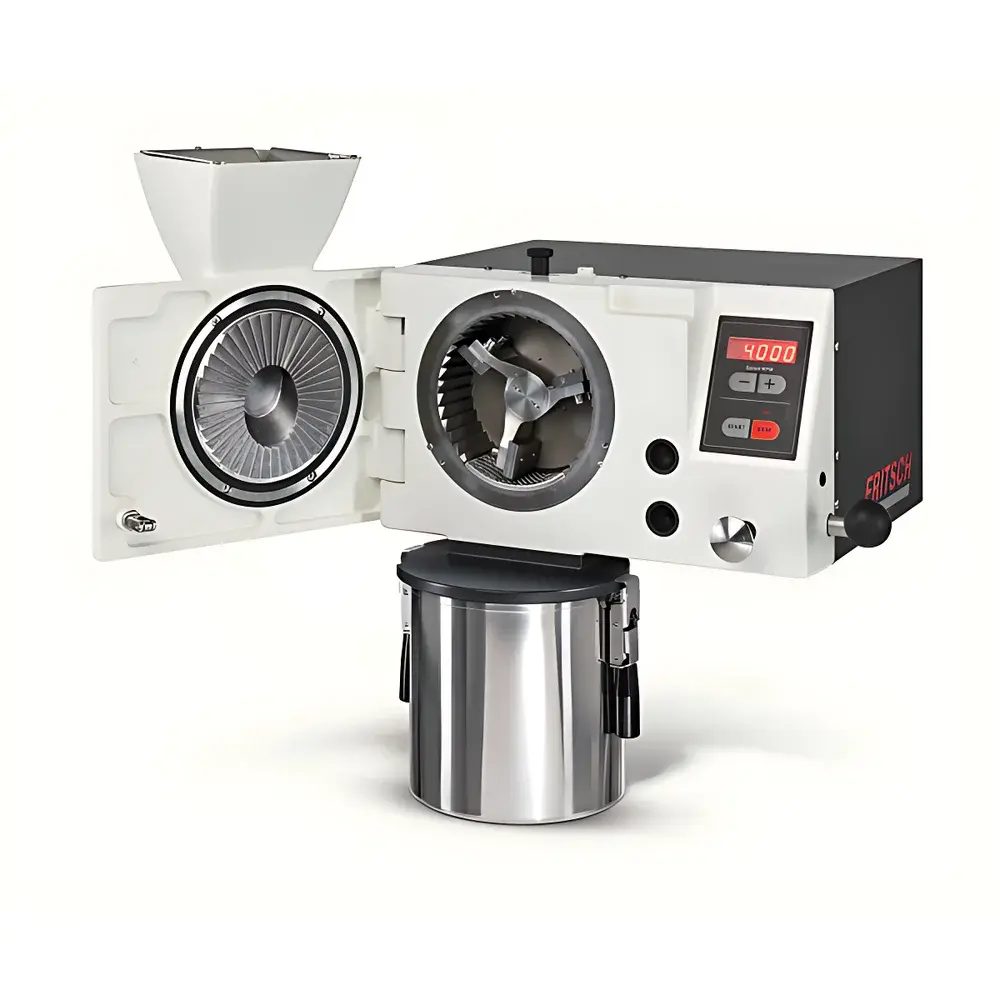
The Fritsch P-16 Cross Beater Mill is a high-performance, benchtop or floor-standing laboratory crusher engineered for reproducible pre-crushing and fine comminution of medium-hard, brittle materials. Operating on the principle of dynamic impact, friction, and shear forces generated by rapidly rotating beater arms within a precisely engineered grinding chamber, the P-16 delivers consistent particle size reduction without thermal degradation or mechanical contamination. The sample is introduced into the mill’s robust stainless-steel grinding chamber, where it undergoes repeated collisions with the high-speed cross-beater rotor and the inner chamber walls. Upon reaching the target fineness—determined by the selected sieve mesh—the ground material passes through an interchangeable perforated screen (with trapezoidal or round apertures) and is collected in a downstream container. This closed-loop, gravity-assisted discharge mechanism ensures minimal operator exposure and avoids airborne loss, making the P-16 suitable for routine QC labs, R&D facilities, and pilot-scale process development environments.
Key Features
- Stainless-steel grinding chamber and interchangeable sieves (trapezoidal or round aperture geometry) for rapid, tool-free replacement and optimal flow control;
- Adjustable rotor speed (2,000–4,000 rpm) enabling precise tuning of impact energy to match sample hardness and desired fineness;
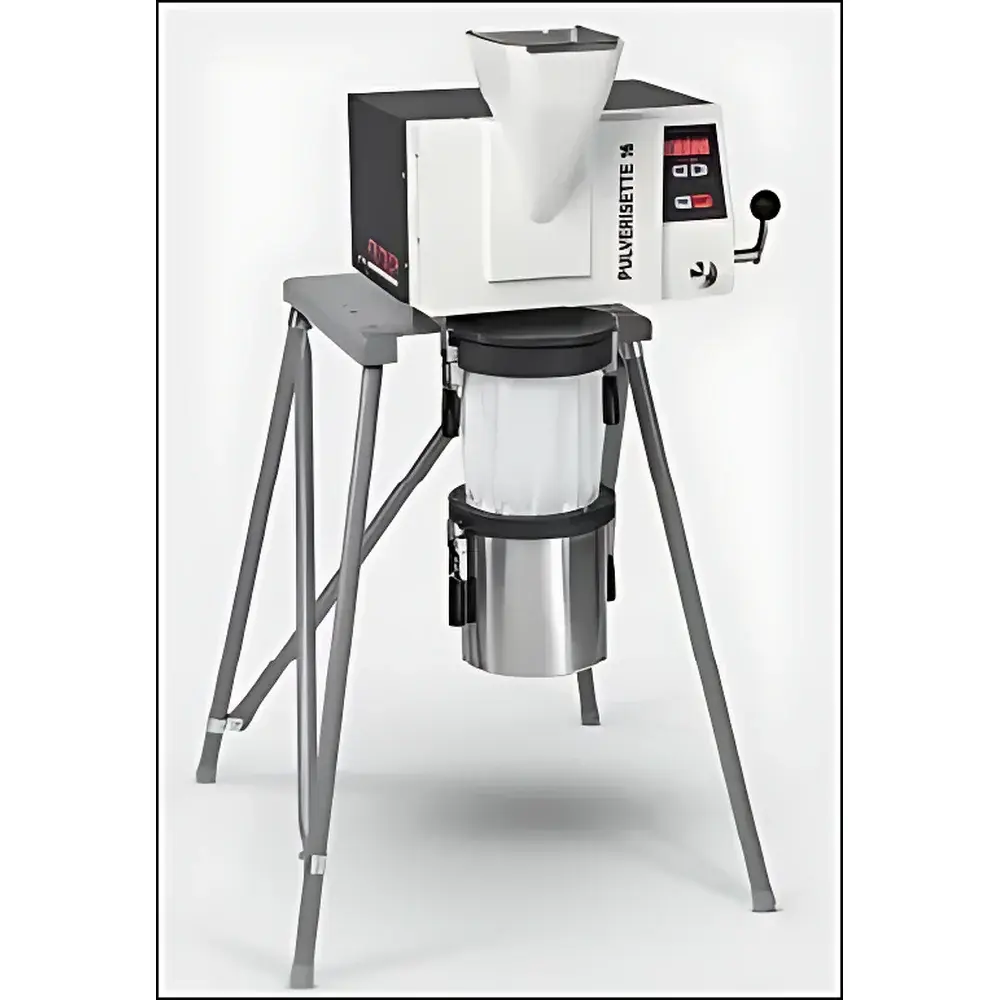
- Dual mounting options: secure fastening to laboratory benches or independent floor installation using optional support frame;
- Integrated overload protection circuitry safeguards motor and drive system during transient feed blockages or overloading;
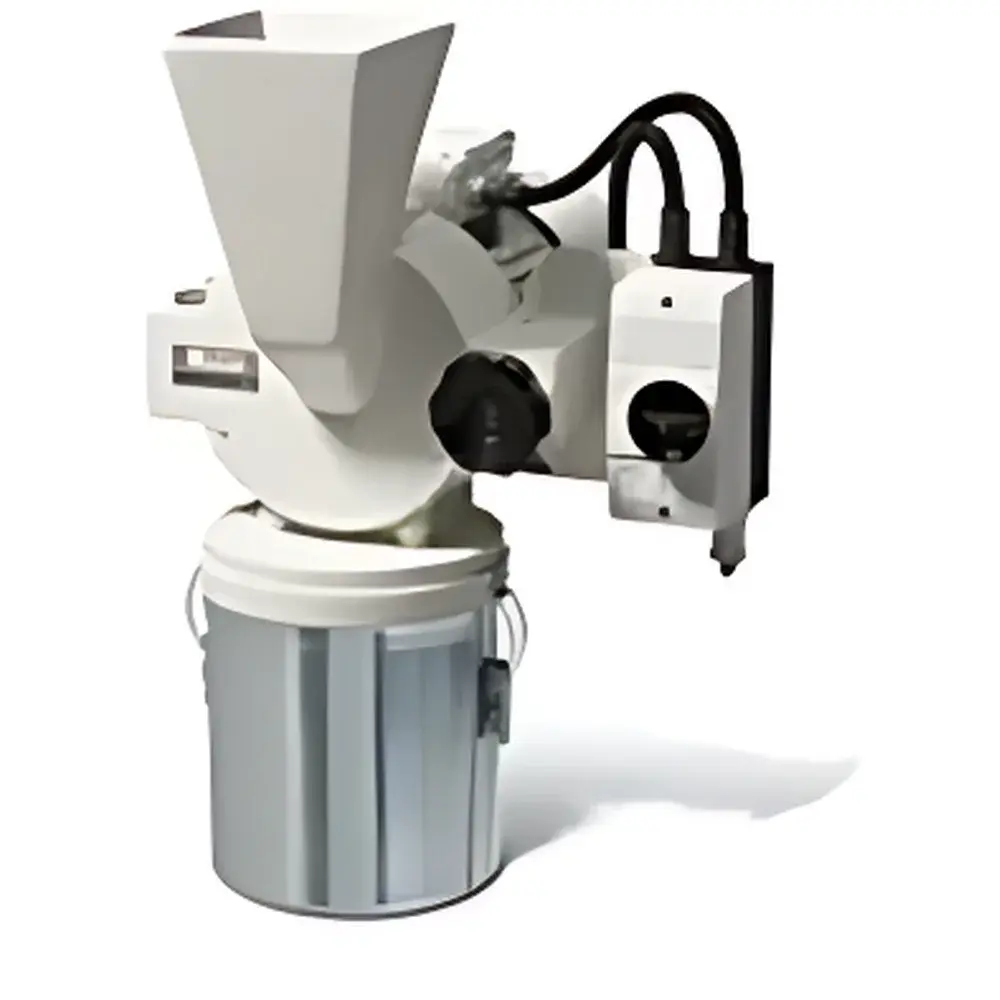
- Optional integrated air filter system prevents sieve clogging by dust-laden airflow, maintains consistent throughput, and preserves sample integrity;
- Compliant with IEC 61000-3-2 (harmonic current emissions) and IEC 61000-3-3 (voltage fluctuations), ensuring electromagnetic compatibility in shared lab infrastructure.
Sample Compatibility & Compliance
The P-16 is validated for use with brittle, non-fibrous, non-sticky materials exhibiting Mohs hardness ≤ 6—including minerals (e.g., quartz, feldspar), ceramics (alumina, zirconia), soils, agricultural feedstocks, pharmaceutical excipients, and inorganic salts. It is not recommended for elastomeric, fibrous, oily, or highly ductile samples. The instrument meets CE marking requirements under the EU Machinery Directive 2006/42/EC and the Low Voltage Directive 2014/35/EU. Its acoustic emission profile (LpA,eq = 85 dB(A)) complies with EU Directive 2003/10/EC on occupational noise exposure. For regulated environments, the P-16 supports GLP-compliant documentation workflows when paired with Fritsch’s optional digital logbook module (not included).
Software & Data Management
The P-16 operates as a standalone electromechanical unit with no embedded microprocessor or onboard software. All operational parameters—including run time, rotor speed setting, and sieve identification—are manually configured via front-panel controls. For traceability, users are advised to record settings and batch metadata in external electronic lab notebooks (ELNs) or LIMS systems. When integrated into automated sample preparation lines, the P-16’s 24 V DC auxiliary output enables synchronization with upstream feeders or downstream analyzers via dry-contact signaling. While the device itself does not generate digital audit trails, its mechanical design and deterministic performance allow full adherence to ISO/IEC 17025:2017 clause 7.7 (sampling) and ASTM D2493–22 (standard practice for sample preparation prior to particle size analysis).
Applications
- Preparation of representative sub-samples for X-ray fluorescence (XRF), X-ray diffraction (XRD), and inductively coupled plasma (ICP) analysis;
- Homogenization of geological core samples and soil aggregates prior to nutrient or heavy metal extraction;
- Fine grinding of ceramic raw materials (e.g., kaolin, talc) to achieve narrow PSD distributions required for sintering consistency;
- Reduction of pharmaceutical granules and tablet fragments for dissolution testing or content uniformity assays;
- Crushing of composite polymer fillers (e.g., calcium carbonate, silica) to verify dispersion quality in masterbatch formulations;
- Batch-wise comminution of battery cathode precursors (e.g., LiCoO2, NMC) prior to electrochemical characterization.
FAQ
What is the maximum allowable feed size for the P-16?
The P-16 accepts feed particles up to 20 mm in diameter. Oversized feed may cause jamming or uneven wear; pre-sizing via jaw crusher or mortar is recommended for heterogeneous samples.
Can the P-16 achieve sub-10 µm final particle size?
Yes—when equipped with a fine-mesh stainless-steel sieve (e.g., 10 µm aperture) and operated at 4,000 rpm with low-moisture, brittle feedstock, the P-16 routinely achieves D90 < 10 µm. Performance depends on material friability and moisture content.
Is the P-16 compliant with FDA 21 CFR Part 11?
No—the P-16 has no electronic data capture, user authentication, or audit trail functionality. It is classified as a Class I general-purpose laboratory instrument per FDA guidance. Digital compliance must be implemented externally via procedural controls and ELN integration.
How often should the sieve be replaced?
Sieve lifetime varies with abrasive load and operating hours. Under typical QC use (≤ 2 h/day), stainless-steel sieves last ≥ 6 months. Visual inspection for deformation or aperture distortion is recommended before each batch.
Does the P-16 require calibration?
No formal calibration is specified by Fritsch, as the device lacks metrological sensors. However, users must verify rotor speed accuracy annually using a certified tachometer and confirm sieve aperture dimensions via optical microscopy or certified gauge pins per ISO 3310-1:2016.



