
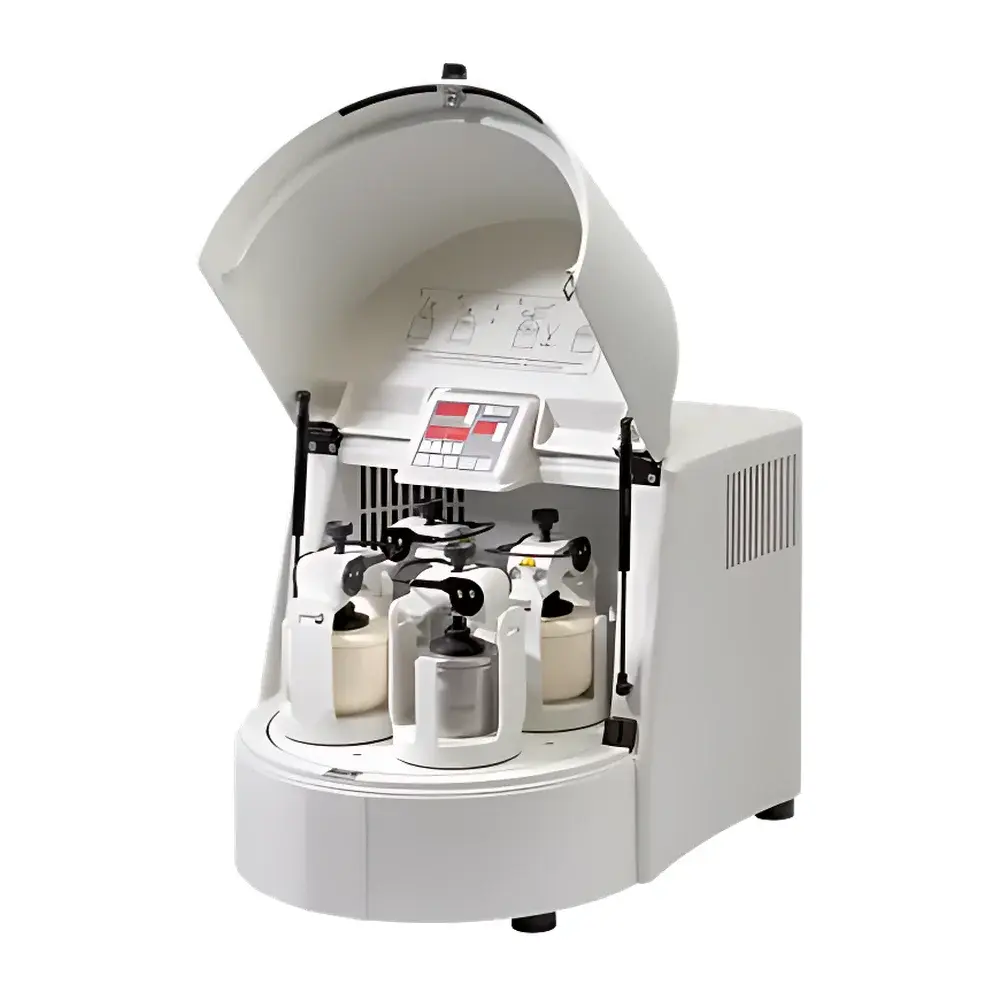
Fritsch P-5 Premium Planetary Micro Mill
| Brand | Fritsch |
|---|---|
| Origin | Germany |
| Manufacturer | Fritsch GmbH |
| Type | Planetary Ball Mill |
| Model | P-5 |
| Maximum Feed Size | < 10 mm |
| Batch Capacity | 4 × 225 mL (900 mL total) |
| Final Particle Size | < 1 µm |
| Noise Level | ~70 dB(A) (with 250 mL bowl & 10 mm balls) |
| Power Supply | 100–120 / 200–240 V, 1–phase, 50–60 Hz, 880 W |
| Net Weight | 120 kg |
| Dimensions (W×H×D) | 58 × 67 × 57 cm |
| Grinding Modes | Dry & Wet |
| Atmosphere Control | Inert gas compatibility (e.g., Ar, N₂) |
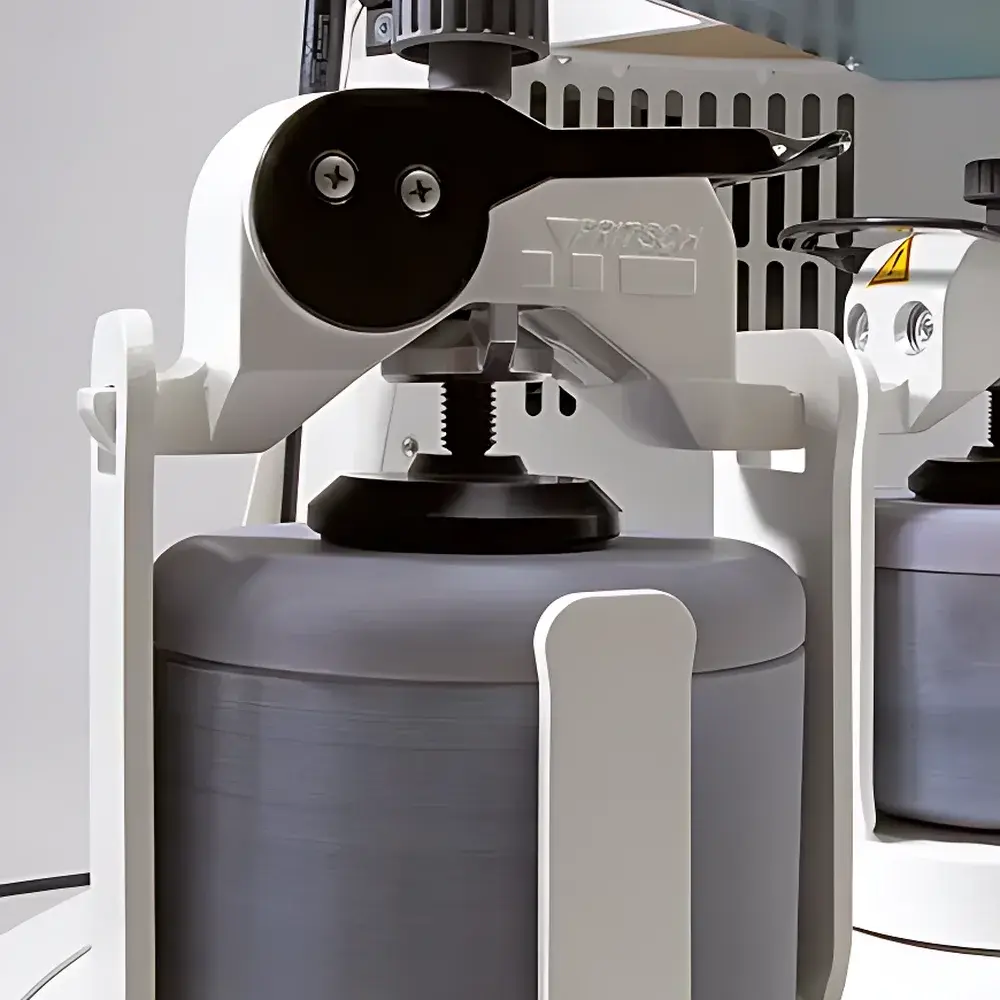
| Bowl Volumes | 80, 250, 500 mL |
| Ball Diameters | 3, 5, 10, 15, 20, 30, 40 mm |
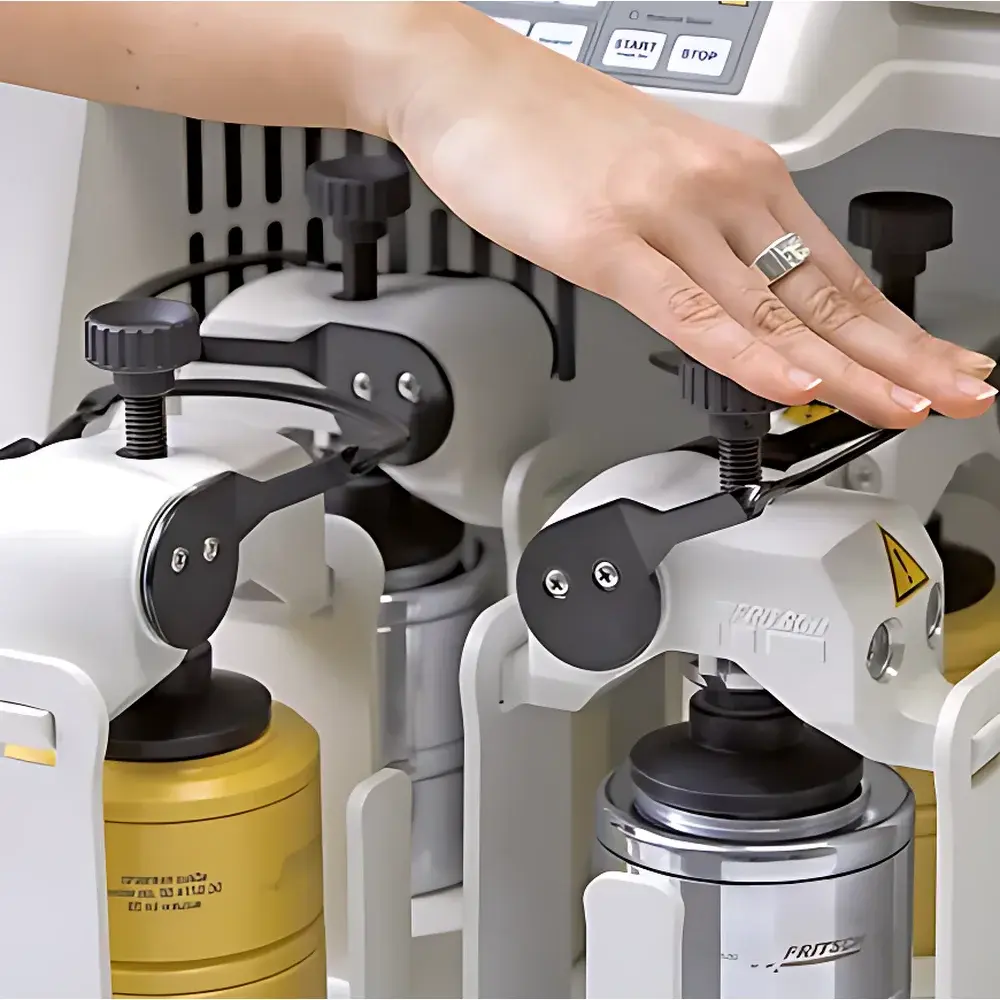
| Bowl & Ball Materials | Agate, Silicon Nitride, Alumina, Zirconia, Stainless Steel, Hardened Steel, Tungsten Carbide |
| Simultaneous Sample Processing | Up to 8 samples |
| Time Resolution | Programmable in 1-second increments for grinding/cooling cycles |
| GTM Integration | Yes (Gas Temperature & Pressure Monitoring System) |
Overview
The Fritsch P-5 Premium Planetary Micro Mill is a high-energy laboratory ball mill engineered for reproducible, contamination-controlled size reduction of hard, brittle, and fibrous materials down to the sub-micron range. Based on the planetary motion principle—where grinding bowls rotate around a central sun wheel while simultaneously revolving on their own axes—the P-5 generates intense centrifugal and Coriolis forces that accelerate grinding media to velocities exceeding 20 m/s. This kinematic design enables efficient mechanical activation, alloying, amorphization, and nanoscale particle synthesis via impact, shear, and friction mechanisms. Developed by Fritsch GmbH (Idar-Oberstein, Germany) and patented since 1962, the P-5 represents over six decades of refinement in precision milling architecture. Its robust cast-iron frame, precision-balanced drive system, and thermally stable gear train ensure long-term operational consistency under repeated high-load cycles—critical for method transfer across R&D, QC, and regulatory-compliant environments.
Key Features
- Four independent grinding stations enabling parallel processing of up to eight samples (two per bowl using dual-sample inserts), significantly improving throughput without cross-contamination.
- Programmable time control with 1-second resolution for both grinding and active cooling intervals—essential for heat-sensitive compounds, polymorphic stability studies, or exothermic mechanochemical reactions.
- Full inert-atmosphere compatibility: integrated gas purge ports support operation under argon, nitrogen, or other controlled atmospheres to prevent oxidation, hydrolysis, or pyrophoric degradation during milling.
- Seven certified grinding material options—including agate (for ultra-low trace metal contamination), zirconia (high wear resistance), tungsten carbide (for extreme hardness), and silicon nitride (non-magnetic, chemically inert)—allow rigorous selection based on sample reactivity, purity requirements, and analytical detection limits.
- Optional GTM (Gas Temperature & Pressure Monitoring) integration: the only commercially available system capable of real-time in-situ measurement of internal bowl gas temperature and pressure during operation—providing empirical data for reaction thermodynamics, phase transformation kinetics, and safety-critical process validation.
- Acoustic optimization: sound-dampened housing and vibration-isolated mounting reduce operational noise to approximately 70 dB(A) under standard conditions—meeting ISO 11201 occupational exposure guidelines for continuous lab use.
Sample Compatibility & Compliance
The P-5 accommodates diverse material classes including oxides, metals, alloys, pharmaceutical actives, geological minerals, ceramics, polymers, and biological tissues. Its versatility supports applications governed by ASTM E290, ISO 13320 (laser diffraction), USP <429> (particle size distribution), and ICH Q5A (viral clearance validation requiring defined particle fragmentation). For regulated environments, the instrument’s deterministic timing, repeatable energy input (via fixed rpm and mass ratios), and audit-ready parameter logging align with GLP and GMP principles. When paired with Fritsch’s certified reference materials and documented SOPs, the P-5 serves as a validated sample preparation tool for FDA 21 CFR Part 11–compliant workflows where electronic records and operator authentication are required.
Software & Data Management
The P-5 operates via an intuitive touchscreen interface with embedded firmware supporting up to 99 customizable methods. Each method stores rotational speed (rpm), total grinding duration, pause intervals, direction reversal sequences, and GTM-triggered event markers. Exportable CSV logs include timestamped parameters, real-time RPM feedback, thermal profiles (when GTM is active), and error codes—all traceable to operator ID and instrument serial number. Optional Fritsch LabSoft software enables remote monitoring, multi-instrument fleet management, and automated report generation compliant with ISO/IEC 17025 documentation standards. All data files adhere to FAIR principles (Findable, Accessible, Interoperable, Reusable) and integrate with LIMS platforms via standard OPC UA or REST API protocols.
Applications
- Mechanochemical synthesis of MOFs, co-crystals, and solid-state electrolytes for battery research.
- Pharmaceutical pre-formulation: polymorph screening, amorphous dispersion generation, and excipient compatibility testing per ICH Q1E.
- Geochemical sample homogenization for XRF, ICP-MS, and SEM-EDS analysis—ensuring representative sub-µm particle distribution.
- Nanomaterial production: top-down synthesis of graphene quantum dots, transition metal dichalcogenides, and catalytic nanoparticles.
- Materials science: mechanical alloying of Al-Mg, Fe-Cr-Ni systems; cold welding of immiscible metals; defect engineering in semiconductors.
- Environmental testing: extraction efficiency optimization for microplastics, soil contaminants, and airborne particulates prior to GC-MS or LC-HRMS quantification.
FAQ
What is the maximum recommended continuous operating time per cycle?
The P-5 supports uninterrupted grinding cycles up to 99 hours and 59 minutes, though optimal thermal management typically recommends ≤60 min per cycle when processing exothermic materials—cooled pauses may be inserted programmatically.
Can the P-5 be validated for GMP-regulated pharmaceutical use?
Yes—when configured with GTM, electronic signature-capable firmware, and 21 CFR Part 11–enabled LabSoft, the system meets qualification requirements for IQ/OQ/PQ protocols in drug substance manufacturing.
How does bowl material selection affect analytical recovery in trace metal analysis?
Agate and zirconia bowls minimize leaching of Fe, Cr, Ni, and Co; certified blank testing shows <0.1 ng/g background for ICP-MS-grade applications—validated per ISO 17025 accredited methods.
Is maintenance documentation available in English with metrological traceability?
All service manuals, calibration certificates (NIST-traceable torque and time calibration), and preventive maintenance schedules are provided in English and comply with ISO 9001:2015 quality management system requirements.
Does Fritsch offer application-specific method development support?
Yes—Fritsch Application Laboratories (Idar-Oberstein and Shanghai) provide remote and on-site method optimization, including ball-to-powder ratio studies, kinetic energy mapping, and contamination profiling reports.



