
FRITSCH P-19 Large High-Torque Cutting Grinder
| Brand | FRITSCH |
|---|---|
| Origin | Germany |
| Manufacturer | FRITSCH GmbH |
| Product Type | Cutting Grinder |
| Model | P-19 Large |
| Sample Type | Dry, soft to medium-hard, fibrous materials |
| Max. Feed Size | 120 × 85 mm |
| Throughput Capacity | 85 L/h |
| Final Particle Size | < 1 mm (typical), adjustable down to ~0.5 mm with optional sieve inserts |
| Rotor Speed | 300–360 rpm |
| Motor Power | 2.2 kW |
| Net Weight | 75 kg |
| Gross Weight | 105 kg |
| Dimensions (W×D×H) | 45 × 65 × 63 cm |
| Cutting Gap | Adjustable externally |
| Compliance | CE, ISO 9001, GLP-supporting design |
Overview
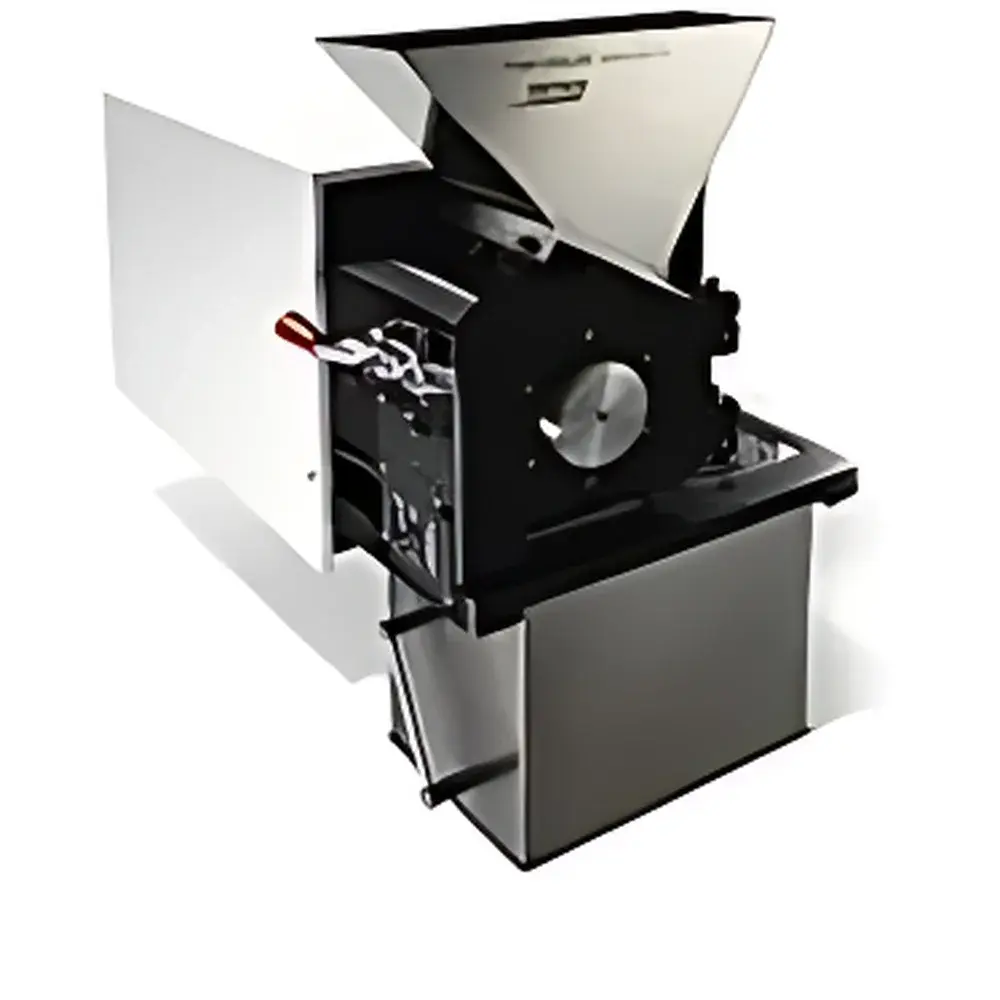
The FRITSCH P-19 Large is a high-torque, industrial-grade cutting grinder engineered for reproducible size reduction of dry, fibrous, and moderately hard bulk materials in laboratory and pilot-scale environments. Unlike impact or disc-based mills, the P-19 Large employs a precision-engineered rotating cutting rotor system operating on the principle of controlled shear and compression between sharp, geometrically optimized blades and a stationary perforated sieve plate. This mechanism enables efficient comminution without excessive heat generation or sample degradation—critical for thermolabile or structurally sensitive matrices such as herbs, pharmaceutical tablets, leather, textiles, biomass, and composite waste streams. Designed and manufactured in Idar-Oberstein, Germany, the instrument reflects FRITSCH’s decades-long expertise in mechanical sample preparation, adhering to stringent European engineering standards and robust build quality expected from premium laboratory instrumentation.
Key Features
- High-torque gearmotor (2.2 kW) delivering consistent rotational force across the full speed range (300–360 rpm), ensuring stable throughput even with heterogeneous or dense feedstock.
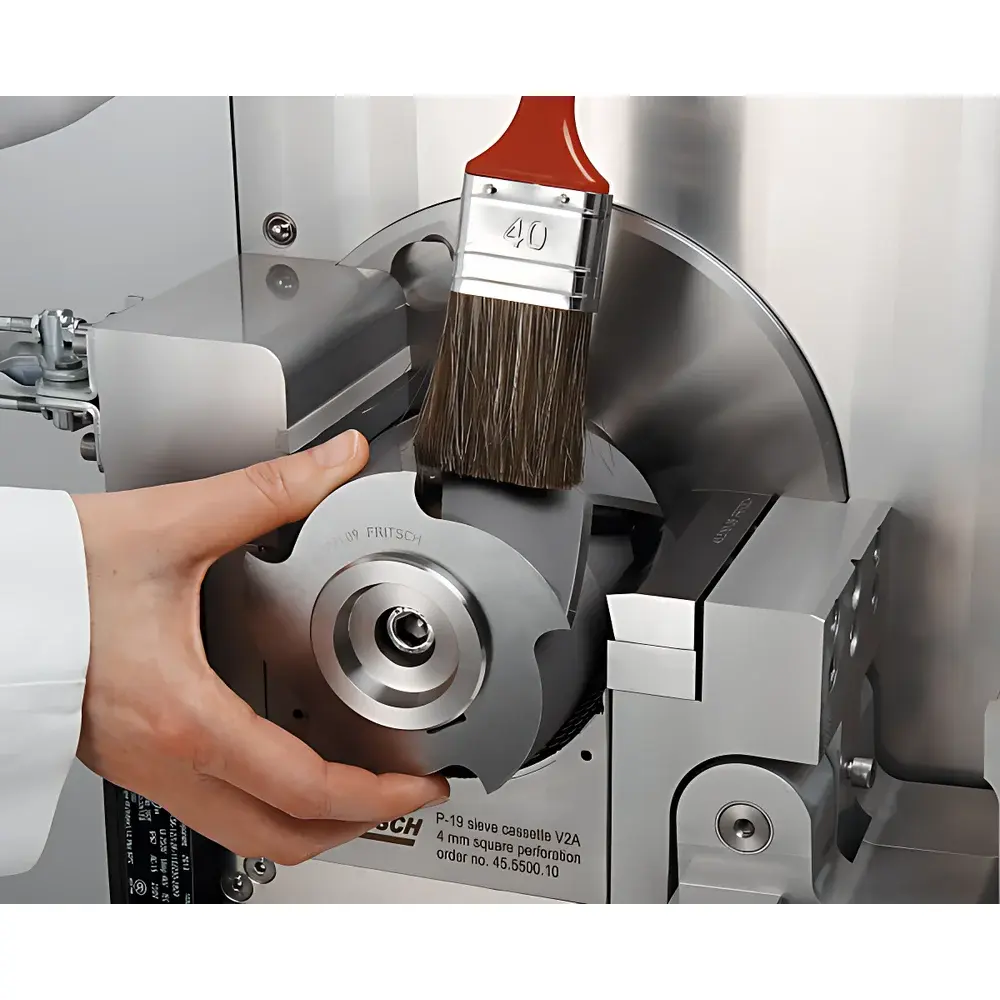
- Modular rotor system with interchangeable cutting geometries—flat, serrated, and staggered blade configurations—to match material rheology and desired particle distribution.
- Externally adjustable cutting gap allows real-time optimization of particle size output without disassembly, supporting method development and process validation.
- Tool-free access to both rotor assembly and sieve plate facilitates rapid changeover between analytical batches or cleaning protocols—reducing cross-contamination risk and downtime.
- Integrated dust extraction port compatible with standard lab vacuum systems; continuous airflow maintains sample temperature below critical thresholds during extended operation.
- All wetted components—including blades and sieve inserts—are fabricated from chromium-free stainless steel alloys, eliminating heavy-metal leaching risks essential for food, feed, pharmaceutical, and environmental testing applications.
- Compact footprint (45 × 65 × 63 cm) and self-contained design enable seamless integration into regulated laboratory workflows compliant with ISO/IEC 17025 and GLP requirements.
Sample Compatibility & Compliance
The P-19 Large accommodates a broad spectrum of non-liquid, low-moisture samples ranging from elastic polymers (rubber, leather, plastics) to lignocellulosic biomass (wood chips, straw, cork), agricultural commodities (grains, malt, corn), animal-derived solids (bone, dried meat, horns), and pharmaceutical dosage forms (tablets, capsules). Its maximum feed dimension (120 × 85 mm) permits whole-length processing of elongated specimens—such as rods, stems, or strips—without pre-cutting. Final particle size is governed by sieve aperture selection and operational parameters, routinely achieving ≤1 mm median diameter under standardized conditions. The system meets CE marking requirements and conforms to ISO 9001 manufacturing controls. While not intrinsically 21 CFR Part 11-compliant (as it lacks embedded software audit trails), its mechanical design supports traceable, documented grinding protocols aligned with GMP/GLP documentation practices.
Software & Data Management
The P-19 Large operates as a stand-alone electromechanical device with no integrated digital interface or firmware. All operational parameters—including rotor speed, runtime, and sieve configuration—are set manually and recorded externally via laboratory notebooks or electronic lab notebooks (ELNs). For regulatory traceability, users are advised to document batch-specific settings, maintenance logs, and calibration checks per internal SOPs. Optional external timers or programmable power controllers may be deployed to enforce repeatable run durations. FRITSCH provides comprehensive technical documentation—including dimensional drawings, spare parts catalogs, and maintenance schedules—in English and German, supporting audit readiness and long-term serviceability.
Applications
- Preparation of representative subsamples for elemental analysis (e.g., ICP-OES, XRF) of heterogeneous waste streams, coal, or metallurgical scrap.
- Homogenization of botanical materials prior to extraction or HPLC analysis in phytochemical and nutraceutical QA/QC.
- Size reduction of pharmaceutical tablets and excipient blends for dissolution testing and content uniformity studies.
- Routine grinding of feedstuffs and pet food ingredients for proximate analysis (crude protein, fiber, ash) per AOAC and AACC methods.
- Processing of forensic or archaeological specimens—including bone, horn, and plant remains—where structural integrity must be preserved during comminution.
- Feed preparation for subsequent milling steps (e.g., planetary ball milling or cryogenic grinding) where coarse pre-grinding improves downstream efficiency.
FAQ
What types of materials are unsuitable for the P-19 Large?
Materials with high moisture content (>15% w/w), sticky or adhesive properties (e.g., fresh fruit pulp, gum resins), or extreme hardness (e.g., sintered ceramics, tungsten carbide) are not recommended. The unit is designed exclusively for dry, free-flowing, or fibrous solids.
Can the P-19 Large be used for regulatory submissions requiring data integrity?
While the instrument itself does not generate electronic records, its mechanical repeatability, documented SOPs, and chromium-free construction make it suitable for GLP-compliant workflows when paired with rigorous manual documentation and audit-trail practices.
Is routine maintenance required beyond cleaning?
Yes. FRITSCH recommends biannual inspection of blade wear, bearing lubrication status, and electrical safety certification—particularly after 500 hours of cumulative operation or per institutional equipment management policies.
How does the P-19 Large compare to jaw crushers or disc mills for coarse grinding?
Unlike jaw crushers that rely on compressive fracture, or disc mills that induce abrasive attrition, the P-19 Large achieves size reduction through controlled shearing—yielding narrower particle distributions and lower fines generation, especially for anisotropic or fibrous substrates.
Are replacement sieves and rotors available for immediate shipment?
Standard sieve plates (0.5–10 mm apertures) and rotor assemblies are stocked globally by FRITSCH authorized distributors; lead time for custom geometries is typically 4–6 weeks from order confirmation.



