
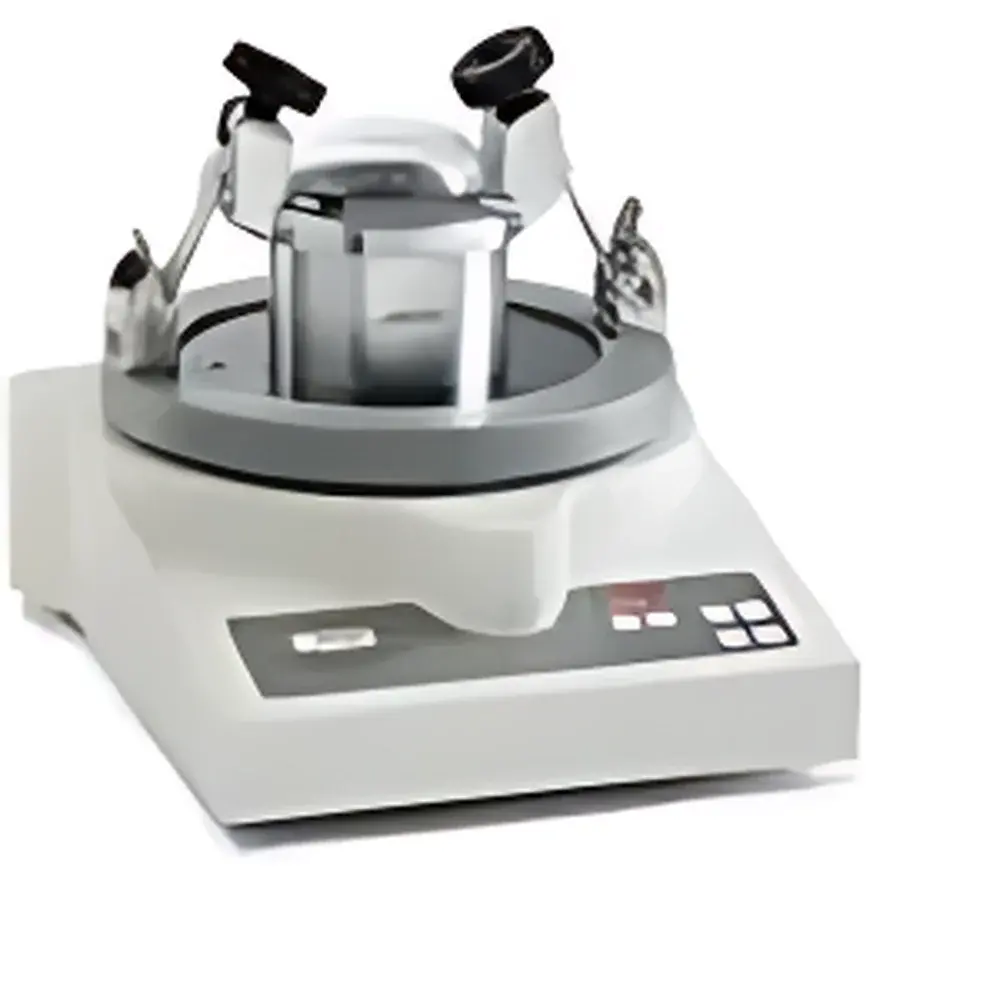
Fritsch P-0 Micro Vibratory Mill
| Brand | Fritsch |
|---|---|
| Origin | Germany |
| Manufacturer | FRITSCH GmbH |
| Model | P-0 |
| Instrument Type | Vibratory Micro Mill |
| Sample Compatibility | Cryogenic & Ambient-Temperature Samples |
| Max. Feed Size | 5 mm |
| Batch Volume | 0.1–10 mL |
| Final Particle Size | 5–10 µm |
| Power Supply | 100–240 V, 1~ , 50–60 Hz, 50 W |
| Net Weight | 21 kg |
| Dimensions (L×W×H) | 37 × 40 × 20 cm |
| Grinding Mode | Dry or Wet |
| Observation Window | Yes |
| Digital Timer | Yes |
| Amplitude Control | Adjustable |
Overview
The Fritsch P-0 Micro Vibratory Mill is a precision-engineered laboratory instrument designed for reproducible, high-efficiency size reduction of small-volume samples under controlled conditions. Operating on the principle of high-frequency vibrational energy transfer, the P-0 subjects samples to intense impact and shear forces generated by oscillating grinding balls within a sealed, temperature-stable chamber. Unlike rotary or planetary ball mills, the P-0 employs a vertically oriented, resonant vibration mechanism—optimized for minimal heat generation and maximal mechanical energy transfer per unit volume. This makes it especially suitable for thermally sensitive, brittle, or heterogeneous materials common in RoHS-compliant electronics analysis (e.g., PCB substrates, lithium-ion battery electrodes, polymer encapsulants, and mixed-metal alloys). Its compact footprint and low power consumption (50 W) align with modern lab sustainability and space optimization requirements, while its CE-marked design complies with EU Machinery Directive 2006/42/EC and RoHS 2011/65/EU conformity standards.
Key Features
- Adjustable amplitude control enables precise tuning of vibrational intensity to match sample hardness, brittleness, and desired final particle distribution.
- Integrated digital timer with ±0.1 s resolution ensures repeatable processing durations across analytical batches—critical for method validation and inter-laboratory comparability.
- Optical observation window allows real-time monitoring of grinding dynamics without interrupting operation or compromising containment integrity.
- Modular chamber design supports rapid conversion between dry grinding, wet dispersion, and cryogenic milling configurations using standardized accessories (e.g., liquid nitrogen cooling adapters, solvent-resistant liners).
- Low-mass grinding chamber (stainless steel or tungsten carbide options) minimizes cross-contamination and facilitates complete sample recovery—essential for trace-level elemental or organic analysis.
- Robust cast-aluminum housing with vibration-damping feet ensures operational stability and acoustic attenuation in shared laboratory environments.
Sample Compatibility & Compliance
The P-0 accommodates diverse sample matrices including printed circuit boards (PCBs), cathode/anode foils, polymer housings, solder alloys, ceramic capacitors, and composite laminates—common targets in regulatory compliance testing per EU Directive 2011/65/EU (RoHS) and IEC 62321-7-2:2017 (determination of Cd, Pb, Hg, Cr(VI), Br). It supports both ambient and cryogenic grinding down to –196 °C via optional LN₂-cooled sample holders, preserving volatile organics and preventing thermal degradation of halogenated flame retardants. All wet-grinding protocols are compatible with common solvents (e.g., ethanol, acetone, isopropanol) and aqueous surfactant dispersions. The system meets ISO/IEC 17025:2017 requirements for equipment qualification when operated within documented SOPs, and its closed-chamber architecture supports GLP-aligned sample integrity protocols.
Software & Data Management
While the P-0 operates as a standalone benchtop unit with analog/digital controls, its operational parameters—including time, amplitude setting, and cycle count—are fully documentable within laboratory information management systems (LIMS) via manual entry or integration with external data loggers. For regulated environments, users may implement audit-trail-capable electronic notebooks (e.g., LabArchives, Benchling) to record instrument settings, batch IDs, and post-grinding sieve analysis results. Though no proprietary software is bundled, Fritsch provides comprehensive calibration certificates, maintenance logs, and IQ/OQ documentation templates compliant with FDA 21 CFR Part 11 expectations for metadata traceability.
Applications
- XRF and SEM-EDS sample preparation for homogeneous pellet formation from heterogeneous electronic waste fractions.
- Pre-analytical homogenization prior to ICP-MS or AAS quantification of restricted substances (e.g., Cd < 100 ppm, Pb < 1000 ppm).
- Particle size reduction for FTIR spectral library matching of polymer blends and flame-retardant additives.
- Microbial cell lysis and DNA extraction support in environmental RoHS surveillance studies involving contaminated soil or dust filters.
- Mineralogical phase isolation for XRD analysis of solder joint intermetallic compounds (e.g., Cu₆Sn₅, Ni₃Sn₄).
- Routine QC grinding of reference materials (e.g., NIST SRM 2783, “Trace Elements in Air Particulate Matter”) to verify analytical method performance.
FAQ
Can the P-0 achieve sub-10 µm particle sizes consistently?
Yes—under optimized conditions (e.g., stainless-steel vial, 3-mm ZrO₂ balls, 2-min duration at 90% amplitude), the P-0 routinely delivers D₉₀ ≤ 8 µm for brittle polymers and metals, verified by laser diffraction (ISO 13320) or SEM image analysis.
Is cryogenic grinding validated for halogen analysis (Br, Cl)?
Yes—Fritsch’s LN₂-compatible accessory kit has been used in accredited labs to prepare samples for IC-MS and pyrolysis-GC/MS per IEC 62321-8:2021, minimizing thermal dehalogenation artifacts.
What maintenance intervals are recommended?
Vibration isolators and sealing gaskets should be inspected quarterly; grinding vials require visual inspection for microcracks before each use; full mechanical service is recommended every 2,000 operating hours or biannually, whichever occurs first.
Does the P-0 support GMP documentation workflows?
Yes—its deterministic, parameter-driven operation enables straightforward inclusion in equipment qualification (IQ/OQ/PQ) packages, and all physical settings are manually recordable in compliant electronic lab notebooks with timestamped user authentication.



