
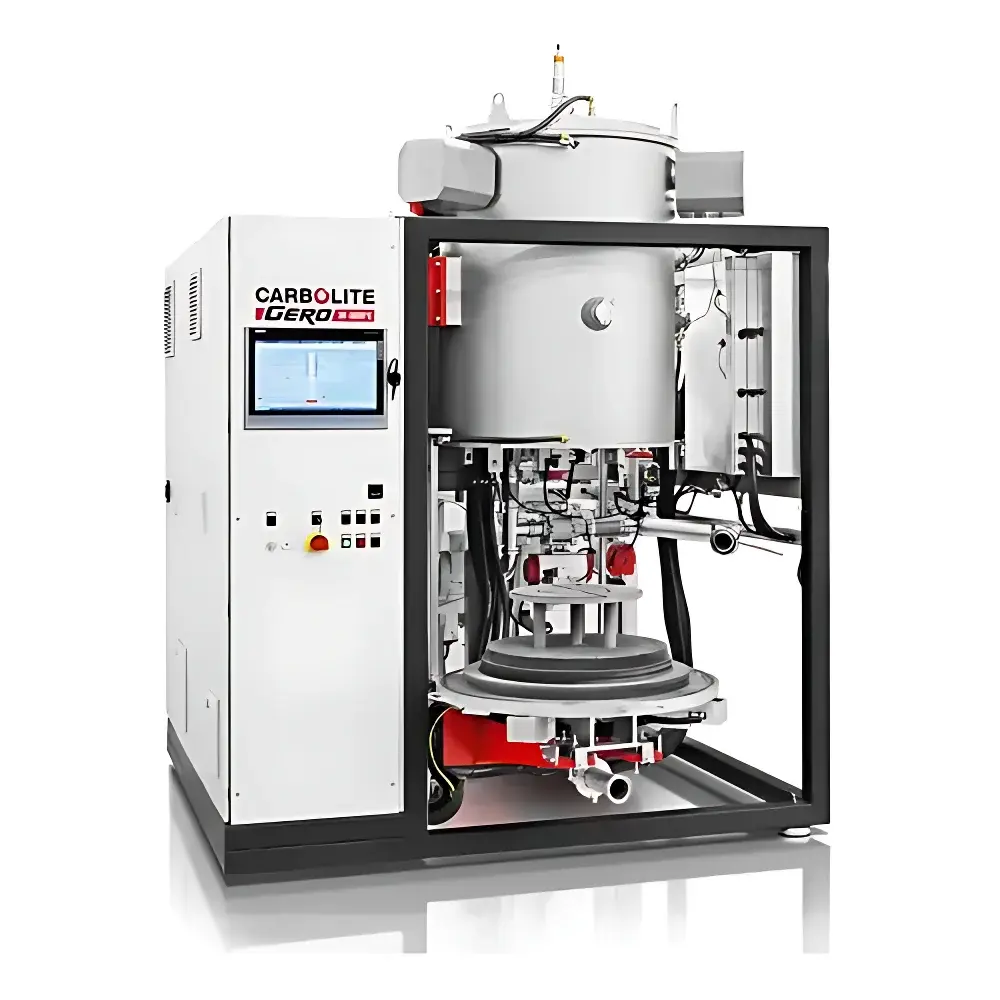
Carbolite Gero HTBL GR Graphite Bottom-Loading High-Temperature Furnace
| Brand | Carbolite Gero |
|---|---|
| Origin | Germany |
| Model | HTBL GR |
| Type | Bottom-Loading Tube Furnace |
| Max Temperature | 3000°C |
| Heating Element | Graphite |
| Insulation | Graphite Fiber with Water-Cooled Jacket |
| Atmosphere Options | N₂, Ar, H₂ (single or mixed), 10–1000 mbar overpressure |
| Vacuum Capability | Yes, with integrated vacuum pump |
| Sample Loading | Fully automated vertical furnace descent + 90° manual horizontal base extension |
| Compliance | Designed for ISO/IEC 17025-compliant thermal processing environments |
| Optional Accessories | IR pyrometer, retractable thermocouples, custom atmosphere chambers, hydrogen partial pressure control module |
Overview
The Carbolite Gero HTBL GR is a high-precision, bottom-loading graphite tube furnace engineered for ultra-high-temperature thermal processing under controlled inert or reducing atmospheres. Operating up to 3000°C, it employs a vertically actuated graphite heating chamber that descends automatically to expose the full sample zone—enabling unrestricted multi-directional loading of large, irregular, or delicate components. Unlike conventional top- or front-loading furnaces, the HTBL GR eliminates mechanical constraints on sample geometry, weight, or orientation. Its core architecture integrates a cylindrical graphite heating element array embedded in high-purity graphite fiber insulation, surrounded by a continuously water-cooled outer jacket to ensure structural integrity and thermal containment. Temperature uniformity across the hot zone is maintained via distributed power zoning and real-time feedback from optional embedded thermocouples or non-contact infrared pyrometry. The system is designed for repeatable, traceable operation in R&D laboratories and pilot-scale production settings where process reproducibility, atmospheric purity, and thermal stability are critical—particularly in advanced ceramics, powder metallurgy, and semiconductor precursor synthesis.
Key Features
- Fully automated vertical furnace descent mechanism with hydraulic actuation, enabling precise positioning of the hot zone at operator-accessible height
- Manual 90° horizontal extension of the base after full descent—facilitating safe, ergonomic placement and retrieval of heavy or oversized samples
- Graphite heating elements arranged circumferentially along the cylindrical wall, delivering symmetrical radiant heat distribution up to 3000°C
- Multi-layer insulation system: high-density graphite fiber core + water-cooled stainless-steel jacket + external thermal shielding
- Integrated gas manifold supporting N₂, Ar, and H₂ (individually or blended), with programmable overpressure control (10–1000 mbar) via mass flow controllers
- Vacuum compatibility down to 10⁻³ mbar using an integrated oil-free scroll pump; vacuum ramping and hold profiles fully programmable
- Dual temperature monitoring capability: fixed-position thermocouples (Type C or B) plus optional calibrated IR pyrometer for non-invasive surface measurement
- Overtemperature protection circuitry with independent hardware cutoff (≥3100°C threshold) and software-based thermal runaway detection
Sample Compatibility & Compliance
The HTBL GR accommodates sample volumes of 50 L, 80 L, or 200 L, making it suitable for both single-component validation and batch-scale processing. Samples may be mounted directly on graphite fixtures, placed in crucibles (graphite, SiC, or refractory metal), or inserted into custom-designed atmosphere chambers—available upon request. Due to the graphite construction, direct contact between carbon-sensitive materials (e.g., certain oxides, silicon wafers, or oxygen-stoichiometric ceramics) and the furnace interior is not recommended; alternative metallic hot-zone configurations can be specified. The system meets mechanical and electrical safety requirements per IEC 61000-6-4 (EMC) and IEC 61000-6-2 (immunity), and its control architecture supports audit-ready data logging compliant with ISO/IEC 17025, FDA 21 CFR Part 11 (when paired with validated software), and GLP/GMP documentation workflows.
Software & Data Management
Operation is managed via Carbolite Gero’s proprietary TCU (Thermal Control Unit) software, offering multi-segment ramp-soak profiles, real-time graphing of temperature, pressure, and gas flow, and synchronized event tagging (e.g., “furnace descent complete”, “vacuum achieved”). All process parameters—including setpoints, actual readings, alarms, and operator actions—are timestamped and stored in encrypted CSV or SQLite format. Exported logs include digital signatures for integrity verification and support third-party LIMS integration via OPC UA or Modbus TCP. Optional firmware upgrades enable remote diagnostics, predictive maintenance alerts (based on heater resistance drift), and calibration certificate traceability linked to national metrology institutes (e.g., PTB, NIST).
Applications
- Sintering of ultra-refractory ceramics (ZrB₂, TaC, HfC) and CMCs (ceramic matrix composites)
- Thermal treatment of MIM (metal injection molding) and CIM (ceramic injection molding) green parts—debinding, brown-phase sintering, and final densification
- High-temperature annealing of semiconductor substrates and epitaxial layers
- Carburization, nitridation, and silicidation of transition metals and alloys
- Pyrolysis of polymer-derived ceramics and preceramic polymers
- Hydrogen-reduction of metal oxides (e.g., WO₃ → W, NiO → Ni) under controlled p(H₂)
- Thermal shock testing and rapid thermal processing (RTP) protocols requiring precise dwell-time control at >2500°C
- Atmospheric-controlled graphitization of carbon fibers and precursors
FAQ
Can the HTBL GR operate in air or oxidizing atmospheres?
No. Graphite components degrade rapidly above 600°C in oxygen-containing environments. Only inert (N₂, Ar) or reducing (H₂, forming gas) atmospheres are permitted.
Is vacuum pumping integrated or external?
A dedicated oil-free scroll vacuum pump is factory-integrated and plumbed directly to the furnace chamber; no external pump connection is required.
What is the standard temperature uniformity specification across the hot zone?
At 2500°C, radial uniformity is ±15°C over a 100 mm length; axial uniformity is ±25°C over the same length—measured per ASTM E220 calibration practice.
Can the system be validated for GMP manufacturing use?
Yes. IQ/OQ documentation packages, sensor calibration certificates (traceable to NIST), and 21 CFR Part 11-compliant software modules are available as configurable options.
Are custom furnace dimensions or hot-zone geometries supported?
Yes. Carbolite Gero offers engineering consultation and mechanical redesign services for non-standard sample configurations, including elliptical chambers, dual-zone gradients, and hybrid graphite/molybdenum hot zones.
Related Products



