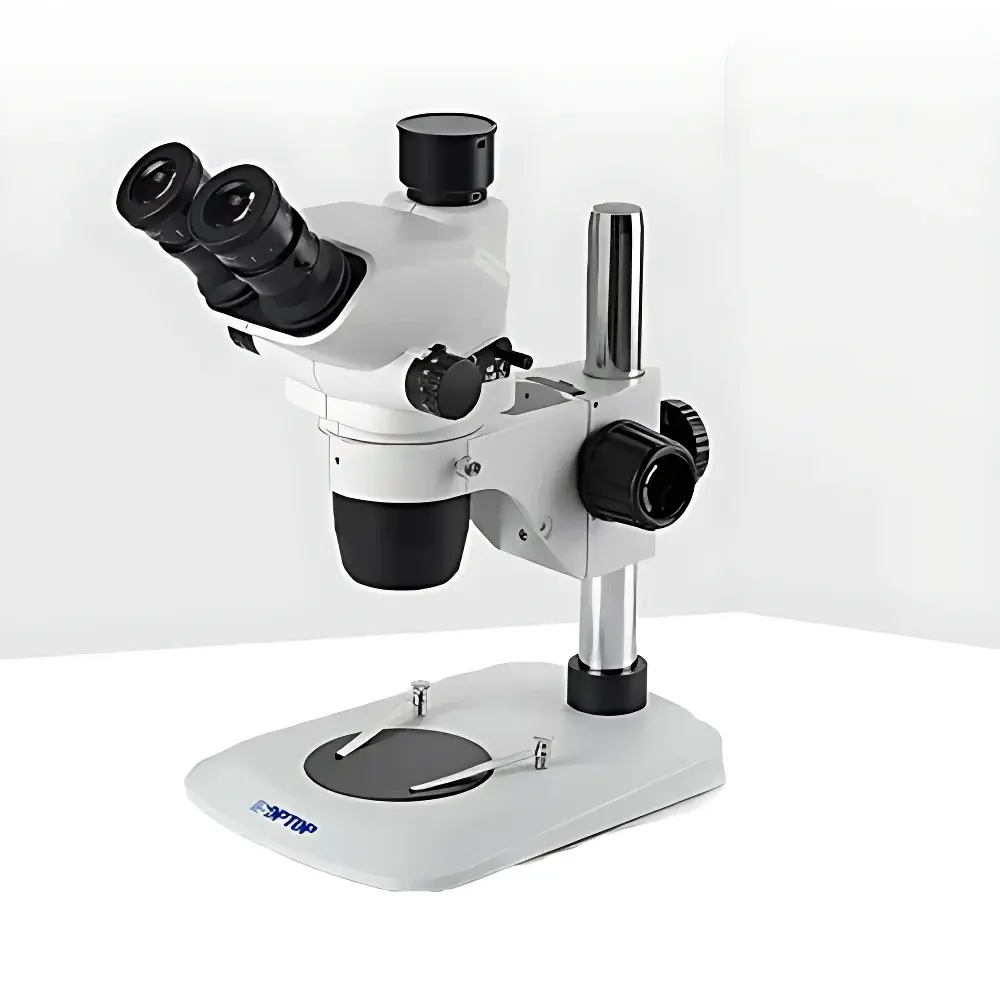
SZN71 Continuous Zoom Stereo Microscope by Jihepu

| Brand | Jihepu |
|---|---|
| Origin | Shandong, China |
| Model | SZN71 |
| Total Magnification Range | 8×–35× |
| Zoom Ratio | 0.67×–4.5× |
| Field Diameter | 7 mm |
| Working Distance | 110 mm |
| Objective Type | Continuous Zoom Objective |
| Illumination | LED |
| Depth of Field | 92 mm |
| Numerical Aperture Equivalent | 0.052–0.076 (calculated per standard stereo microscope conventions) |
| Eyepiece Options | PL10×/22 mm, PL15×/16 mm, PL20×/12.5 mm (all high-eye-point, wide-field, adjustable diopter) |
| Interpupillary Adjustment Range | 52–76 mm |
| Viewing Angle | 45° inclined binocular/trocar head |
| Optional auxiliary objectives | 0.5× (WD 177 mm), 0.7× (WD 116 mm), 1.5× (WD 47 mm) |
| Stand Types | Integrated vertical-arm stand or modular column stand compatible with universal base platforms |
| Camera Adapters | 0.35×, 0.5×, 0.65×, 1× C-mount couplers |
| Optional accessories | Precision measurement stage, gemstone clamps, illuminated base plate |
Ask about pricing, availability and specifications.
Overview
The SZN71 Continuous Zoom Stereo Microscope is an industrial-grade, ergonomically engineered optical instrument designed for high-fidelity three-dimensional observation across quality control, electronics assembly, precision manufacturing, gemology, and academic research environments. Based on the Greenough optical architecture—featuring dual, laterally separated objective paths—the SZN71 delivers natural stereoscopic depth perception and minimal parallax error. Its continuously variable zoom system (0.67×–4.5×) enables seamless magnification transitions without mechanical repositioning, while the integrated detent mechanism provides precise, repeatable magnification locking at user-defined settings—critical for comparative analysis, documentation consistency, and ISO/IEC 17025-compliant inspection workflows. With a fixed 45° inclined viewing head, adjustable interpupillary distance (52–76 mm), and high-eye-point wide-field eyepieces (PL10×/22 mm, PL15×/16 mm, PL20×/12.5 mm), the system accommodates extended operator use under GLP-aligned ergonomic standards.
Key Features
- Continuous zoom optics with calibrated detent positions for repeatable magnification recall—ensuring traceable, reproducible imaging across shifts or operators
- 110 mm working distance maintained across full zoom range—facilitating hands-on manipulation, soldering, micro-assembly, and non-contact measurement
- LED illumination system with uniform, cool-white output (5000–5700 K), flicker-free operation, and >50,000-hour lifetime—compliant with IEC 62471 photobiological safety requirements
- Depth of field up to 92 mm at lowest magnification—ideal for layered sample assessment and topographic evaluation of irregular surfaces
- Modular stand architecture: choice of integrated vertical-arm frame or detachable column mount—enabling rapid reconfiguration for benchtop, boom-arm, or custom metrology integration
- C-mount compatible camera adapters (0.35×, 0.5×, 0.65×, 1×) support standardized digital imaging pipelines compliant with ASTM E2821 and ISO 10934-1 for quantitative image-based metrology
Sample Compatibility & Compliance
The SZN71 supports diverse specimen geometries—from PCBs and semiconductor wafers to biological tissue sections, mineral specimens, and jewelry components—without requiring vacuum or conductive coating. Its large field diameter (7 mm at 1× objective setting) and extended depth of field enable simultaneous visualization of surface features and subsurface structures. The microscope conforms to EN 61000-6-3 (EMC emissions) and EN 61000-6-2 (immunity) standards. Optional accessories—including precision translation stages with 0.01 mm vernier scales and gemstone-specific clamping fixtures—extend capability into ISO 11251 (gem identification) and ASTM F2636 (microelectronic component inspection) applications. All optical components utilize multi-layer anti-reflective coatings meeting MIL-C-48497A specifications.
Software & Data Management
While the SZN71 operates as a standalone optical platform, its C-mount interface enables integration with third-party imaging software suites supporting FDA 21 CFR Part 11 audit trail functionality (e.g., Stream Motion, Olympus cellSens, or Tucsen ToupView). Image metadata—including magnification, exposure time, timestamp, and objective ID—is embedded in TIFF/OME-TIFF exports. When paired with calibrated stage encoders or motorized zoom controllers (available as OEM add-ons), the system supports automated focus stacking, stitching, and dimensional annotation workflows aligned with ISO/IEC 17025 documentation requirements.
Applications
- Electronics manufacturing: solder joint inspection, BGA rework verification, flex circuit defect mapping
- Jewelry and gemology: inclusion characterization, facet symmetry assessment, laser inscription verification per GIA protocols
- Materials science: corrosion morphology analysis, coating thickness estimation, fracture surface topography
- Life sciences: dissection guidance, histological slide screening, arthropod morphology studies
- Forensic document examination: ink differentiation, paper fiber analysis, indented writing recovery
- Quality assurance labs: incoming component inspection, post-process verification, failure root cause analysis
FAQ
Does the SZN71 support motorized zoom or focus?
The base model features manual zoom and coarse/fine focus controls; motorized zoom and Z-axis drive modules are available as optional OEM upgrades.
What is the maximum resolution achievable with this microscope?
Resolution is governed by the Rayleigh criterion and effective NA; at 35× total magnification, theoretical lateral resolution is approximately 2.8 µm under optimal LED illumination and using the PL10×/22 mm eyepiece.
Can the SZN71 be integrated into automated production lines?
Yes—via programmable LED intensity control, TTL-triggered camera capture, and RS-232/USB interfaces (optional), enabling synchronization with PLC-controlled conveyors or robotic handlers.
Is calibration certification available?
Factory calibration certificates (traceable to NIST standards) and ISO/IEC 17025-accredited calibration services are offered through authorized service centers.
What maintenance is required for long-term optical performance?
Annual cleaning of optical surfaces using Class 100 cleanroom-grade lens tissue and reagent-grade isopropanol; biannual verification of zoom linearity and interpupillary alignment per manufacturer’s technical bulletin TB-SZN71-Rev.D.