
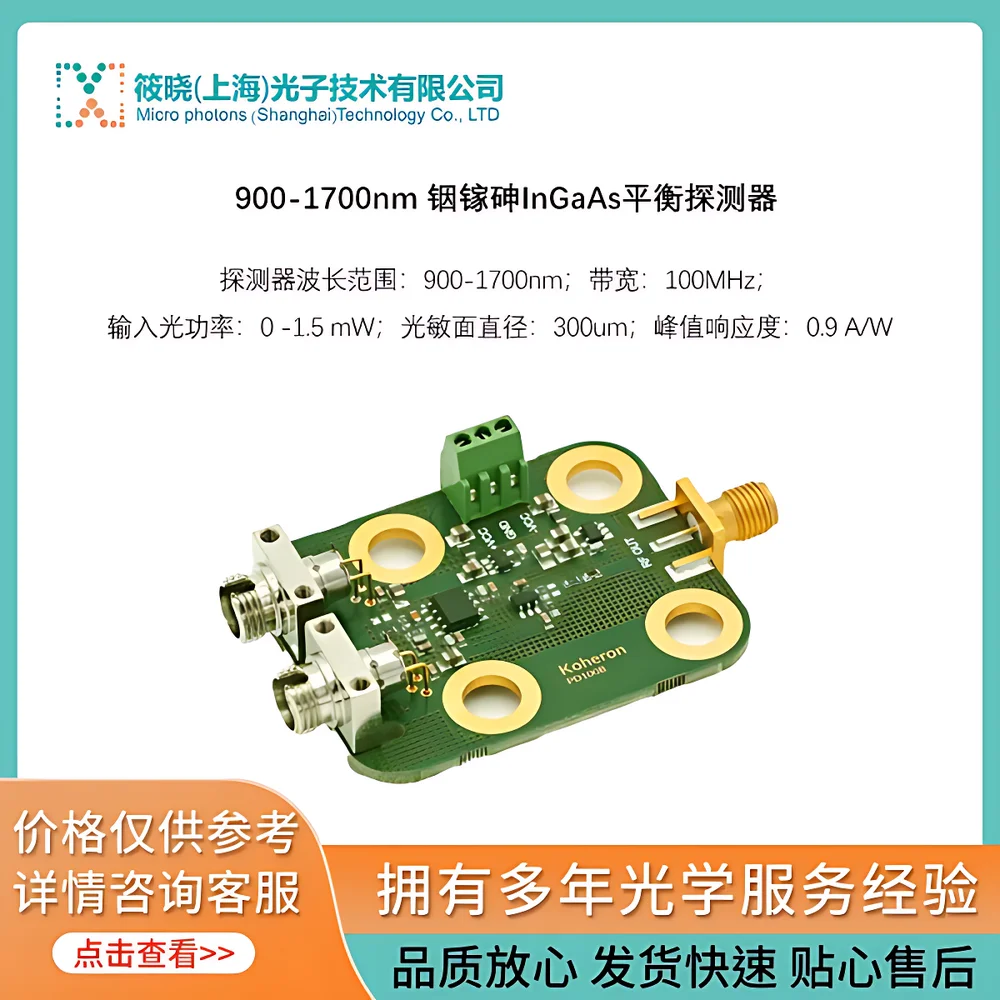
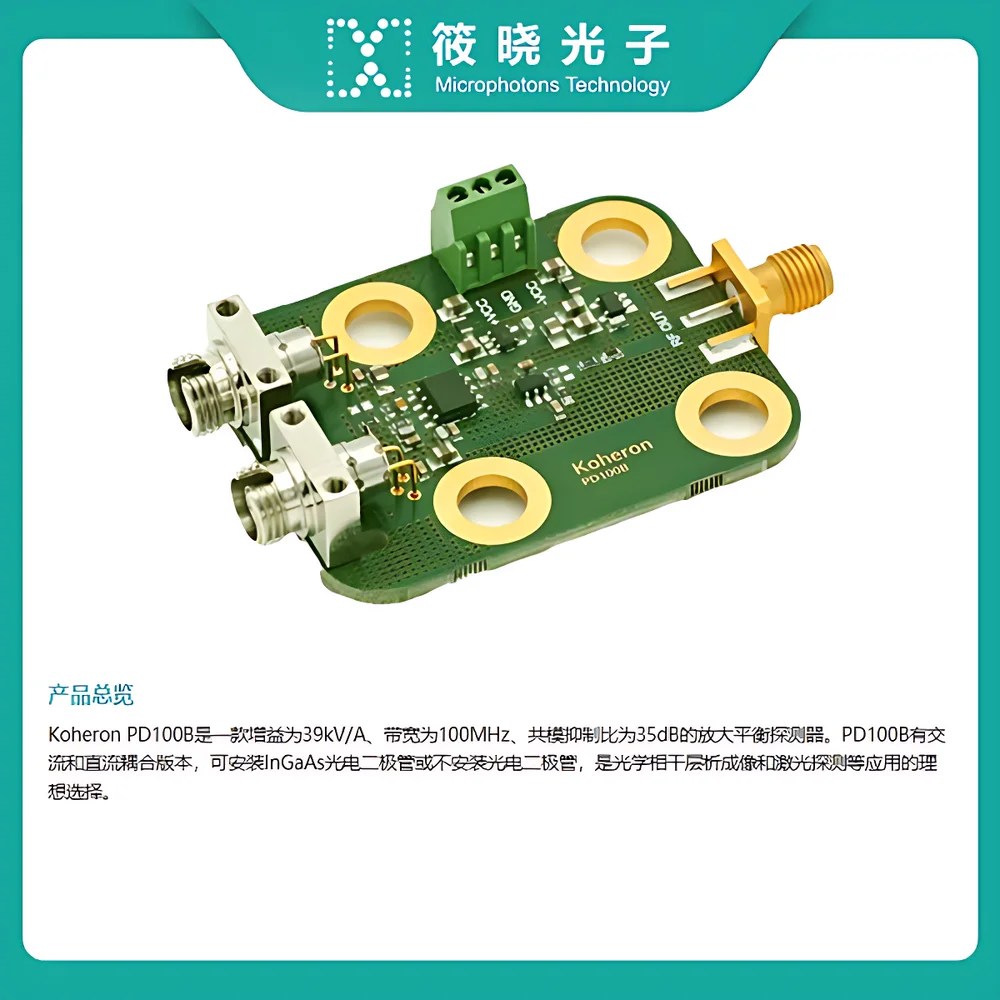
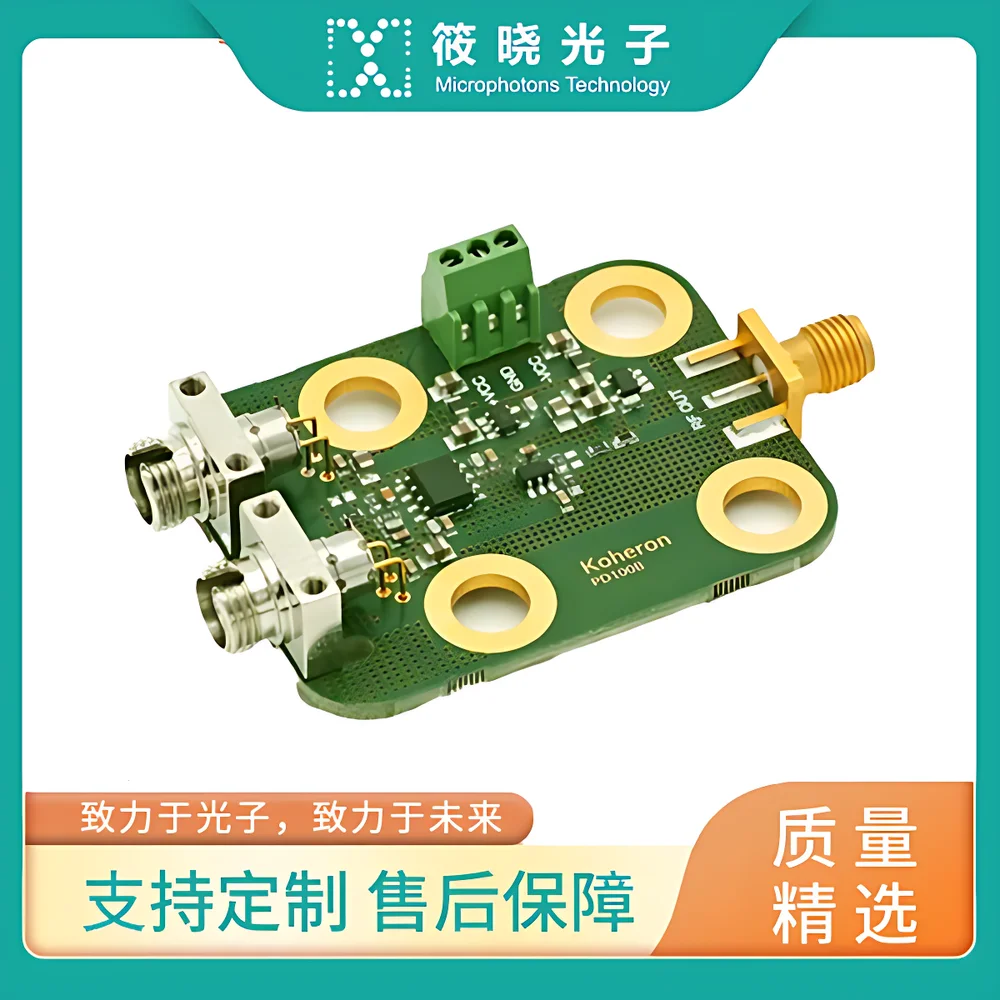
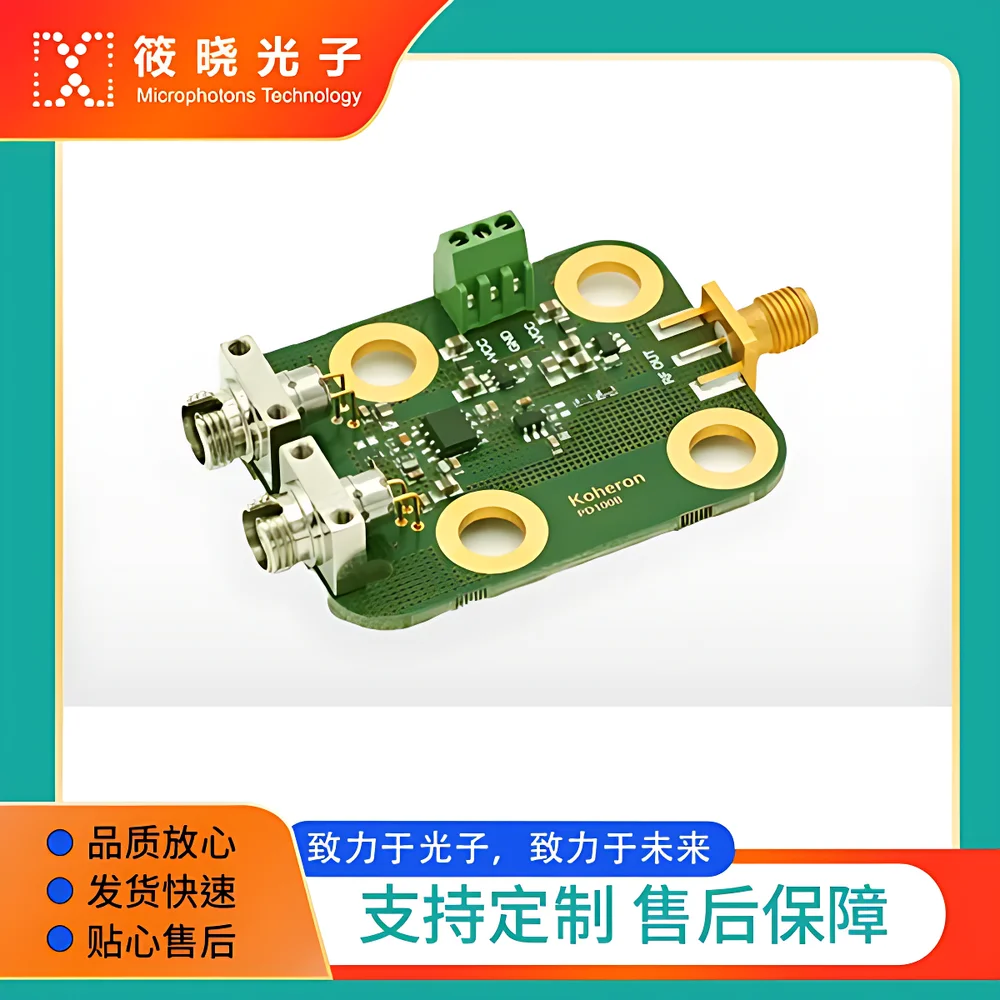
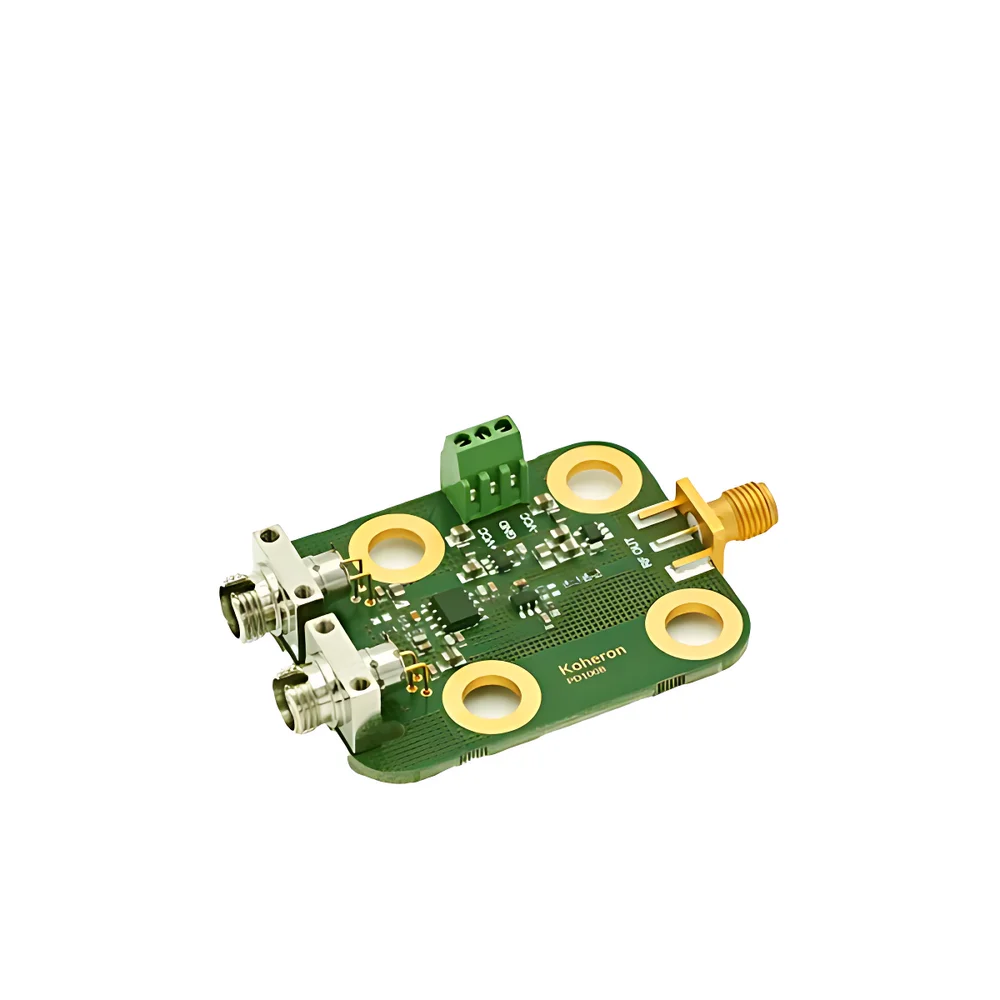
Microphotons PD100B-AC-NOP InGaAs Balanced Photodetector (900–1700 nm)

| Brand | Microphotons |
|---|---|
| Origin | France |
| Manufacturer Type | Original Equipment Manufacturer (OEM) |
| Product Category | Imported Optical Component |
| Model | PD100B-AC-NOP |
| Component Type | Optical Detector |
| Spectral Range | 900–1700 nm |
| Detector Material | Indium Gallium Arsenide (InGaAs) |
| Output Configuration | AC-Coupled Balanced Differential Output |
| Compliance | RoHS-compliant, CE-marked for laboratory use |
Ask about pricing, availability and specifications.
Overview
The Microphotons PD100B-AC-NOP is a high-performance, AC-coupled balanced photodetector engineered for precision optical heterodyne and interferometric measurements in the near-infrared (NIR) spectral band. Based on dual-monolithic InGaAs photodiodes with matched responsivity and low capacitance, it operates across a continuous wavelength range of 900–1700 nm—fully covering key telecom bands (O-, E-, S-, C-, L-, and U-bands) as well as common fiber laser and quantum optics wavelengths (e.g., 1064 nm, 1310 nm, 1550 nm, and 1650 nm). Its balanced architecture suppresses common-mode intensity noise—including laser relative intensity noise (RIN) and power supply ripple—enabling shot-noise-limited detection at moderate to high optical input powers. The detector employs transimpedance amplification with fixed gain and DC-blocking AC coupling, making it especially suited for dynamic signal recovery in phase-sensitive applications such as optical coherence tomography (OCT), fiber optic sensing, coherent communications testing, and ultrafast pump-probe spectroscopy.
Key Features
- Monolithic InGaAs dual-photodiode structure with <±1.5% responsivity matching across the 900–1700 nm band
- AC-coupled differential output with 50 Ω impedance termination and SMA female connectors
- Typical bandwidth: DC to >100 MHz (small-signal, –3 dB point), optimized for high-fidelity RF envelope detection
- Common-mode rejection ratio (CMRR): >35 dB up to 50 MHz, ensuring robust noise suppression in interferometric setups
- Low dark current (<5 nA at –5 V bias) and high linearity (≤1% deviation up to 1 mW total incident power per diode)
- RoHS-compliant construction and CE marking for integration into ISO/IEC 17025-accredited optical laboratories
- No internal bias tee or active temperature stabilization; designed for passive integration into vibration-isolated optical tables and OEM subsystems
Sample Compatibility & Compliance
The PD100B-AC-NOP accepts free-space or fiber-pigtailed input via optional FC/APC or FC/PC adapters (sold separately). It is compatible with single-mode and polarization-maintaining fibers (SMF-28, PM1550), as well as collimated NIR beams from tunable lasers (e.g., Koheron LD100 series), DFB lasers, and superluminescent diodes (SLDs). Input power handling is specified up to 1.7 mW per photodiode (3.4 mW total), with thermal derating recommended above 40 °C ambient. The device complies with IEC 61340-5-1 (ESD control), EN 61326-1 (EMC for laboratory equipment), and meets mechanical stability requirements per ISO 10110-7 for optical component mounting. It supports traceable calibration workflows under GLP conditions when used with NIST-traceable power meters and reference detectors.
Software & Data Management
As a hardware-level analog signal conditioning component, the PD100B-AC-NOP does not include embedded firmware or digital interfaces. Its output is a voltage signal proportional to the instantaneous difference photocurrent, intended for acquisition by external digitizers (e.g., Keysight Infiniium oscilloscopes, National Instruments PXIe systems, or Zurich Instruments HF2LI lock-in amplifiers). Power spectral density (PSD) characterization—such as that performed using Koheron LD100 lasers at 1550 nm—is typically conducted via FFT-based post-processing in MATLAB, Python (SciPy), or LabVIEW. For regulated environments (e.g., FDA-regulated OCT system development), raw PSD data logs may be archived with full audit trail metadata (timestamp, instrument ID, operator ID, environmental sensor readings) to satisfy 21 CFR Part 11 electronic record requirements when paired with compliant DAQ software.
Applications
- Coherent optical time-domain reflectometry (C-OTDR) and distributed acoustic sensing (DAS)
- Interferometric fiber-optic gyroscopes (IFOGs) and Michelson/Mach–Zehnder sensor readout
- Quantum key distribution (QKD) receiver modules requiring high CMRR and low excess noise
- High-speed optical modulation analysis (e.g., QPSK, 16-QAM) in research-grade coherent transceivers
- Low-noise characterization of narrow-linewidth lasers and optical frequency combs
- Lock-in detection of weak absorption signals in gas-phase NIR spectroscopy (e.g., CH₄, CO₂, NH₃)
FAQ
What is the maximum recommended optical power per photodiode?
The absolute maximum incident optical power per diode is 1.7 mW. Operation above 1 mW per diode requires thermal management and verification of linearity via calibrated reference measurement.
Is DC response available in this model?
No—the PD100B-AC-NOP is strictly AC-coupled. For DC-capable operation, refer to the PD100B-DC-NOP variant (same housing, different output stage).
Can this detector be used with multimode fiber inputs?
While physically compatible, multimode coupling degrades spatial mode matching and responsivity uniformity; performance specifications assume single-mode or collimated input.
Does the unit include calibration data?
Each unit ships with a factory test report including measured responsivity vs. wavelength (at 1550 nm), CMRR sweep, and bandwidth verification—traceable to NPL standards via Microphotons’ ISO/IEC 17025-accredited calibration lab.
What is the typical rise time and output voltage swing?
Measured small-signal rise time is ≤3.5 ns; output voltage swing is ±1.2 V into 50 Ω load at full-scale differential photocurrent (1 mA).
More from Microphotons
View all Microphotons products → Microphotons ABL-005IR-GE InGaAs Linear Sensor SWIR Camera (QVGA Resolution, GigE Vision Interface)
- Difrotec D7 Series Ultra-High-Precision Laser Interferometer (λ/1000)
- Microphotons TPX-D25.4-f10-t12.7 Mounted Aspheric Plano-Convex THz Lens for High-Spatial-Resolution Imaging
- Microphotons ASE-0980-10 Broadband Amplified Spontaneous Emission Light Source at 980 nm (10 mW Output)


