

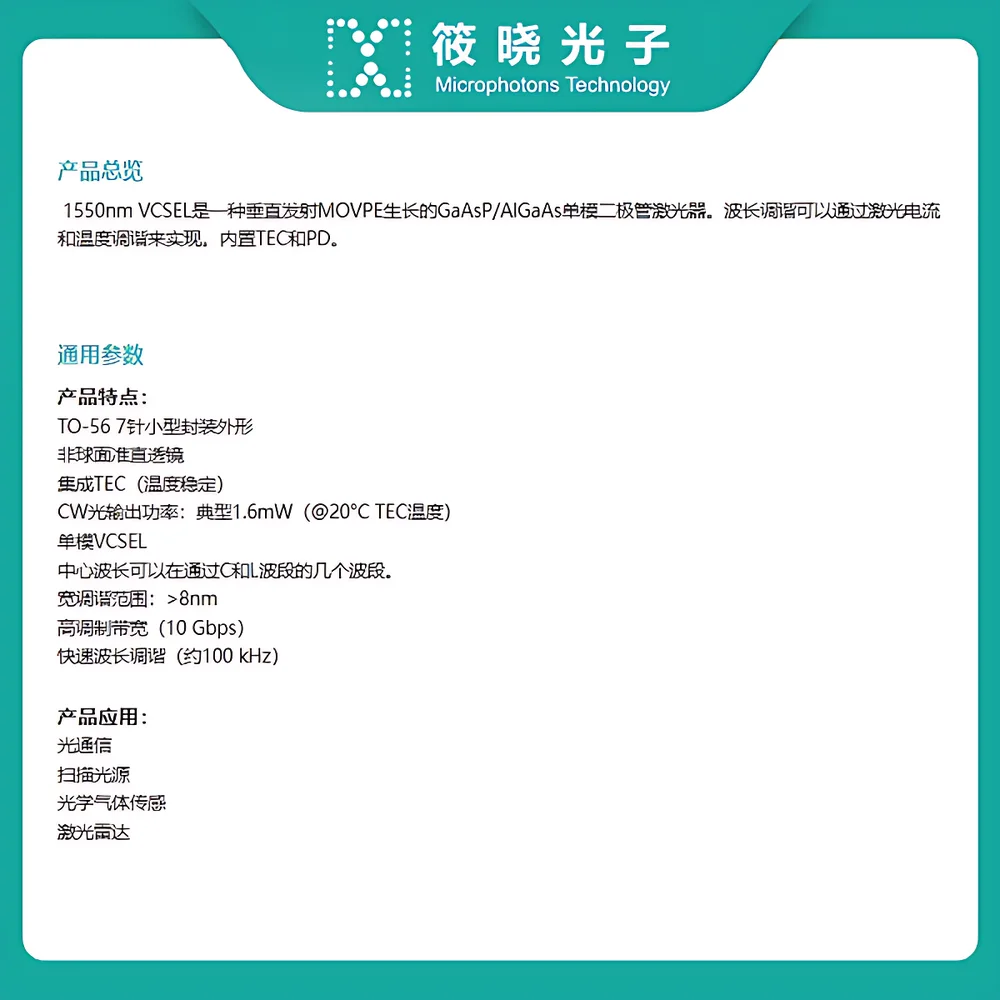
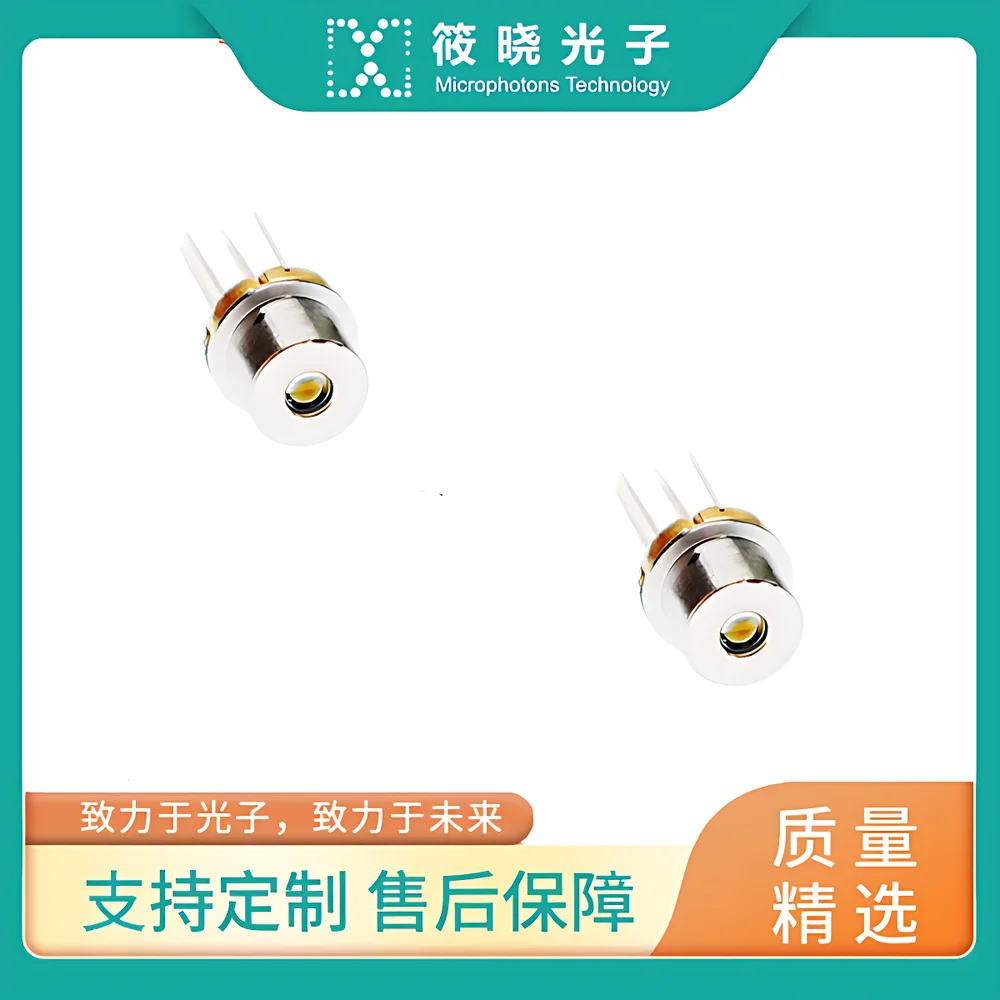
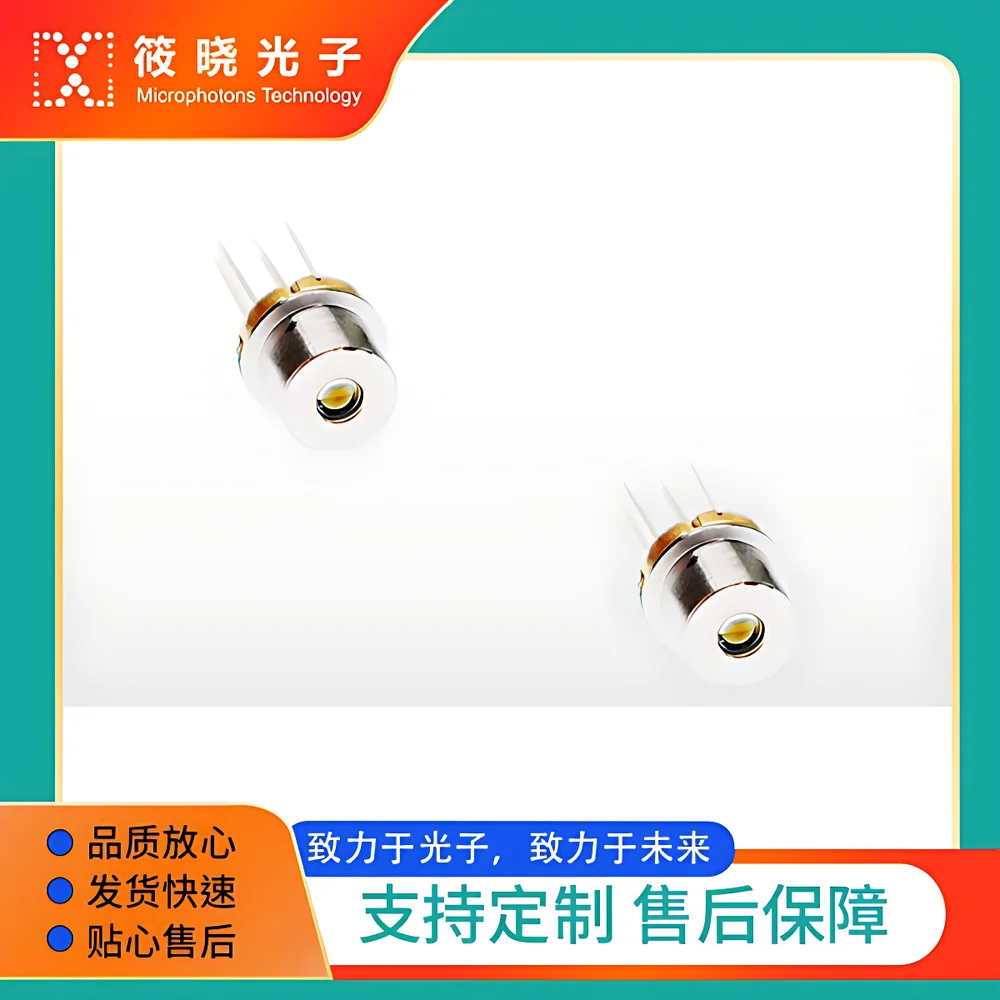
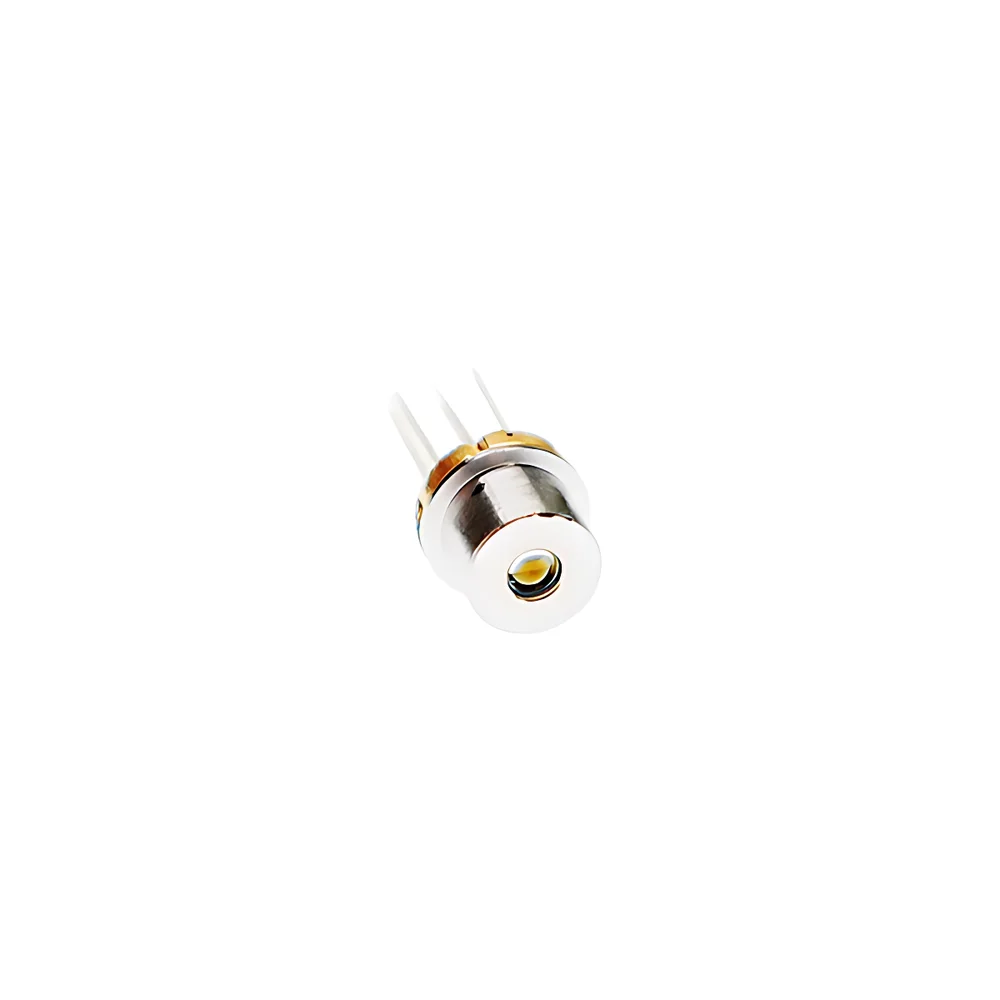
Microphotons PL-VCSEL-1550-1-A82-TO56 TEC-Stabilized Tunable 1550 nm Vertical-Cavity Surface-Emitting Laser

| Brand | Microphotons |
|---|---|
| Origin | Singapore |
| Manufacturer Type | OEM Manufacturer |
| Import Status | Imported |
| Model | PL-VCSEL-1550-1-A82-TO56 |
| Component Category | Optical Component |
| Package | TO-56, 7-pin |
| Output Power (CW, 20°C TEC) | 1.6 mW (typ.) |
| Tuning Range | >8 nm |
| Center Wavelength Range | 1525–1575 nm |
| SMSR | 30–40 dB |
| Linewidth (FWHM, CW) | 300 MHz |
| Modulation Bandwidth | 10 Gbps |
| Tuning Speed | 100–200 kHz |
| TEC Voltage | 0.35–1.5 V |
| TEC Current | 0.05–0.6 A |
| Operating Temperature (Case) | –5 to +70 °C |
| Storage Temperature | –20 to +85 °C |
| Threshold Current | 8–12 mA |
| Slope Efficiency | 0.14–0.18 mW/mA |
| Forward Voltage | ≤2.5 V |
| RIN | –128 dB/Hz |
Ask about pricing, availability and specifications.
Overview
The Microphotons PL-VCSEL-1550-1-A82-TO56 is a high-stability, single-mode tunable vertical-cavity surface-emitting laser (VCSEL) engineered for precision applications in telecom-grade optical sensing, coherent detection, and time-resolved spectroscopy. Operating at the low-dispersion, low-loss 1550 nm window of the C- and L-bands, this device leverages MOVPE-grown GaAsP/AlGaAs heterostructures to deliver intrinsic wavelength stability and narrow spectral emission. Unlike edge-emitting lasers, its vertical emission geometry enables direct integration with aspheric collimation optics and compact thermal management—critical for miniaturized photonic modules. Wavelength tuning is achieved simultaneously via two independent control axes: injection current (fast, fine adjustment) and thermoelectric cooler (TEC) temperature (coarse, drift-compensated tuning), enabling continuous, hysteresis-minimized scanning across >8 nm with sub-picometer repeatability under closed-loop thermal regulation. The integrated monitor photodiode (PD) provides real-time optical power feedback, supporting automated power stabilization in closed-loop driver configurations compliant with IEC 60825-1 Class 1 safety requirements.
Key Features
- Hermetically sealed TO-56 7-pin package with integrated TEC and back-facet photodiode for active thermal and power monitoring
- Aspheric collimating lens pre-aligned to minimize beam divergence (<1.5 mrad full angle)
- CW output power up to 1.6 mW at 20°C TEC setpoint; slope efficiency of 0.14–0.18 mW/mA ensures efficient drive-current utilization
- Single longitudinal mode operation with side-mode suppression ratio (SMSR) ≥30 dB (typ. 40 dB), eliminating mode-hopping artifacts in interferometric setups
- Electro-thermal tuning bandwidth of 100–200 kHz enables rapid spectral scanning for swept-source OCT or gas absorption line profiling
- Modulation-capable architecture supporting direct 10 Gbps NRZ data transmission without external modulators
- Low relative intensity noise (RIN) of –128 dB/Hz ensures high signal-to-noise ratio in coherent detection systems
Sample Compatibility & Compliance
This VCSEL is compatible with standard fiber-pigtailed modules (FC/APC or SC/PC adapters via optional coupling optics), free-space optical benches (e.g., Thorlabs Kinesis stages), and OEM photonic integrated circuit (PIC) test fixtures. Its operating envelope (–5 to +70 °C case temperature) aligns with Telcordia GR-468-CORE reliability standards for optoelectronic components. The device meets RoHS Directive 2011/65/EU and REACH Annex XVII substance restrictions. For regulated environments—including clinical optical coherence tomography (OCT) systems or industrial process analyzers—the integrated PD and TEC enable traceable calibration against NIST-traceable power meters (e.g., Ophir Vega) and temperature references (e.g., Fluke 1523). Full compliance documentation—including MSL level 3 moisture sensitivity labeling and JEDEC J-STD-020D reflow profiles—is available upon request for GMP/GLP audit readiness.
Software & Data Management
Microphotons provides a Windows/Linux-compatible SDK (C/C++, Python bindings) for bidirectional communication via USB-to-serial interface, supporting simultaneous control of laser bias current (0–25 mA), TEC setpoint (–40 to +85 °C), and analog monitor PD readout. The SDK includes built-in waveform generators for linear sweeps, step-and-hold tuning, and chirped modulation sequences—with timestamped logging at up to 10 kHz sampling. All operational parameters are stored in non-volatile memory with configurable EEPROM write cycles. Data export supports CSV, HDF5, and MATLAB .mat formats. For FDA 21 CFR Part 11 compliance, optional audit-trail firmware logs all parameter changes with user ID, timestamp, and checksum-verified integrity metadata—enabling full electronic record retention in pharmaceutical or medical device validation workflows.
Applications
- Telecom & Datacom: Wavelength-division multiplexing (WDM) channel characterization, tunable transceiver calibration, and PON upstream transmitter testing
- Gas Sensing: High-resolution absorption spectroscopy of methane (CH₄), carbon dioxide (CO₂), and hydrogen sulfide (H₂S) using tunable diode laser absorption spectroscopy (TDLAS) near 1550 nm
- LIDAR & Metrology: Coherent FMCW LIDAR sources, displacement interferometry, and cavity ring-down spectroscopy (CRDS) requiring narrow linewidth and fast sweep fidelity
- Biophotonics: Swept-source OCT systems demanding 30 dB SMSR, and long-term wavelength repeatability over 10⁶ scan cycles
- Quantum Optics: Pump source for periodically poled lithium niobate (PPLN) waveguides in mid-IR difference-frequency generation (DFG)
FAQ
What is the guaranteed tuning range, and how is it calibrated?
The device guarantees ≥8 nm continuous tuning within the 1525–1575 nm band. Calibration is performed at wafer level using a high-resolution optical spectrum analyzer (OSA) traceable to NIST SRM 2034, with individual device test sheets provided.
Can this VCSEL be driven with standard laser diode controllers?
Yes—compatible with commercial drivers supporting analog current control (0–25 mA) and TEC voltage input (0–1.5 V). Microphotons recommends drivers with <10 µA current noise floor and ±0.01 °C TEC stability for optimal SMSR maintenance.
Is the output polarization stabilized?
The device emits linearly polarized light with a typical polarization extinction ratio (PER) of 15–20 dB; external polarization-maintaining (PM) fiber coupling is recommended for applications requiring >25 dB PER.
What is the maximum allowable soldering temperature during PCB assembly?
Peak soldering temperature must not exceed 350 °C for ≤10 seconds; TEC junction temperature must remain below 150 °C throughout reflow to prevent thermoelectric material degradation.
Does the SDK support LabVIEW integration?
Yes—NI LabVIEW 2018+ drivers are included, with VIs for current ramping, TEC PID tuning, and synchronized PD-triggered data acquisition.
More from Microphotons
View all Microphotons products → Microphotons ABL-005IR-GE InGaAs Linear Sensor SWIR Camera (QVGA Resolution, GigE Vision Interface)
- Difrotec D7 Series Ultra-High-Precision Laser Interferometer (λ/1000)
- Microphotons TPX-D25.4-f10-t12.7 Mounted Aspheric Plano-Convex THz Lens for High-Spatial-Resolution Imaging
- Microphotons ASE-0980-10 Broadband Amplified Spontaneous Emission Light Source at 980 nm (10 mW Output)


