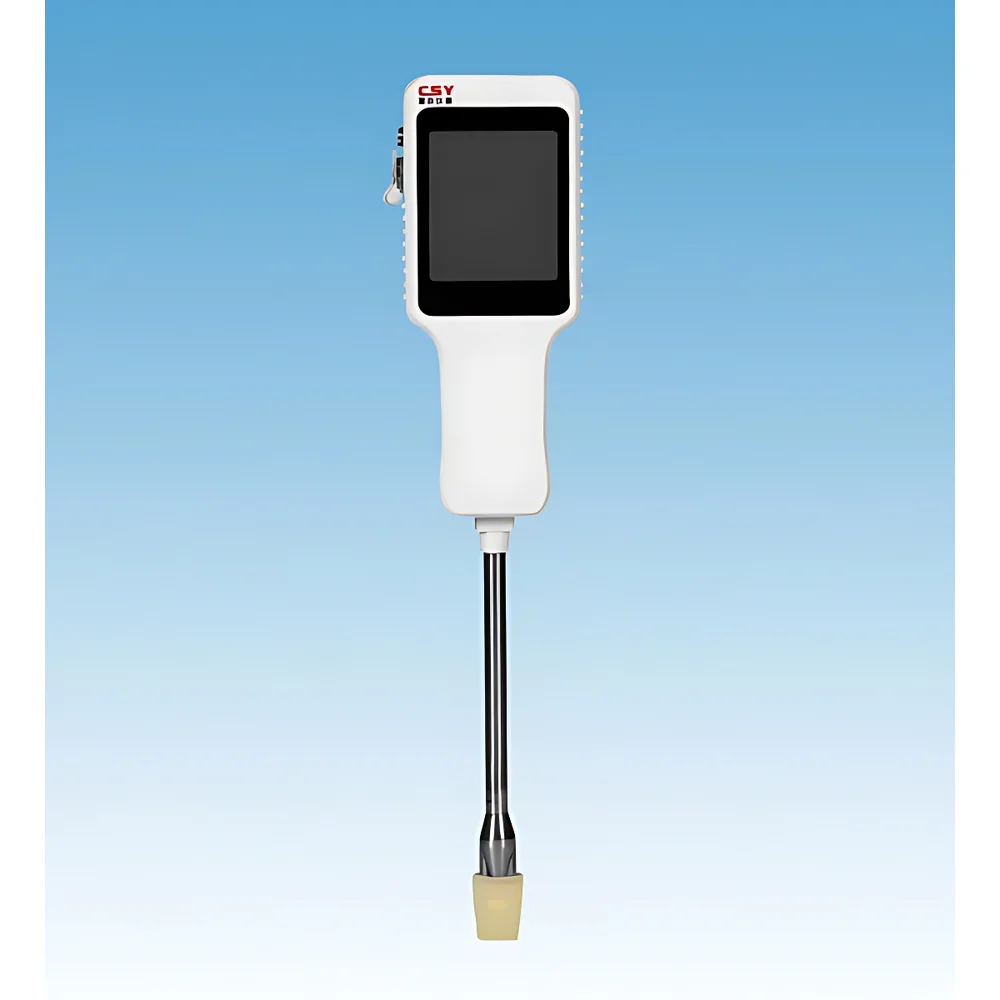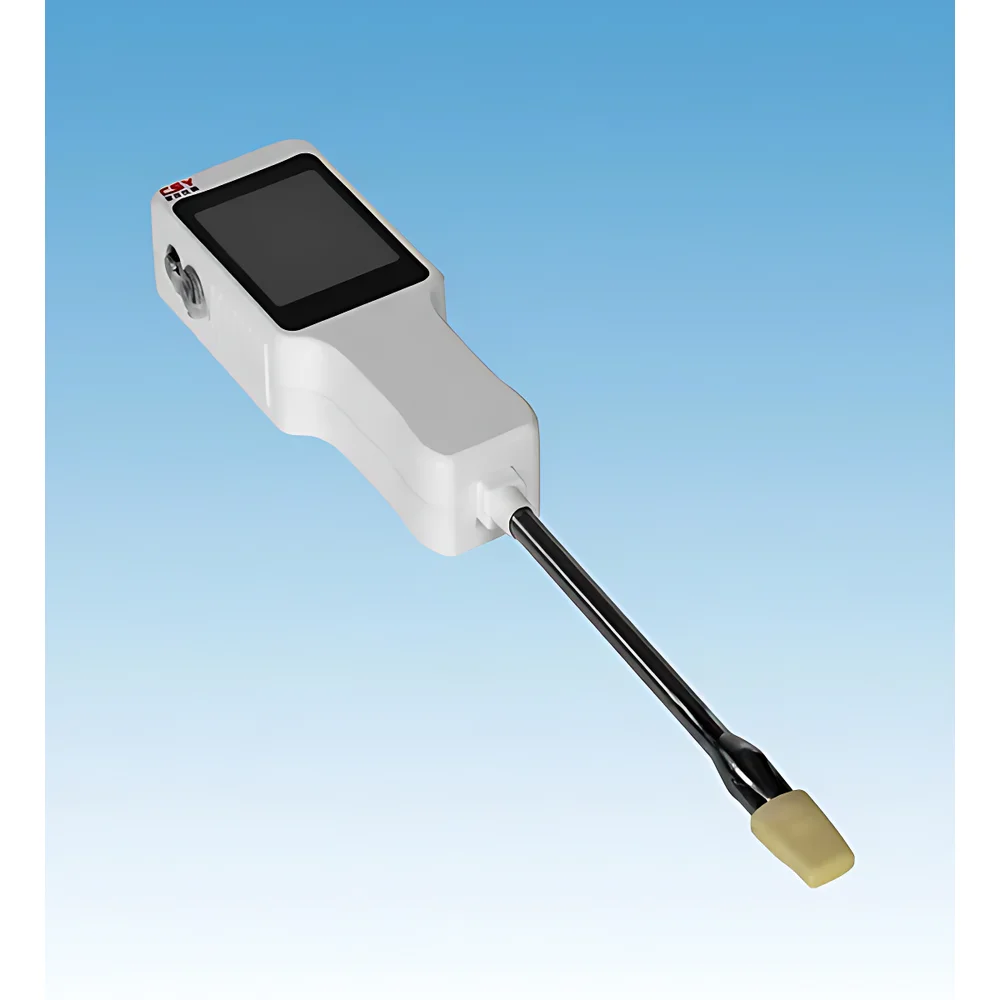
CSY-SDC Edible Oil Quality Analyzer by Shenzhen CSY Instrument

| Brand | CSY Instrument |
|---|---|
| Model | CSY-SDC |
| Origin | Shenzhen, China |
| Type | Portable TPM (Total Polar Materials) Analyzer for Edible Oils |
| Measurement Principle | Dielectric Constant-Based Rapid Quantification of Polar Compounds |
| Measuring Range | 0–40% TPM |
| Accuracy | ±2% TPM |
| Resolution | 0.1% TPM |
| Temperature Range | 0–200 °C |
| Temp. Accuracy | ±1 °C |
| Temp. Resolution | 0.1 °C |
| Display | 2.4-inch capacitive touchscreen |
| Data Storage | ≥5,000,000 records with timestamped logging |
| Connectivity | Bluetooth 4.2 (optional thermal printer support) |
| Alarm Logic | User-configurable pass/fail thresholds with visual (color-coded), audible, and textual alerts |
| Compliance | Designed to support GB 7102.1–2003, EU Directive 2006/86/EC, and ASTM D7467–22 (Standard Test Method for Determination of Total Polar Compounds in Used Frying Oils) |
Ask about pricing, availability and specifications.
Overview
The CSY-SDC Edible Oil Quality Analyzer is a field-deployable, dielectric constant-based instrument engineered for rapid, on-site quantification of Total Polar Materials (TPM) in frying oils and edible fats. Unlike chromatographic or gravimetric reference methods—which require solvent extraction, laboratory infrastructure, and trained personnel—the CSY-SDC leverages the well-established correlation between oil polarity and dielectric permittivity. As edible oils degrade under thermal stress (e.g., repeated frying), oxidation, hydrolysis, polymerization, and cleavage reactions generate polar degradation products—including free fatty acids, mono- and di-glycerides, oxidized triglycerides, and aldehydic/ketonic species—that significantly increase bulk dielectric response. The analyzer measures this change in real time, converting it into a calibrated TPM percentage via factory-traceable algorithms validated against AOAC Official Method 982.27 and ISO 8534:2017. Its operational design targets regulatory enforcement, food service quality assurance, and public health surveillance—particularly where immediate decisions on oil discard or process adjustment are required.
Key Features
- Direct immersion probe enables measurement at operating frying temperatures (up to 200 °C), eliminating need for cooling and minimizing sampling error
- Integrated dual-sensor architecture simultaneously acquires TPM and oil temperature with independent calibration traceability
- High-resolution 2.4-inch capacitive touchscreen with intuitive Chinese/English bilingual UI and context-sensitive prompts
- Configurable alarm system supports three-tier alerting: visual (red/green status bar + icon), audible (programmable beep), and textual (pass/fail label with numeric TPM value)
- On-device statistical engine computes batch合格率 (pass rate), mean TPM, standard deviation, and max/min values across user-defined time windows
- Bluetooth 4.2 module enables secure wireless export of CSV-formatted datasets to mobile devices or PCs; optional thermal printer integration supports GLP-compliant hard-copy generation
Sample Compatibility & Compliance
The CSY-SDC is validated for use with common culinary oils including soybean, palm, sunflower, canola, peanut, and blended frying media. It does not require sample dilution, filtration, or reagent addition. Instrument performance aligns with national and international regulatory frameworks governing frying oil safety: GB 7102.1–2003 (China, TPM ≤27%), EU Regulation (EC) No 852/2004 and Commission Directive 2006/86/EC (TPM ≤24–27% depending on oil type), and FDA Food Code 2022 (recommendation: discard when TPM exceeds 25%). While not a primary compliance device per se, its measurement uncertainty profile (±2% TPM) meets the requirements for screening-level verification under ISO/IEC 17025-accredited food testing laboratories performing method validation per ILAC-G8:2021.
Software & Data Management
All measurements are timestamped and stored locally in non-volatile memory with capacity for ≥5 million records. Data fields include: TPM (%), oil temperature (°C), measurement ID, operator ID (user-definable), and pass/fail flag. Historical records are retrievable by date range, TPM threshold, or batch tag. Exported data includes ISO 8601 timestamps and conforms to FAO/WHO Codex Alimentarius Annex II metadata standards for food safety records. The embedded firmware supports over-the-air (OTA) updates via USB-C interface and maintains full audit trail functionality—including user login history, parameter modification logs, and calibration event timestamps—supporting basic 21 CFR Part 11 readiness when deployed with external identity management.
Applications
- Routine monitoring of deep-fry oil integrity in commercial kitchens, fast-food chains, and institutional catering facilities
- Field inspections by municipal food safety regulators and provincial CDC units conducting unannounced audits
- Quality control checkpoints in edible oil refining and repackaging plants verifying post-processing stability
- Screening tool for identifying illicitly recycled cooking oil (“gutter oil”) based on abnormally elevated TPM combined with anomalous viscosity or color indices
- Educational use in food science laboratories for teaching lipid oxidation kinetics and sensory–chemical correlation studies
FAQ
What physical principle does the CSY-SDC use to quantify polar compounds?
It measures the relative permittivity (dielectric constant) of hot oil using a calibrated coaxial sensor; polar degradation products increase permittivity linearly within the 0–40% TPM range.
Can the instrument be used with solid or semi-solid fats like lard or coconut oil?
No—it requires liquid-phase measurement; samples must be fully molten and homogeneous at test temperature.
Is periodic recalibration required, and what is the recommended interval?
Factory calibration is stable for 12 months under normal use; annual verification against NIST-traceable TPM reference standards (e.g., CSY-REF-01 series) is advised.
Does the device meet GLP or GMP documentation requirements?
It provides core audit-trail elements (timestamps, operator IDs, calibration logs); full GLP compliance requires integration with a validated LIMS platform.
How is temperature compensation handled during TPM measurement?
Real-time oil temperature is measured concurrently via integrated Pt100 RTD; TPM algorithm applies dynamic correction coefficients derived from empirical dielectric–temperature–TPM matrices.