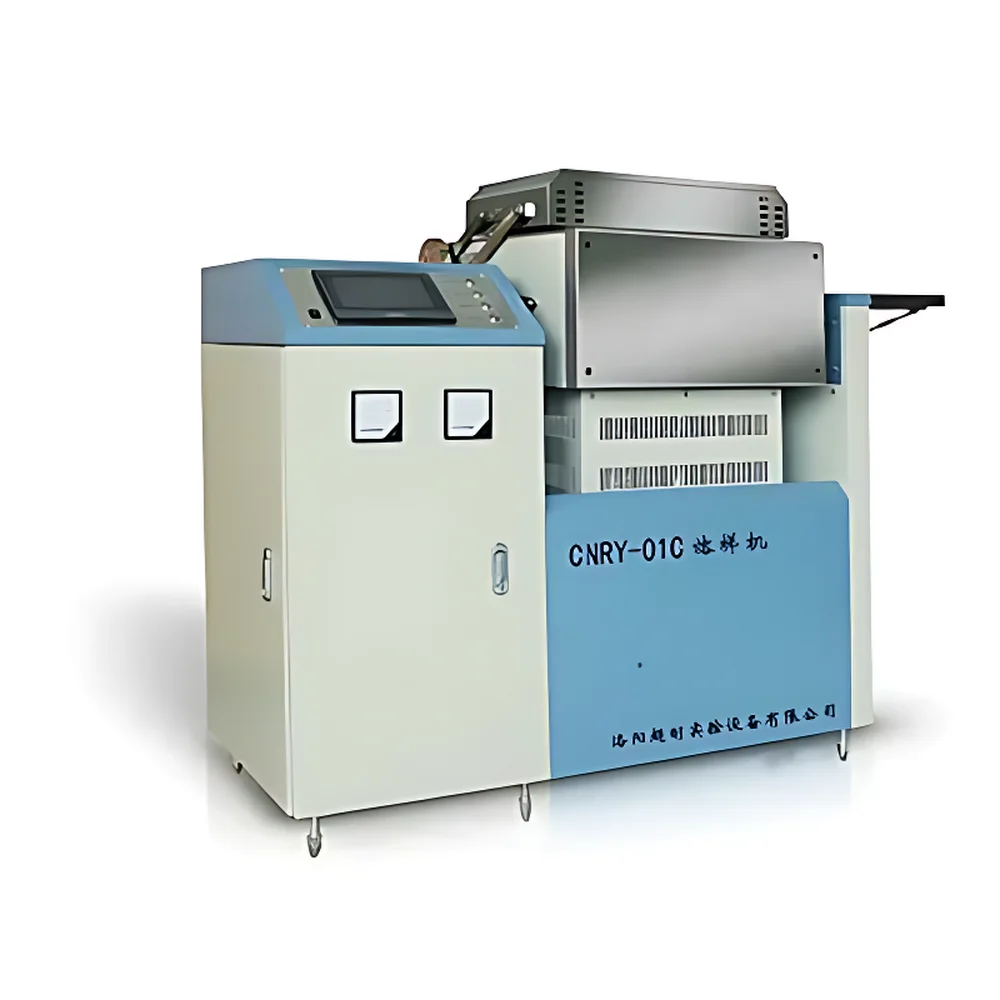
Chuonai CNRY-01C Fully Automated Fusion Machine for XRF Sample Preparation

| Origin | Henan, China |
|---|---|
| Manufacturer Type | Authorized Distributor |
| Origin Category | Domestic (China) |
| Model | CNRY-01C |
| Price Range | USD 14,000 – 28,000 |
| Dimensions (L×W×D) | 1120 mm × 620 mm × 1050 mm |
| Temperature Control Accuracy | ±2 °C (at holding stage) |
| Maximum Operating Temperature | 1250 °C (up to 1300 °C peak) |
| Sample Capacity | 4 positions |
| Heating Rate | 30 °C/min (average) |
| Furnace Oscillation Angle | 0–40° adjustable |
| Crucible Holder Rotation Speed | 0–25 rpm (variable-frequency, bidirectional) |
| Pre-/Post-Hold Time Range | 0–160 min each |
| Oscillation Duration | 0–160 min |
| Total Cycle Time Limit | 165 h |
| Net Weight | 380 kg |
| Rated Power | 8 kW (typical operating power: 2–5 kW) |
| Electrical Supply | Heating circuit — single-phase 380 V AC |
| Rated Current | 30 A |
| Frequency | 50 Hz |
| Thermocouple Type | S-type Pt/Rh (Platinum–10% Rhodium vs. Platinum–6% Rhodium) |
| Heating Element | Silicon Carbide (SiC) rods |
| Control System | PLC + AI-based PID algorithm with touchscreen HMI |
| Safety Features | Dual hardware/software protection against thermocouple failure, overtemperature, and mechanical limit overrun |
| Preloaded Fusion Curves | 9 programmable temperature–time profiles |
Ask about pricing, availability and specifications.
Overview
The Chuonai CNRY-01C Fully Automated Fusion Machine is a precision-engineered sample preparation system designed specifically for the production of homogeneous, bubble-free glass beads used in wavelength-dispersive (WDXRF) and energy-dispersive (EDXRF) X-ray fluorescence spectroscopy. It operates on the principle of high-temperature flux fusion—melting solid samples (e.g., oxides, silicates, metals, slags) with lithium tetraborate (Li₂B₄O₇), lithium metaborate (LiBO₂), or mixed fluxes at controlled thermal profiles—to yield chemically stable, isotropic discs suitable for quantitative elemental analysis. The CNRY-01C integrates dual-axis motion control (furnace oscillation + crucible rotation) to induce turbulent melt convection, thereby minimizing phase segregation, accelerating gas release, and ensuring exceptional homogeneity across the final bead surface. With a maximum rated temperature of 1250 °C (extendable to 1300 °C for refractory matrices), it accommodates demanding applications in cement, metallurgy, geochemistry, ceramics, and refractories—where accurate stoichiometric conversion and reproducible matrix matching are critical for trace-element calibration and inter-laboratory comparability.
Key Features
- Four-position simultaneous fusion capability with independent crucible holders, supporting both direct casting (one-step molding) and inverted pouring (two-step pour-and-cool)
- AI-enhanced PLC control system featuring adaptive PID tuning, real-time fault diagnostics, and auto-recovery from transient thermal deviations
- Dual-motion agitation architecture: furnace oscillation (0–40° amplitude, programmable frequency) combined with crucible rotation (0–25 rpm, bidirectional, variable-frequency drive) for optimized melt homogenization
- S-type platinum–rhodium thermocouple (Pt–10%Rh / Pt–6%Rh) embedded in the furnace chamber for high-stability, NIST-traceable temperature measurement and closed-loop regulation (±2 °C accuracy during isothermal hold)
- Touchscreen HMI interface with intuitive workflow navigation, multilingual support (English default), and parameter-defaulting logic to minimize operator input error
- Integrated safety architecture including hardware-limit switches, redundant overtemperature cutoffs, thermocouple break detection, and soft/hard limit enforcement for all mechanical axes
- Nine preconfigured fusion curves stored onboard—customizable via USB or Ethernet—for standardized protocols aligned with ASTM E1361, ISO 29581-1, and GB/T 176-2017
Sample Compatibility & Compliance
The CNRY-01C supports a broad range of inorganic sample types—including powdered ores, sintered clinkers, fly ash, slag, limestone, bauxite, and alloy powders—when paired with appropriate flux ratios and oxidizing/reducing additives (e.g., NH₄NO₃, CoO, NiO). Its 1250 °C operational ceiling enables complete dissolution of high-melting-point phases such as chromite (FeCr₂O₄), zircon (ZrSiO₄), and corundum (Al₂O₃), provided sufficient flux excess and dwell time. All thermal cycles comply with GLP documentation requirements: timestamped event logs (start/end times, max temp reached, deviation alerts), audit-trail-enabled parameter changes, and non-volatile memory retention of last 100 fusion records. While not FDA 21 CFR Part 11–certified out-of-the-box, the system’s firmware architecture permits integration with validated LIMS environments through Modbus TCP or RS-485 interfaces—facilitating alignment with ISO/IEC 17025 quality management systems.
Software & Data Management
Fusion programming is executed via an embedded industrial-grade HMI running a deterministic real-time OS. Users define multi-stage thermal profiles—including pre-heating ramp, flux addition delay, oscillation onset, peak-temperature hold, and controlled cooling—with granular control over timing (0–160 min per segment) and motion parameters. All cycle data—including actual vs. setpoint temperature traces, motor status flags, and alarm timestamps—are logged automatically to internal flash memory and exportable via USB 2.0 in CSV format. Optional Ethernet connectivity enables remote monitoring and batch scheduling through third-party SCADA platforms. No proprietary software installation is required on host PCs; configuration remains fully self-contained within the device firmware.
Applications
- Preparation of certified reference material (CRM) beads for XRF calibration in cement QA/QC labs (per ASTM C114 and EN 196-2)
- Routine fusion of geological survey samples for major- and minor-element mapping (SiO₂, Al₂O₃, Fe₂O₃, CaO, MgO, Na₂O, K₂O, TiO₂, P₂O₅)
- Metallurgical process control: slag analysis in steelmaking, nickel-cobalt matte assays, and aluminum dross characterization
- Environmental compliance testing: heavy metal quantification (Pb, Cd, As, Cr, Hg) in waste incineration ash per EPA Method 6010D
- Refractory product certification: alumina-silica ratio verification in firebrick and monolithic linings
FAQ
What fluxes are compatible with the CNRY-01C?
Lithium tetraborate (Li₂B₄O₇), lithium metaborate (LiBO₂), and binary mixtures (e.g., 67% Li₂B₄O₇ + 33% LiBO₂) are standard. Oxidants (NH₄NO₃) and reducing agents (CoO, NiO) may be added manually prior to fusion.
Can the machine handle corrosive fluxes like sodium peroxide?
No. The CNRY-01C is engineered for low-volatility lithium-based fluxes only. Sodium peroxide, potassium nitrate, or other aggressive alkali oxidizers exceed material compatibility limits of the SiC heating elements and alumina crucible supports.
Is remote operation supported?
Yes—the system includes built-in Ethernet and RS-485 ports for integration into lab-wide automation networks. Remote start/stop, cycle monitoring, and log retrieval are supported via Modbus TCP without requiring vendor-specific drivers.
How is calibration traceability maintained?
S-type thermocouples are supplied with individual calibration certificates traceable to NIM (National Institute of Metrology, China). Furnace uniformity mapping reports (±5 °C across 4-position zone) are available upon request for ISO/IEC 17025 accreditation submissions.
What maintenance intervals are recommended?
Biannual inspection of SiC rod resistance, thermocouple junction integrity, and oscillation linkage lubrication is advised. Crucible trays and graphite spacers should be replaced after ~500 cycles or upon visible pitting/cracking.