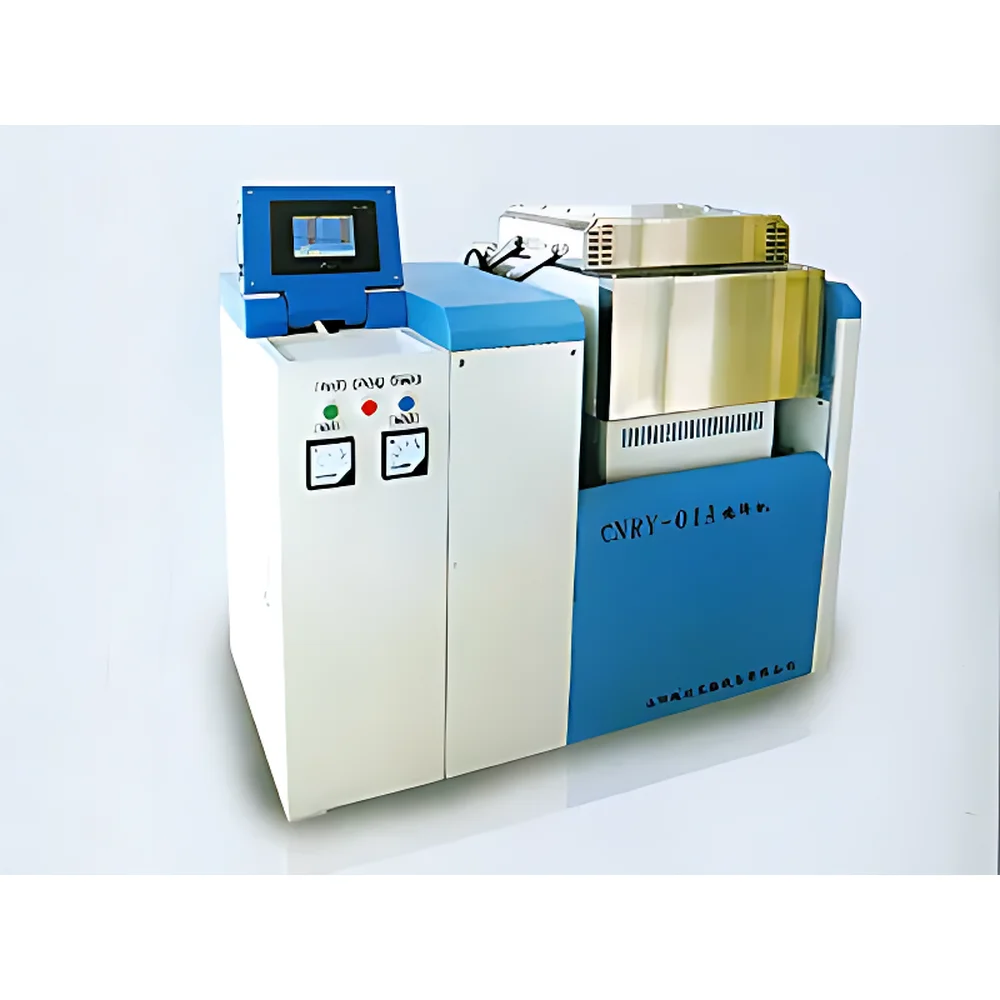
Chuonai CNRY-01A Fully Automated Fusion Machine

| Origin | Henan, China |
|---|---|
| Manufacturer Type | Authorized Distributor |
| Origin Category | Domestic (China) |
| Model | CNRY-01A |
| Price Range | USD 14,000 – 28,000 |
| Dimensions (L×W×D) | 1120 mm × 620 mm × 1050 mm |
| Temperature Control Accuracy | ±2 °C (at holding temperature) |
| Maximum Operating Temperature | 1250 °C (up to 1300 °C short-term) |
| Sample Capacity | 4 positions |
| Heating Rate | ~30 °C/min (average) |
| Furnace Oscillation Angle | 0–40° adjustable |
| Crucible Holder Rotation Speed | 0–25 rpm (variable-frequency, bidirectional) |
| Pre-heating / Oscillation / Post-holding Time | 0–160 min each |
| Max Continuous Operation Time | 165 h |
| Total Weight | 380 kg |
| Power Supply | Heating circuit — single-phase 380 V AC |
| Rated Power | 8 kW (typical operating power: 2–5 kW) |
| Rated Current | 30 A |
| Frequency | 50 Hz |
| Thermocouple Type | S-type Platinum-Rhodium |
| Heating Element | Silicon Carbide Rods |
| Control System | PLC + AI-based PID controller with touchscreen HMI |
| Safety Protections | Dual hardware/software overtemperature cutoff, thermocouple break detection, mechanical limit switch protection |
| Predefined Fusion Curves | 9 programmable profiles |
Ask about pricing, availability and specifications.
Overview
The Chuonai CNRY-01A Fully Automated Fusion Machine is a high-precision, laboratory-grade sample preparation instrument engineered for the reproducible preparation of homogeneous, bubble-free fused beads used in wavelength-dispersive (WDXRF) and energy-dispersive (EDXRF) X-ray fluorescence spectrometry. It operates on the principle of high-temperature flux fusion—melting solid samples (e.g., oxides, silicates, metals, slags) with lithium tetraborate (Li₂B₄O₇), lithium metaborate (LiBO₂), or mixed fluxes at controlled thermal profiles to produce transparent, glassy discs suitable for quantitative elemental analysis. Designed specifically to meet the stringent requirements of ISO 9516-1, ASTM E1375, and GB/T 176-2017, the CNRY-01A integrates furnace oscillation and crucible rotation to induce controlled turbulent mixing, ensuring complete homogenization and efficient degassing—critical for minimizing matrix effects and achieving sub-0.5% RSD in repeated fusion runs.
Key Features
- Dual-Motion Fusion Architecture: Simultaneous furnace oscillation (0–40° amplitude) and crucible holder rotation (0–25 rpm, bidirectional, frequency-controlled) generate vortex-like melt flow—enhancing dissolution kinetics and eliminating entrapped gas bubbles without manual intervention.
- AI-Optimized Thermal Control: PLC-driven PID algorithm with S-type Pt/Rh thermocouple feedback delivers ±2 °C stability during isothermal holds; ramp rates up to 30 °C/min support rapid thermal cycling while preserving flux integrity.
- 4-Position Parallel Processing: Supports batch preparation of up to four fused beads per cycle using either direct casting (one-step molding) or inverted pouring (two-step pour-and-cool), configurable via touchscreen interface.
- Remote Monitoring & Smart Diagnostics: Ethernet-enabled control system allows real-time status monitoring, parameter logging, and fault diagnostics (e.g., thermocouple failure, overtravel, overtemperature) from offsite workstations—compatible with LabVantage and Thermo Fisher SampleManager integration frameworks.
- Operator Safety Engineering: Motorized sample loading/unloading mechanism minimizes exposure to radiant heat (>1200 °C); integrated quartz viewing window enables visual verification of melt progression without opening the furnace chamber.
- Robust Industrial Build: Heavy-duty stainless steel housing (380 kg total mass), silicon carbide heating elements, and dual-layer ceramic insulation ensure long-term thermal stability and resistance to corrosive flux vapors (e.g., HF, B₂O₃).
Sample Compatibility & Compliance
The CNRY-01A accommodates standard platinum-gold (Pt/Au) or platinum-rhodium (Pt/Rh) crucibles (typically 30–40 mL capacity) and supports a wide range of geological, metallurgical, and industrial matrices—including iron ores, cement clinkers, fly ash, refractory ceramics, slag, and alloy powders. Its programmable 9-fusion-curve library covers common protocols for silicate rock analysis (e.g., LiBO₂/Li₂B₄O₇ 66:34 w/w), steel slag digestion (Na₂CO₃ + Li₂B₄O₇), and high-melting-point refractories (up to 1300 °C). The system complies with GLP documentation requirements: all fusion parameters (time, temperature, motion sequence) are timestamped and stored with user ID and audit trail—fully traceable for FDA 21 CFR Part 11–compliant environments when paired with validated LIMS software.
Software & Data Management
The embedded 7-inch capacitive touchscreen HMI runs a deterministic real-time OS with intuitive workflow navigation. Users define fusion sequences via stepwise editing (pre-heat → flux addition → melt → oscillation → pour → cool), assign curve names, and set safety limits (e.g., max temperature = 1280 °C, max oscillation time = 120 min). All operational data—including thermocouple readings, motor encoder feedback, power draw, and alarm history—are logged in CSV format and exportable via USB or network share. Optional OPC UA server module enables seamless connectivity to enterprise MES systems for automated batch record generation and electronic signature capture in regulated QA/QC labs.
Applications
- Preparation of fused beads for XRF analysis in cement quality control (ASTM C114)
- Routine fusion of geological reference materials (e.g., USGS GSP-2, NIST SRM 278) for calibration verification
- High-precision major/minor oxide determination in ferroalloys and stainless steel production
- Slag composition monitoring in blast furnace and EAF steelmaking operations
- Research-scale synthesis of homogeneous glass standards for EPMA and LA-ICP-MS calibration
- Compliance testing per ISO/IEC 17025 accredited laboratories requiring full process traceability
FAQ
What crucible types are compatible with the CNRY-01A?
Standard 30 mL and 40 mL Pt/Au (95/5) or Pt/Rh (90/10) crucibles are supported; custom crucible holders available upon request.
Does the system support automatic flux dosing?
No—flux addition remains manual to maintain operator control over stoichiometry; however, the machine pauses at pre-defined “addition points” with audible/visual prompts.
Can fusion curves be exported or backed up externally?
Yes—curve configurations and historical logs are exportable via USB drive in encrypted binary format; CSV exports include full parameter metadata.
Is the CNRY-01A certified for use in Class 1000 cleanrooms?
The unit is not ISO 14644-classified; however, its sealed furnace chamber and low particulate emission design make it suitable for installation in adjacent preparation areas with HEPA-filtered air supply.
What maintenance intervals are recommended?
Quarterly inspection of thermocouple calibration, biannual replacement of silicon carbide heating rods (under continuous 1200 °C operation), and annual verification of oscillation/rotation mechanical tolerances per manufacturer’s service manual.