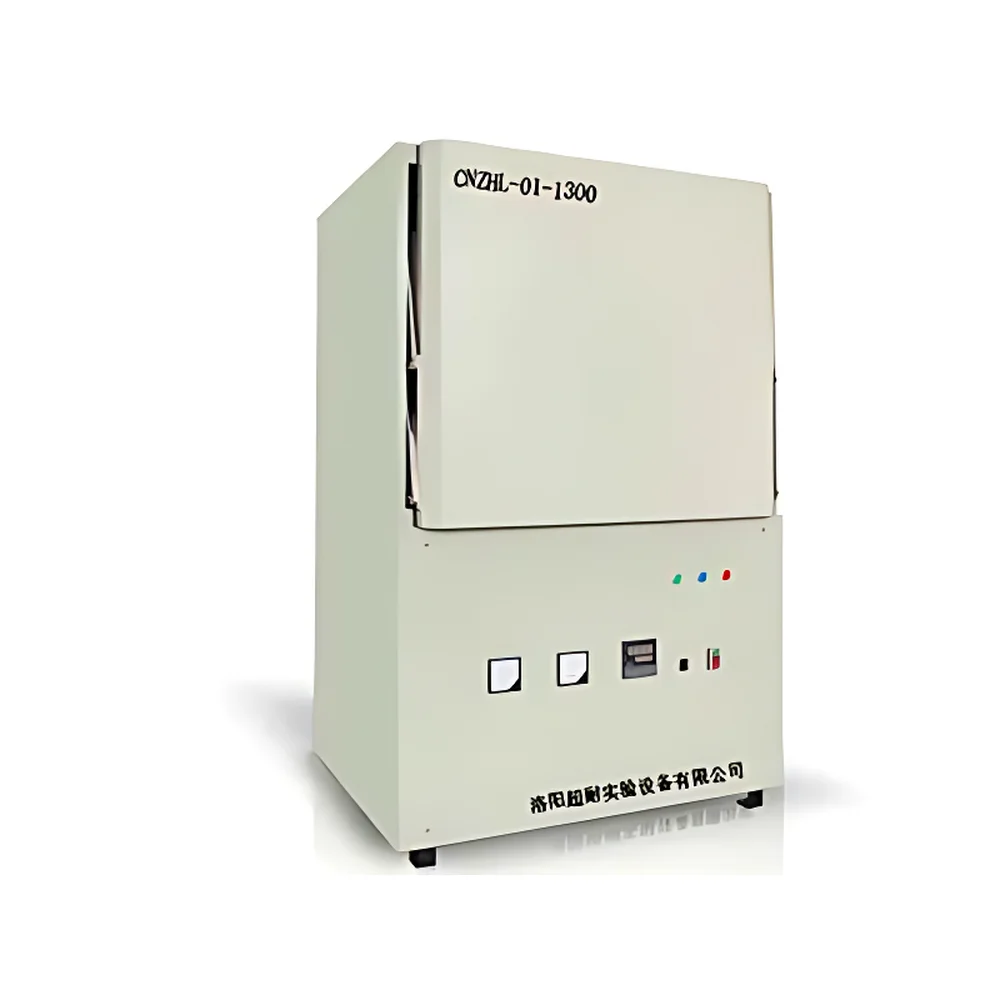
CNZHL-01-1300 High-Temperature Box-Type Quenching Furnace

| Origin | Henan, China |
|---|---|
| Manufacturer Type | Authorized Distributor |
| Origin Category | Domestic (PRC) |
| Model | CNZHL-01-1300 |
| Quotation | Available Upon Request |
| Rated Temperature | 1300 °C |
| Average Heating Rate | 20 °C/min |
| Chamber Dimensions | 560 mm × 500 mm × 400 mm |
| External Dimensions | 1080 mm × 890 mm × 1700 mm |
| Rated Power | 35 kW |
| Supply Voltage | 380 V (Heating Circuit), 220 V (Control Circuit) |
| Rated Current | 93 A |
| Frequency | 50 Hz |
Ask about pricing, availability and specifications.
Overview
The CNZHL-01-1300 is a high-temperature box-type quenching furnace engineered for precision thermal processing in R&D laboratories, pilot-scale production facilities, and quality control environments. Designed to meet stringent metallurgical and materials science requirements, it operates on resistive heating principles using silicon carbide (SiC) heating elements, delivering stable, uniform temperature distribution across its insulated chamber. The furnace supports controlled heating, soaking, and rapid cooling cycles—critical for hardening, tempering, annealing, and solution heat treatment of ferrous and non-ferrous alloys, ceramics, and advanced composites. Its maximum operating temperature of 1300 °C complies with ASTM E1142 (Standard Specification for Laboratory Furnaces) and aligns with ISO 9001-certified thermal processing workflows. The system integrates dual-circuit power management and safety interlocks to ensure operational integrity during quench transitions.
Key Features
- Programmable multi-stage thermal profiles: Up to five independent heating/cooling curves, each configurable with up to ten discrete segments—including ramp rate, soak time, and target temperature.
- Advanced SCR phase-angle firing control: Enables smooth, low-noise power delivery to SiC heating elements, minimizing thermal shock and ensuring long-term stability of resistance characteristics.
- Motorized vertical-lift furnace door: Reduces manual handling risk and improves repeatability in batch loading/unloading; actuated via industrial-grade gearmotor with position feedback.
- Sequential electrical interlock system: Door opening triggers immediate deactivation of the SCR trigger circuit followed by disconnection of the main contactor—ensuring zero-current switching to protect contactor contacts and extend component service life.
- High-efficiency insulation architecture: Multi-layer ceramic fiber lining (density ≥ 128 kg/m³) combined with reflective aluminum foil barriers minimizes radial heat loss and maintains ±1.5 °C temperature uniformity at 1300 °C (per ASTM E220 calibration methodology).
- Dual-voltage architecture: Isolated 380 V three-phase heating supply and 220 V single-phase control circuitry support compliance with IEC 61000-4 electromagnetic compatibility standards.
Sample Compatibility & Compliance
The CNZHL-01-1300 accommodates standard crucibles (Al₂O₃, SiC, or graphite), metal fixtures, and inert atmosphere-compatible sample holders up to 500 mm in height. It supports both air-cooled and oil/water-quench configurations when integrated with external quench tanks (not included). The furnace meets essential safety requirements per EN 60519-2 (Electrical Equipment for Industrial Electroheating) and incorporates over-temperature cutoff (OTC) protection with redundant thermocouple inputs (Type S, calibrated traceable to NIST standards). All control logic adheres to GLP documentation practices, enabling audit-ready operation in regulated environments such as ISO/IEC 17025-accredited testing labs.
Software & Data Management
Equipped with an embedded 7-inch TFT touchscreen HMI running real-time Linux OS, the furnace provides local curve editing, data logging (1-second interval), and USB export of CSV-formatted temperature/time records. Optional RS485 Modbus RTU or Ethernet TCP/IP interface enables integration into SCADA systems and centralized MES platforms. Data integrity is preserved through timestamped event logging—including door status, power state, alarm triggers, and operator login events—supporting 21 CFR Part 11-compliant electronic record retention when paired with validated third-party software solutions.
Applications
- Heat treatment validation for aerospace-grade titanium alloys (e.g., Ti-6Al-4V) per AMS 2750E pyrometry requirements.
- Phase transformation studies in steel microstructures using dilatometric simulation protocols.
- Sintering optimization of powder metallurgy components under inert gas purging (N₂ or Ar).
- Calibration reference furnace applications for secondary thermocouple verification against primary standards.
- Thermal aging tests for electronic packaging materials per IPC-9701 reliability guidelines.
FAQ
What is the maximum recommended continuous operating temperature?
The furnace is rated for continuous operation at 1300 °C, with derated performance advised above 1250 °C for extended service life.
Can this furnace be operated under protective atmospheres?
Yes—compatible with nitrogen, argon, and vacuum-compatible modifications (requires optional flange-mounted gas inlet/outlet ports and pressure monitoring module).
Is third-party calibration certification available?
Factory calibration includes Type S thermocouple verification at three points (600 °C, 900 °C, 1200 °C); full NIST-traceable calibration reports are available upon request.
What maintenance intervals are recommended for SiC heating elements?
Under typical usage (≤8 hrs/day, ≤5 cycles/day), inspection every 500 operating hours is advised; replacement frequency depends on thermal cycling severity and atmosphere composition.
Does the system support remote monitoring via network connection?
Yes—via optional Ethernet interface and compatible OPC UA server configuration, enabling real-time parameter readout and alarm notification through enterprise-level infrastructure.