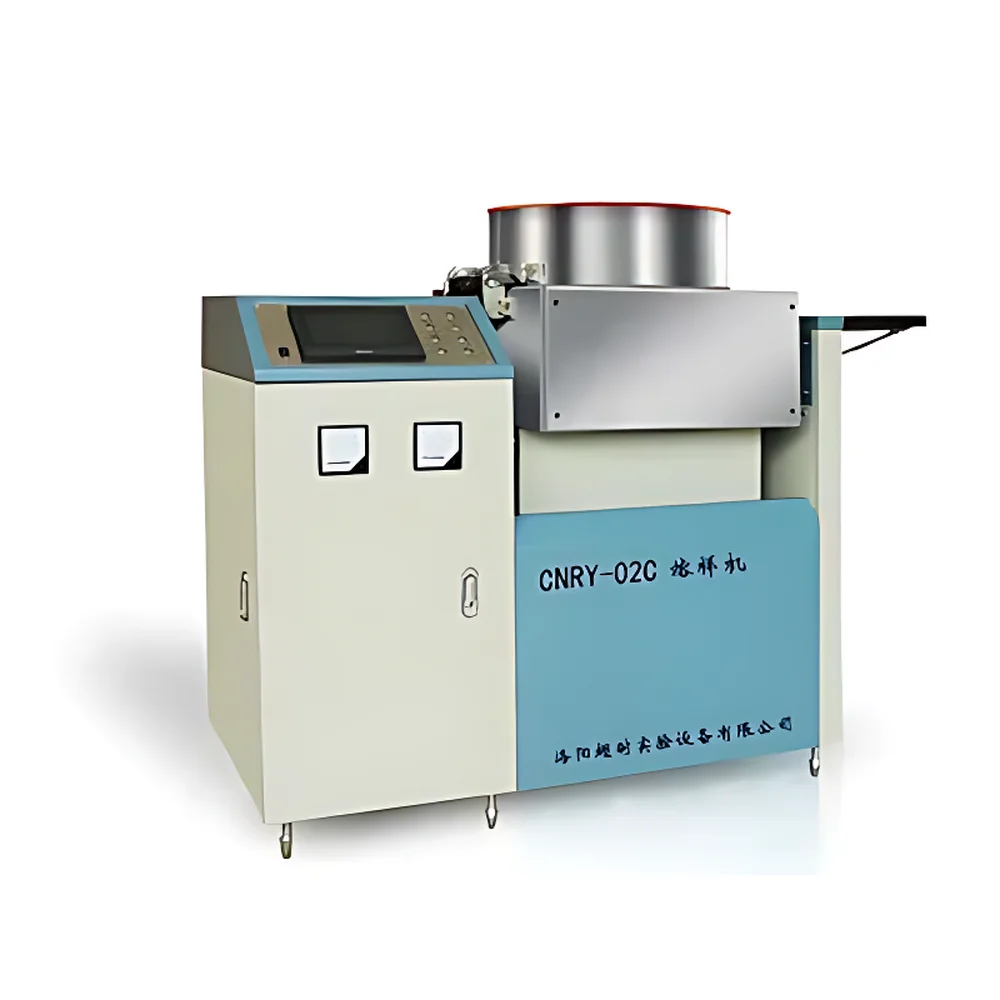
Chuonai CNRY-02C Fully Automated Fusion Machine

| Origin | Henan, China |
|---|---|
| Manufacturer Type | Authorized Distributor |
| Origin Category | Domestic (China) |
| Model | CNRY-02C |
| Price Range | USD 14,000–28,000 |
| Dimensions (L×W×D) | 1120 mm × 620 mm × 1050 mm |
| Temperature Control Accuracy | ±2 °C (at holding temperature) |
| Maximum Operating Temperature | 1250 °C (up to 1300 °C short-term) |
| Sample Capacity | 4 positions |
| Heating Rate | ~30 °C/min (average) |
| Furnace Oscillation Angle | 0–40° adjustable |
| Crucible Holder Rotation Speed | 0–25 rpm (variable-frequency, bidirectional) |
| Pre-/Post-Hold Time Range | 0–160 min each |
| Oscillation Duration | 0–160 min |
| Total Cycle Runtime Limit | 165 h |
| Power Supply | Heating circuit — single-phase 380 V AC |
| Rated Frequency | 50 Hz |
| Rated Current | 30 A |
| Rated Power | 8 kW (typical operating power: 2–5 kW) |
| Net Weight | 380 kg |
| Thermocouple Type | S-type Pt/Rh (Platinum-Rhodium) |
| Heating Element | Silicon Carbide (SiC) Rods |
| Control System | AI-enhanced PLC with touch-screen HMI |
| Safety Protections | Dual hardware/software overtemperature cutoff, thermocouple break detection, mechanical limit switch interlock |
Ask about pricing, availability and specifications.
Overview
The Chuonai CNRY-02C Fully Automated Fusion Machine is a high-precision, programmable sample preparation system engineered for the quantitative fusion of inorganic powders—primarily for X-ray fluorescence (XRF) spectroscopic analysis. It operates on the principle of high-temperature flux-assisted fusion, where powdered samples are mixed with lithium tetraborate or lithium metaborate fluxes and melted at controlled temperatures up to 1300 °C to produce homogeneous, bubble-free glass discs. This process eliminates mineralogical and particle-size effects, ensuring analytical reproducibility required by ISO 9516-1, ASTM E1719, and GB/T 176–2017 standards. Designed specifically for laboratories serving metallurgy, cement, geology, ceramics, refractories, and chemical industries, the CNRY-02C integrates furnace oscillation and crucible rotation to induce turbulent melt convection—enhancing homogenization and degassing efficiency beyond static fusion systems. Its dual-axis motion architecture (0–40° tilt + 0–25 rpm rotation) ensures uniform thermal exposure and consistent disc geometry across all four sample positions.
Key Features
- Fully automated 4-position fusion cycle with programmable pre-heating, fusion, oscillation, rotation, and cooling stages
- AI-enhanced PLC control system with intuitive 7-inch color touchscreen HMI and default parameter templates for rapid method deployment
- High-stability silicon carbide (SiC) heating elements paired with S-type Pt/Rh thermocouples for precise, drift-resistant temperature measurement (±2 °C at setpoint)
- Dual-motion fusion mechanism: independently adjustable furnace oscillation (0–40°) and crucible holder rotation (0–25 rpm, bidirectional, variable-frequency)
- Integrated auto-loading/unloading mechanism reduces operator exposure to radiant heat during sample insertion and retrieval
- Nine pre-configurable fusion curves stored onboard, supporting multi-step thermal profiles for diverse matrix types (e.g., iron-rich ores, siliceous clays, alkaline slags)
- Comprehensive safety architecture: hardware/software overtemperature cut-off, thermocouple failure detection, mechanical end-stop interlocks, and real-time fault diagnostics
- Energy-efficient operation with dynamic power modulation (2–5 kW typical draw), minimizing standby consumption without compromising ramp rate (~30 °C/min average)
Sample Compatibility & Compliance
The CNRY-02C accommodates standard 32-mm or 40-mm platinum-gold (Pt/Au) or platinum-rhodium (Pt/Rh) crucibles, compatible with common XRF fusion protocols using Li₂B₄O₇, LiBO₂, or mixed-flux formulations. It supports both direct casting (one-step molding) and inverted pour (two-step pouring into graphite or ceramic molds), enabling flexibility for viscous or volatile matrices. The system meets functional requirements for GLP-compliant environments: audit-trail-capable parameter logging (time-stamped temperature, motion, and status events), user-access-level management, and traceable method recall. While not FDA 21 CFR Part 11 certified out-of-the-box, its data export (CSV/Excel) and configurable event logging support integration into validated LIMS or ELN platforms under laboratory-defined validation protocols per ISO/IEC 17025.
Software & Data Management
Operation is managed via an embedded industrial HMI running a deterministic real-time control kernel. All fusion parameters—including hold times, ramp rates, oscillation angles, rotational speed/direction, and curve selection—are configured through a menu-driven interface with password-protected administrator access. Each run generates a timestamped log file containing setpoints, actual temperature history, motion actuation status, and fault codes. Logs are exportable via USB port in CSV format for external review or statistical process control (SPC) analysis. No cloud connectivity or remote desktop functionality is included; however, local network integration (via optional RS-485 or Ethernet module) enables centralized monitoring in multi-instrument labs adhering to internal IT security policies.
Applications
- Preparation of fused beads for major- and minor-element quantification in iron ore, slag, and sinter by wavelength-dispersive XRF
- Routine calibration standard production for cement raw meal and clinker analysis per ASTM C114 and EN 196-2
- Geochemical mapping of soil and rock samples requiring high-precision SiO₂, Al₂O₃, Fe₂O₃, CaO, MgO determinations
- Quality control of refractory raw materials (e.g., alumina, zirconia, magnesia) where phase heterogeneity must be eliminated prior to analysis
- Regulatory compliance testing in ceramic glaze and pigment manufacturing under ISO 10012 and GB/T 3810 series
FAQ
What crucible types and sizes are supported?
Standard 32-mm and 40-mm Pt/Au or Pt/Rh crucibles are compatible; custom holders for alternative diameters can be supplied upon request.
Does the system support ASTM E1719-compliant fusion protocols?
Yes—the programmable thermal profiles, S-type thermocouple accuracy, and dual-motion homogenization meet the instrumental performance criteria outlined in ASTM E1719 for XRF fusion bead preparation.
Can the CNRY-02C operate unattended overnight?
Yes, with a maximum cycle runtime of 165 hours and built-in thermal runaway protection, it is suitable for extended unattended operation when deployed in secure, ventilated laboratory environments.
Is third-party calibration documentation available?
Factory calibration certificates for temperature (traceable to NIM China) and motion actuators are provided; on-site verification services are available through authorized service partners.
What maintenance intervals are recommended?
Quarterly inspection of SiC rod resistance, thermocouple integrity, and mechanical linkage lubrication is advised; annual replacement of high-temperature seals and gaskets is typical under continuous use.