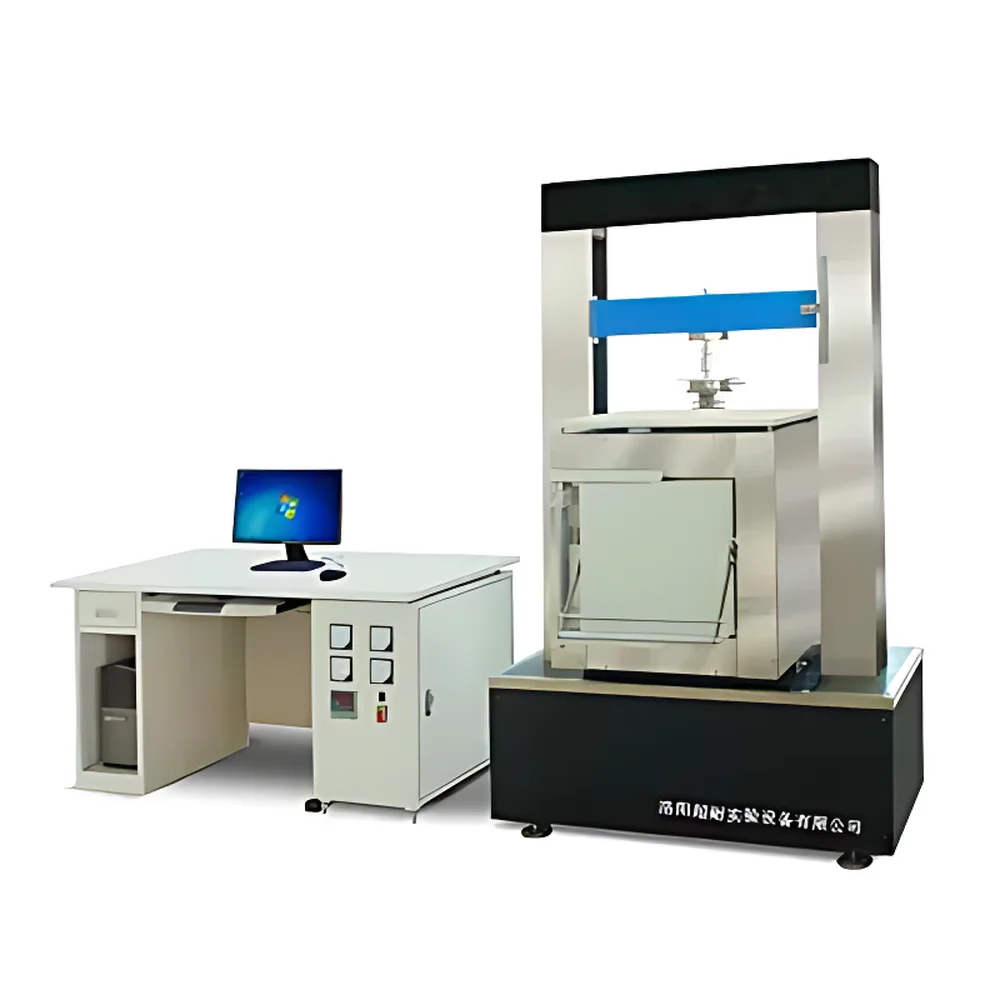
CNHMOR-03A Automatic High-Temperature Flexural Strength Tester

| Origin | Henan, China |
|---|---|
| Manufacturer Type | Authorized Distributor |
| Origin Category | Domestic (PRC) |
| Model | CNHMOR-03A |
| Quotation | Available Upon Request |
| Max Load Capacity | 10,000 N |
| Load Indication Accuracy | ±0.5% of full scale (FS) within 10–100% FS range |
| Loading Accuracy | Compliant with ISO 5013 |
| Furnace Chamber Dimensions | 530 × 250 × 220 mm (L × W × H) |
| Operating Temperature Range | Up to 1550 °C (short-term peak: 1600 °C) |
| Specimen Configurations Supported | Six 25 × 25 × 150 mm bars or four 40 × 40 × 160 mm bars |
| Accuracy Class | 0.5 per ISO 7500-1 |
Ask about pricing, availability and specifications.
Overview
The CNHMOR-03A Automatic High-Temperature Flexural Strength Tester is an engineered solution for precise determination of flexural strength (modulus of rupture) of refractory ceramics, insulating firebricks, castables, and high-performance oxide/non-oxide composites under controlled thermal conditions. It operates on the three-point bending principle in accordance with ISO 5013 and ISO 5014, where a rectangular specimen is supported at two lower points while a central loading nose applies compressive force until fracture. The system integrates a high-stability electric resistance furnace with programmable thermal profiles and a rigid load frame featuring dual precision-ground lead screws driven by a variable-frequency motor. This architecture ensures consistent stress-rate control during loading—critical for reproducible high-temperature mechanical property evaluation. Unlike ambient-only testers, the CNHMOR-03A maintains thermal equilibrium between furnace, specimen, and load train through optimized thermal shielding and real-time temperature compensation algorithms, minimizing thermal drift-induced measurement error.
Key Features
- Rigid monolithic frame construction with dual high-precision trapezoidal thread lead screws, delivering axial stiffness >2.5 × 10⁶ N/mm and eliminating backlash during high-temperature loading cycles.
- Programmable furnace system capable of ramping to 1550 °C at rates from 1 °C/min to 10 °C/min, with stable isothermal hold accuracy of ±2 °C over 60 min (verified per ASTM C1683 Annex A2).
- High-resolution 10,000 N load cell calibrated to ISO 7500-1 Class 0.5, with digital signal conditioning and temperature-compensated output to mitigate thermoelectric interference.
- Fully automated specimen handling sequence: furnace door actuation, push-rod insertion, support positioning, load application, fracture detection, and post-test cooling protocol—all synchronized via PLC-controlled motion logic.
- Integrated safety architecture including thermocouple break detection (Type S), overtemperature cutoff (>1620 °C), heating element open-circuit monitoring, hydraulic/pneumatic overpressure protection, and mechanical end-of-travel limit switches.
Sample Compatibility & Compliance
The CNHMOR-03A accommodates standardized refractory test bars per multiple international specifications: six specimens of 25 × 25 × 150 mm (ISO 5013, GB/T 3002) or four specimens of 40 × 40 × 160 mm (ISO 5014). Its furnace cavity (530 × 250 × 220 mm) provides adequate thermal uniformity zone (±5 °C across 100 mm diameter per ISO 8528-2) for simultaneous multi-specimen testing without cross-contamination. All operational parameters—including heating rate, dwell time, loading rate (0.1–1.0 MPa/s adjustable), and data acquisition frequency (100 Hz)—are configurable to meet ISO/IEC 17025 method validation requirements. The system satisfies traceability mandates under GLP and GMP environments when paired with documented calibration certificates (load cell, thermocouples, furnace uniformity mapping) and audit-ready electronic records.
Software & Data Management
Control and analysis are performed using proprietary Windows-based software compliant with FDA 21 CFR Part 11 requirements, including role-based user authentication, electronic signatures, immutable audit trails, and automatic backup to network storage. Real-time graphical display shows load–displacement curves, temperature history, and furnace power consumption. Post-test processing includes automatic fracture point identification, modulus of rupture calculation (σ = 3FL/2bd²), Weibull modulus estimation, and statistical reporting (mean, SD, CV%, confidence intervals). Raw data exports to CSV, XML, or ASTM E1434-compliant formats; integrated SQL database supports long-term trend analysis across batches, materials, and production lots.
Applications
This instrument is routinely deployed in R&D laboratories and quality control departments of refractory manufacturers, metallurgical plants, ceramic research institutes, and national metrology centers. Typical use cases include: qualification of alumina-silica, magnesia-carbon, silicon carbide, and zirconia-based refractories for blast furnace linings; evaluation of hot strength retention after thermal cycling per ASTM C1211; comparative assessment of binder systems in unshaped refractories; validation of sintering schedules for advanced technical ceramics; and generation of high-temperature mechanical property datasets for finite element modeling input.
FAQ
What standards does the CNHMOR-03A fully support?
It meets all functional and performance requirements of ISO 5013, ISO 5014, GB/T 3002–2004, and ASTM C1211 for high-temperature flexural strength testing.
Can the system perform constant strain-rate testing?
Yes—loading is controlled via closed-loop displacement feedback with programmable ramp rates, enabling both constant stress-rate (MPa/s) and constant crosshead-speed (mm/min) modes.
Is furnace temperature uniformity mapped and certified?
Each unit undergoes factory verification per ISO 8528-2; optional on-site uniformity mapping service is available with NIST-traceable thermocouples and certification report.
How is data integrity ensured during extended high-temperature tests?
All sensor signals are digitized at source with galvanic isolation; firmware implements cyclic redundancy checks (CRC) on every data packet, and software enforces write-once archival policies per ALCOA+ principles.
What maintenance intervals are recommended for sustained 1550 °C operation?
Furnace elements require inspection every 200 h at ≥1500 °C; load cell recalibration is advised annually or after 500 test cycles, whichever occurs first.