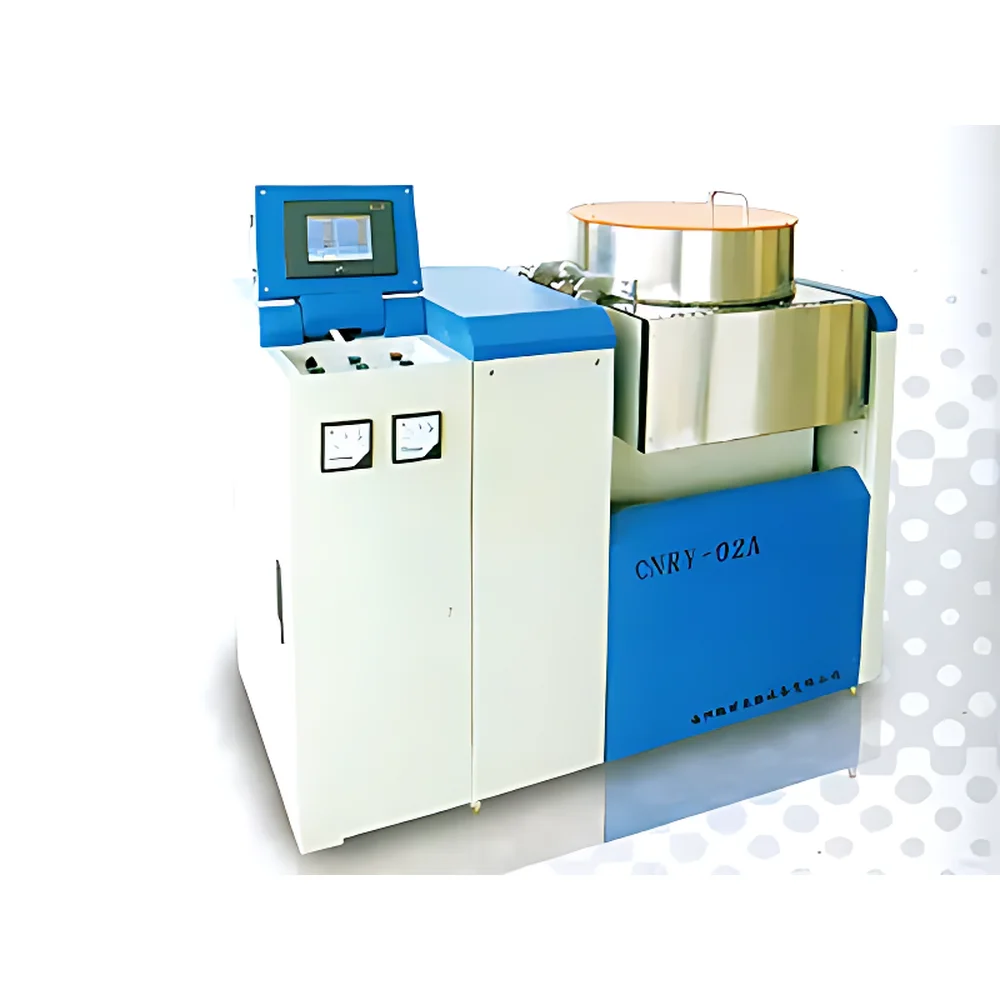
Chuonai CNRY-02A Fully Automated Fusion Machine

| Origin | Henan, China |
|---|---|
| Manufacturer Type | Authorized Distributor |
| Origin Category | Domestic (China) |
| Model | CNRY-02A |
| Price Range | USD 14,000–28,000 |
| Dimensions (L×W×D) | 1120 mm × 620 mm × 1050 mm |
| Temperature Control Accuracy | ±2 °C (at holding temperature) |
| Maximum Operating Temperature | 1250 °C (up to 1300 °C short-term) |
| Sample Capacity | 4 positions |
| Heating Rate | ~30 °C/min (average) |
| Furnace Oscillation Angle | 0–40° adjustable |
| Crucible Holder Rotation Speed | 0–25 rpm (variable-frequency, bidirectional) |
| Pre-/Post-Hold Time Range | 0–160 min each |
| Oscillation Duration | 0–160 min |
| Total Cycle Runtime Limit | 165 h |
| Power Supply | Heating circuit — single-phase 380 V AC |
| Rated Frequency | 50 Hz |
| Rated Current | 30 A |
| Rated Power | 8 kW (typical operating power: 2–5 kW) |
| Net Weight | 380 kg |
| Thermocouple Type | S-type Pt/Rh (Platinum-Rhodium) |
| Heating Element | Silicon Carbide (SiC) Rods |
| Control System | PLC + AI-based PID algorithm with touchscreen HMI |
| Safety Protections | Dual hardware/software safeguards against thermocouple failure, overtemperature, and mechanical overtravel |
| Predefined Fusion Curves | 9 programmable temperature-time profiles |
Ask about pricing, availability and specifications.
Overview
The Chuonai CNRY-02A Fully Automated Fusion Machine is a high-precision, laboratory-grade sample preparation instrument engineered for the quantitative preparation of homogeneous, bubble-free fused beads used in wavelength-dispersive (WDXRF) and energy-dispersive (EDXRF) X-ray fluorescence spectrometry. It operates on the principle of high-temperature flux fusion—melting solid samples (e.g., oxides, silicates, metals, ores, slags, ceramics, cements) with lithium tetraborate (Li₂B₄O₇), lithium metaborate (LiBO₂), or mixed fluxes at controlled thermal profiles to yield glassy discs suitable for non-destructive elemental analysis. The system integrates dual-axis motion control—simultaneous furnace oscillation (0–40°) and crucible holder rotation (0–25 rpm)—to induce turbulent melt convection, ensuring complete homogenization, efficient degassing, and minimal crystallite formation. With a maximum rated temperature of 1250 °C (extendable to 1300 °C for brief intervals), it accommodates refractory materials including chromite, zirconia, and alumina-rich matrices. Its AI-enhanced PLC controller, calibrated S-type Pt/Rh thermocouple feedback, and ±2 °C thermal stability at holding temperature support strict adherence to ISO 8289-1:2021, ASTM E1317, and GB/T 176-2017 protocols for XRF sample preparation.
Key Features
- Fully automated 4-position fusion station with independent crucible handling and synchronized dual-motion mechanics (oscillation + rotation) for optimal melt homogeneity and bubble removal.
- Intelligent human-machine interface (HMI) featuring 7-inch capacitive touchscreen, preloaded with nine customizable fusion curves—each configurable for pre-melt hold, active oscillation, and post-fusion annealing stages.
- Silicon carbide (SiC) heating elements delivering rapid, uniform heating (~30 °C/min average ramp rate) and long service life under cyclic thermal stress.
- Dual-safety architecture: hardware interlocks (e.g., mechanical limit switches, thermal cut-offs) and software-enforced constraints (e.g., overtemperature shutdown, thermocouple break detection, position error monitoring).
- Motorized sample transfer mechanism minimizes operator exposure to radiant heat during loading/unloading—reducing thermal hazard and improving ergonomics in routine QC workflows.
- Modular design supporting both direct casting (one-step bead formation) and inverted mold casting, enabling compatibility with diverse crucible types (Pt-Au, graphite, ceramic) and bead diameters (32 mm, 40 mm).
Sample Compatibility & Compliance
The CNRY-02A accommodates a broad spectrum of inorganic sample matrices requiring fusion prior to XRF analysis—including iron ores, steelmaking slags, cement clinkers, geological reference materials (e.g., NIST SRM 278, GBW standards), refractory raw materials, and environmental dust filters. Its programmable thermal profiles align with international standard methods such as ISO 8289-1 (determination of major constituents in iron ores), ASTM C114 (chemical analysis of hydraulic cement), and JIS R 2201 (analysis of refractories). All operational parameters—including time-stamped temperature logs, motion status, and alarm events—are recorded with audit-trail capability, supporting GLP-compliant documentation and internal QA/QC review. While not certified to FDA 21 CFR Part 11 out-of-the-box, the system’s data export functionality (CSV/USB) enables integration into validated LIMS environments where electronic signatures and user access controls are externally managed.
Software & Data Management
The embedded control firmware provides real-time visualization of all critical process variables: furnace temperature (°C), oscillation angle (°), rotation speed (rpm), elapsed time per stage, and active safety status. Each fusion run generates a timestamped log file containing start/end times, peak temperature, deviation from setpoint, and any triggered warnings (e.g., “TC open circuit”, “position timeout”). Logs are exportable via USB port in plain-text CSV format for traceability and statistical process evaluation (e.g., Cp/Cpk analysis of bead thickness uniformity or repeatability of MgO recovery across batches). No cloud connectivity or remote desktop functionality is included; however, optional RS-485 or Ethernet modules (upon request) permit integration with centralized lab automation systems using Modbus TCP or OPC UA protocols.
Applications
- Routine quality control in cement manufacturing plants for rapid determination of CaO, SiO₂, Al₂O₃, Fe₂O₃, and SO₃.
- Geochemical laboratories performing multi-element analysis of exploration core samples and certified reference materials.
- Metallurgical R&D facilities developing new alloy compositions and evaluating slag basicity indices.
- Ceramic and refractory producers validating raw material purity and batch-to-batch consistency of fired products.
- Environmental testing labs quantifying heavy metals (Pb, Cd, As, Cr) in fly ash, soil digests, and industrial particulates following EPA Method 6010D or ISO 12846.
FAQ
What crucible types are compatible with the CNRY-02A?
Standard operation supports 30 mL platinum-gold (95% Pt / 5% Au) crucibles; optional adapters accommodate graphite and high-purity alumina crucibles up to 45 mL volume.
Is the system compliant with ISO/IEC 17025 requirements for accredited testing laboratories?
Yes—the instrument meets metrological requirements for thermal stability, repeatability, and documentation integrity when operated within its specified environmental conditions (20–25 °C ambient, <60% RH) and maintained per the manufacturer’s calibration schedule.
Can the CNRY-02A be integrated into an automated sample-handling line?
It features standard I/O terminals (dry contact inputs/outputs) and optional communication modules (RS-485, Ethernet) to interface with robotic arms or conveyor-based autosamplers.
What maintenance is required for long-term reliability?
Quarterly inspection of SiC rod resistance, annual recalibration of the S-type thermocouple against a NIST-traceable reference, and biannual lubrication of the oscillation linkage and rotary bearing assembly are recommended.
Does the system support method validation per USP <731> or Ph. Eur. 2.2.27?
While not pharmacopoeial-certified, its precision fusion performance (RSD <0.8% for major oxides across 10 replicate beads) satisfies the repeatability criteria outlined in those monographs for inorganic assay preparation.