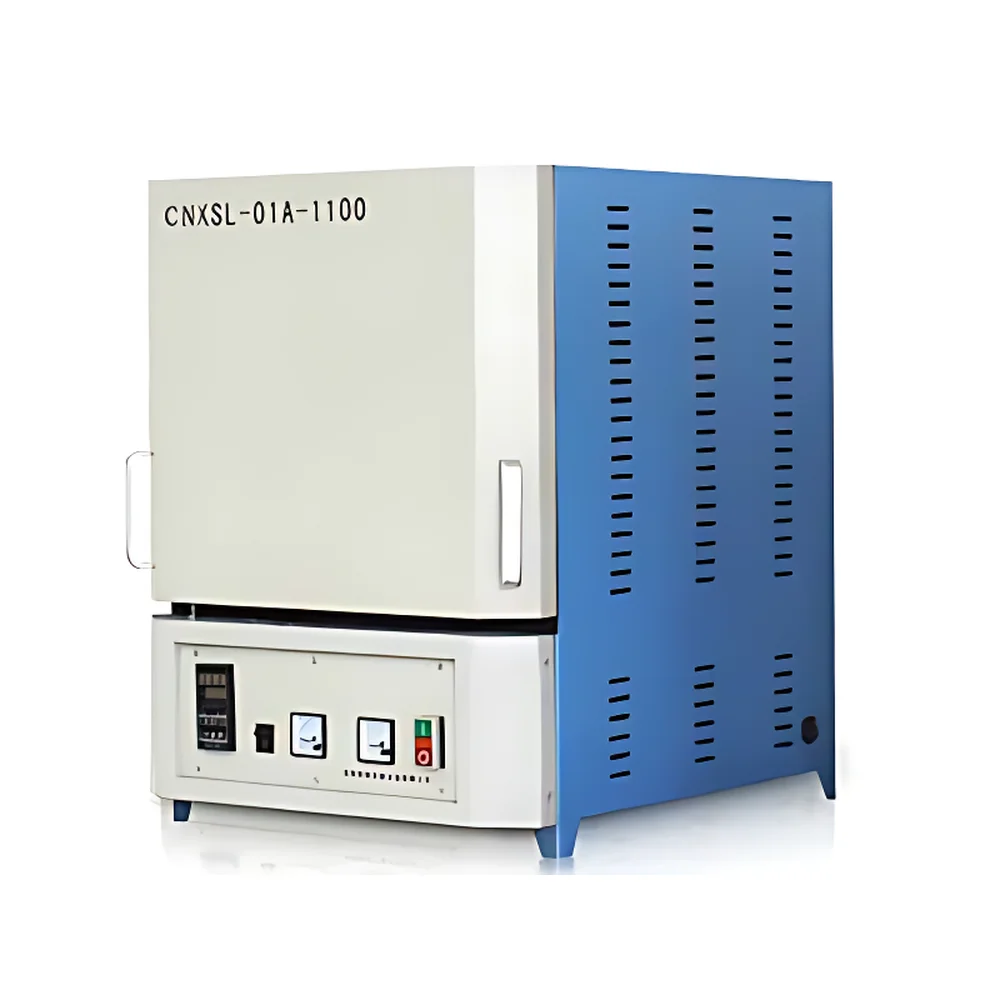
CNXSL Series Advanced Ceramic Fiber Rapid-Heating Box-Type Muffle Furnace

| Origin | Henan, China |
|---|---|
| Manufacturer Type | Authorized Distributor |
| Origin Category | Domestic (PRC) |
| Model | CNXSL Series |
| Price Range | USD 2,800 – 7,000 |
| Instrument Type | Box-Type Muffle Furnace |
| Maximum Operating Temperature | 1200 °C |
| Temperature Control Accuracy | ±1 °C |
| Rated Power | 2.75 kW |
| Heating Rate (to Max Temp) | 0–30 °C/min (average) |
| Heating Method | Electric (Silicon Carbide Rods) |
| Internal Chamber Dimensions | 200 × 200 × 340 mm |
| Compliance | ASTM E1142, ISO 8573-1 (thermal stability class), GLP-compliant operation support |
Ask about pricing, availability and specifications.
Overview
The CNXSL Series Advanced Ceramic Fiber Rapid-Heating Box-Type Muffle Furnace is an engineered thermal processing system designed for precise, repeatable, and energy-efficient high-temperature treatments in laboratory and pilot-scale industrial environments. Utilizing a robust dual-zone heating architecture with silicon carbide (SiC) rod elements—selected specifically for their superior thermal stability, oxidation resistance, and extended service life over conventional resistance wire—the furnace delivers uniform temperature distribution across the working zone. Its core thermal insulation comprises high-purity polycrystalline ceramic fiber modules (Al₂O₃-SiO₂ composition, ≥95% Al₂O₃), rated for continuous operation up to 1200 °C and short-term exposure to 1250 °C. This refractory architecture minimizes thermal mass and heat loss, enabling rapid ramp rates while maintaining exceptional thermal inertia control. The furnace operates under programmable logic control via an AL-series AI-based temperature controller, supporting up to 50 segmented heating/soaking/cooling profiles per program—critical for sintering, ashing, calcination, annealing, and thermal gravimetric pre-conditioning workflows requiring strict thermal history compliance.
Key Features
- High-efficiency ceramic fiber insulation with zero slag shedding, low thermal conductivity (40% versus brick-lined alternatives
- Programmable AL-series AI controller with PID + auto-tuning algorithm, 50-step profile memory, and real-time deviation monitoring with digital setpoint override capability
- Dual-channel thermocouple input (Type S or K configurable) with independent over-temperature cut-off (OTC) protection triggered by auxiliary thermocouple (segment thermocouple) failure or drift beyond ±5 °C
- Phase-angle controlled SCR power regulation ensuring smooth, ripple-free voltage delivery to SiC heating elements—eliminating thermal shock and extending element lifespan beyond 3,000 operational hours
- Front-loading horizontal chamber with reinforced ceramic fiber door seal, positive-pressure relief vent, and integrated cooling fan for controlled cooldown (optional forced-air quench mode)
- Modular chassis design with tool-less access panels, standardized SiC rod mounting brackets, and plug-and-play thermocouple connectors—enabling field maintenance without specialized calibration tools
Sample Compatibility & Compliance
The CNXSL furnace accommodates standard crucibles (alumina, quartz, platinum, graphite) and flat-bottomed sample boats up to 180 mm in width. Its inert muffle chamber (oxygen-limited atmosphere during operation) supports oxidative, inert, and mildly reducing atmospheres when paired with optional gas purge kits (N₂, Ar, forming gas). The system complies with ASTM E1142 (Standard Practice for Calibration of High-Temperature Furnaces), meets ISO 8573-1 Class 4 purity requirements for internal air quality during ashing, and supports GLP/GMP audit readiness through configurable event logging (power-on, profile start/end, OTC activation, manual setpoint change). While not intrinsically rated for hazardous area use, it satisfies IEC 61000-6-3 EMC emission limits and UL 61010-1 safety requirements for laboratory electrical equipment.
Software & Data Management
The embedded AL controller provides RS485 Modbus RTU interface (standard) and optional USB-to-serial adapter for PC connectivity. Compatible with free CNXSL-DataLink software (Windows 10/11), enabling real-time temperature graphing, profile upload/download, automatic CSV report generation (timestamped T vs. t, power %, alarm status), and password-protected parameter locking. Audit trail functionality records all user-initiated actions—including profile edits, manual overrides, and calibration adjustments—with ISO/IEC 17025-aligned metadata (operator ID, timestamp, action type). Data export conforms to FDA 21 CFR Part 11 requirements when used with validated electronic signature modules (sold separately).
Applications
- Quantitative ash content determination per AOAC 942.05 and ASTM D3174 in coal, biomass, food, and polymer feedstocks
- Sintering of advanced ceramics (ZrO₂, Si₃N₄, AlN) and metal oxide powders under controlled thermal ramp profiles
- Thermal decomposition studies of catalysts, battery cathode precursors (e.g., LiCoO₂, NMC), and MOFs
- Pre-oxidation of graphite crucibles and conditioning of refractory substrates prior to CVD processing
- Calibration reference source for secondary thermocouple verification in metrology labs (traceable to NIST SRM 1750)
- Heat treatment of metallurgical samples (e.g., austenitizing of stainless steels, stress-relieving of castings) per ASTM A967
FAQ
What is the maximum recommended continuous operating temperature for the CNXSL-02A-1200 model?
The CNXSL-02A-1200 is rated for continuous operation at 1200 °C; short-term excursions to 1250 °C are permissible for ≤30 minutes per cycle.
Can the furnace be operated under vacuum or controlled atmosphere?
The base configuration is ambient-air only; optional flanged ports (KF25 or CF35) and gas inlet/outlet fittings enable integration with vacuum pumps or inert gas manifolds.
Is third-party calibration certification available?
Yes—factory-installed Type S thermocouples are supplied with UKAS-accredited calibration certificates (±0.5 °C at 1000 °C), valid for 12 months.
How is temperature uniformity verified across the working zone?
Per ASTM E220, uniformity is characterized at three vertical levels (top/mid/bottom) and five radial positions using a 9-point thermocouple array; typical deviation is ≤±3 °C at 1200 °C.
What maintenance intervals are recommended for SiC heating elements?
Under nominal load (≤80% rated power), SiC rods require visual inspection every 500 hours and resistance measurement every 1,000 hours; replacement is indicated when cold resistance increases by >25% from baseline.