仪景通 EVDENT BTX III Portable X-ray Diffractometer with Integrated XRF

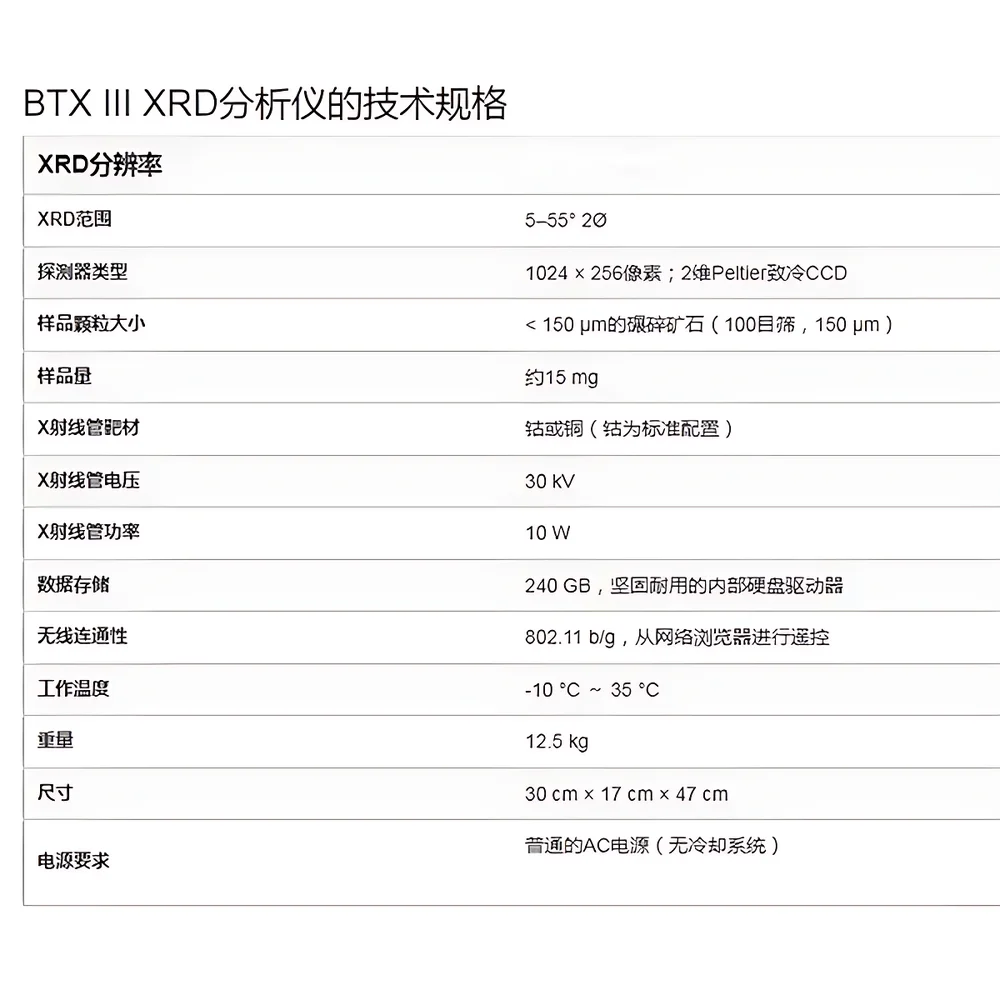
| Brand | EVDENT (formerly Olympus) |
|---|---|
| Origin | USA |
| Instrument Type | Powder X-ray Diffractometer |
| Form Factor | Benchtop |
| Resolution | 0.2° 2θ (FWHM) |
| Detector | CCD-based 2D area detector |
| Geometry | Transmission mode |
| X-ray Source | Co or Cu microfocus tube |
| Sample Mass Required | 15 mg |
| Weight | 12.5 kg |
| Cooling | Air-cooled, no water circulation |
| Power Consumption | Low-power X-ray tube (rated for >10 years nominal lifetime) |
| Connectivity | Built-in Wi-Fi AP + USB |
Ask about pricing, availability and specifications.
Overview
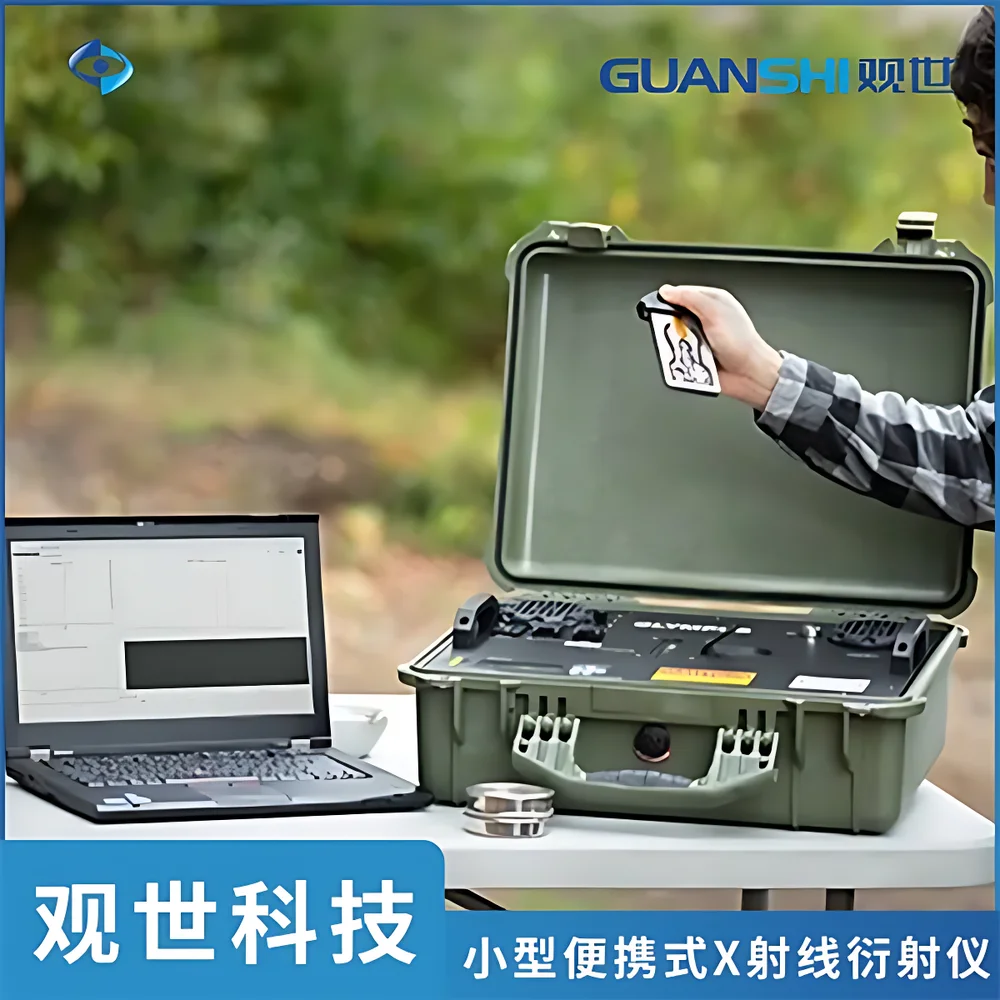
The EVDENT BTX III Portable X-ray Diffractometer is an engineered solution for rapid, field-deployable, and laboratory-grade powder X-ray diffraction (XRD) analysis. Unlike conventional θ–2θ goniometer-based diffractometers, the BTX III employs a fixed-geometry transmission configuration with a microfocus X-ray source and a two-dimensional charge-coupled device (CCD) area detector. This architecture eliminates all moving parts—no goniometer, no motorized stage, and no mechanical alignment—thereby delivering exceptional mechanical stability, long-term calibration retention, and immunity to vibration-induced artifacts. The system operates on Bragg’s law (nλ = 2d sinθ), capturing full Debye–Scherrer diffraction rings in a single exposure (~30 s), enabling real-time phase identification and semi-quantitative Rietveld refinement without scanning. Its transmission geometry ensures consistent angular resolution across variable sample densities—a critical advantage for low-Z materials such as pharmaceuticals, polymers, and soils, where reflection-mode instruments suffer from absorption-related peak broadening and intensity distortion.
Key Features
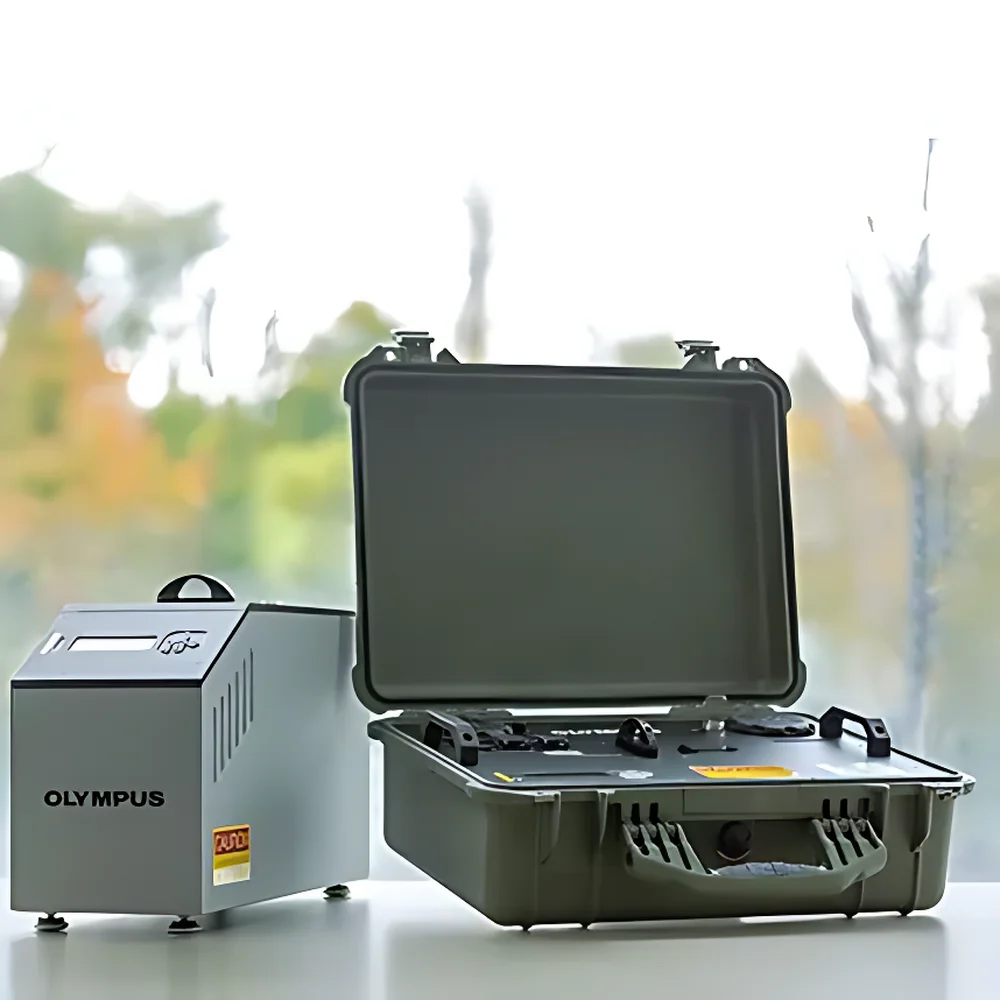
- True portable benchtop design: 12.5 kg total mass; fully integrated unit with no external cooling, high-voltage cabinet, or peripheral modules.
- Simultaneous XRD and XRF acquisition: Energy-resolving detector discriminates between elastically scattered XRD photons and characteristic XRF fluorescence, enabling concurrent crystallographic and elemental analysis.
- Transmission-mode optics: Fixed-sample geometry with polyimide film windows; eliminates preferred orientation bias and density-dependent resolution drift.
- Powder liquefaction sampling: Vibration-assisted randomization of crystallites within 30 seconds ensures statistically isotropic orientation distribution—critical for quantitative phase analysis per ISO 17851 and ASTM E975.
- No user calibration required: Factory-aligned optical path with permanent collimation; zero routine maintenance beyond periodic tube output verification.
- Low-power Co or Cu microfocus tube: Air-cooled, rated for >10 years under typical usage; eliminates dependency on chiller systems and reduces total cost of ownership.
Sample Compatibility & Compliance
The BTX III accepts loose powders, pressed pellets, and thin-film specimens mounted between polymer windows. Minimal sample mass (15 mg) mitigates preparation-induced artifacts—including texture, preferred orientation, and amorphous halo contamination—common in conventional grinding/pressing workflows. It complies with regulatory data integrity expectations for GLP and GMP environments: raw 2D diffraction images and processed patterns are timestamped, digitally signed, and stored with full audit trail metadata. Software supports 21 CFR Part 11-compliant electronic signatures and role-based access control. All quantitative outputs adhere to ISO 17851 (XRD phase quantification), ASTM E1423 (Rietveld methodology), and USP for pharmaceutical solid-state characterization.
Software & Data Management
The proprietary EVDENT XRD Suite provides automated phase identification via ICDD PDF-4+ database matching, full-pattern Rietveld refinement (using GSAS-II engine), lattice parameter extraction, residual stress evaluation (sin²ψ method), and XRF elemental quantification using fundamental parameters. All operations—including background subtraction, peak deconvolution, and crystallite size/strain modeling—are scriptable and reproducible. Data export supports CIF, XYE, CSV, and vendor-neutral HDF5 formats. Wireless operation via embedded Wi-Fi access point enables remote instrument control and live pattern streaming to Windows/macOS clients. Local storage retains ≥10,000 full-frame acquisitions with embedded GPS/geotagging for field deployments.
Applications
The BTX III serves cross-sectoral analytical needs requiring speed, portability, and structural fidelity. In geoscience, it performs real-time mineralogical logging of shale cuttings during mud logging operations (API RP 13D), quantifying quartz, illite, smectite, and pyrite at sub-0.5 wt% detection limits. In cement and building materials, it delivers rapid clinker phase analysis (alite, belite, ferrite) and limestone/dolomite ratio determination with ±0.02% repeatability. For pharmaceutical QA/QC, it verifies polymorphic form identity (e.g., ritonavir Form I vs. II), detects counterfeit APIs, and monitors hydrate/dehydrate transitions—all non-destructively and without sample dilution. In environmental forensics, it characterizes asbestos species (chrysotile, crocidolite) and heavy metal-bearing soil phases (e.g., jarosite, goethite) directly in situ or in mobile labs.
FAQ
Does the BTX III require external cooling or high-voltage infrastructure?
No. It uses an air-cooled, low-power microfocus X-ray tube and draws power from a standard 100–240 V AC input or optional battery pack.
Can it distinguish between structurally similar polymorphs, such as α- and γ-Al₂O₃?
Yes. Its 0.2° 2θ resolution and low-background transmission geometry enable clear separation of diagnostic peaks (e.g., 400 vs. 311 reflections) essential for polymorph discrimination.
Is Rietveld refinement supported out-of-the-box?
Yes. The included software integrates GSAS-II with preconfigured templates for common mineral, pharmaceutical, and metallurgical standards.
How is data integrity ensured for regulated environments?
All acquisitions include embedded timestamps, operator ID, instrument serial number, and cryptographic hash; audit logs record every processing step per 21 CFR Part 11 requirements.
What sample preparation tools are included?
A complete kit comprises stainless steel mortar/pestle, 45 µm sieve, polyimide film spacers, sample holders, and calibration standards (Si, NaCl, corundum).