
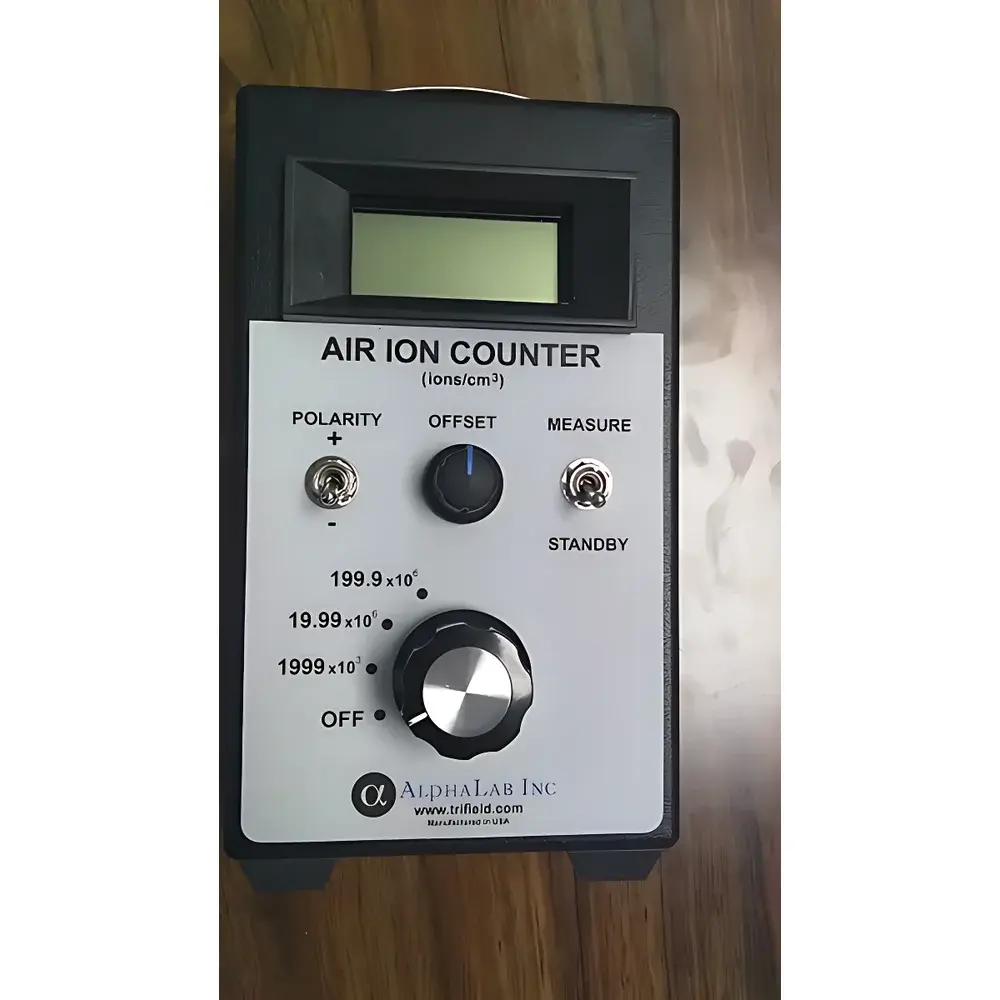
AIC200MJ Air Negative Ion Detector
| Origin | USA |
|---|---|
| Manufacturer Type | Authorized Distributor |
| Origin Category | Imported |
| Model | AIC200MJ |
| Price Range | USD 700–1,400 (FOB) |
| Air Flow Rate | 200 cm/s |
| Measurable Ion Polarity | Positive and Negative |
| Linear Detection Velocity | 40 cm/s |
| Display | Digital LCD |
| Measurement Range | 1 × 10³ to 2 × 10⁸ ions/cm³ |
| Response Time | ~10 s |
| Measurement Scales | Low / Medium / High |
| Minimum Detectable Concentration | 1 × 10³ ions/cm³ |
| Operating Humidity | ≤99 % RH (non-condensing) |
| Operating Temperature | −20 °C to +60 °C |
| Power Supply | 9 V alkaline battery |
| Dimensions | 65.1 × 93.98 × 76.2 mm |
| Weight | 420 g |
Overview
The AIC200MJ Air Negative Ion Detector is a portable, field-deployable electrometer-based instrument engineered for quantitative measurement of unipolar and bipolar air ion concentrations in ambient and controlled environments. It operates on the principle of parallel-plate corona-assisted ion collection: sampled air is drawn through a precisely defined 4-mm aperture into a polarization chamber where outer electrodes maintain a fixed electric field gradient of 1,000 V/m. Ions of opposite polarity migrate toward respective collector plates, while the central linear detection electrode measures induced current proportional to ion flux. This Coulombic detection architecture enables direct, real-time quantification of both positive and negative ion densities—without chemical reagents or radioactive sources—making it suitable for routine validation, R&D, and quality assurance in ion-generating device manufacturing and indoor air quality assessment.
Key Features
- True bipolar measurement capability: simultaneous detection and display of positive and negative ion concentrations (1 × 10³ – 2 × 10⁸ ions/cm³)
- Three-range manual scaling (Low/Medium/High) optimized for dynamic environmental variability and high-output ion generators
- Digital LCD readout with 10-second typical response time, ensuring rapid stabilization under transient airflow conditions
- Compact handheld form factor (65.1 × 93.98 × 76.2 mm; 420 g) powered by a single 9 V alkaline battery for >8 hours of continuous operation
- Robust environmental tolerance: functional across −20 °C to +60 °C and up to 99 % RH (non-condensing), supporting both laboratory and outdoor deployment
- Fixed 4-mm inlet orifice and calibrated 200 cm/s volumetric flow rate ensure reproducible sampling geometry per ASTM D8192-21 guidelines for air ion instrumentation
Sample Compatibility & Compliance
The AIC200MJ is validated for direct measurement of gaseous ion populations in free-air streams, ducted ventilation systems, and proximity zones near ion-emitting surfaces (e.g., ceramic emitters, needle-point corona arrays, photocatalytic coatings). It supports non-invasive assessment of ion emission from consumer appliances—including ionizing air conditioners, hair dryers, lamps, and functional textiles—as well as mineral-based materials (e.g., tourmaline-infused ceramics, zeolite composites) and electrostatically treated fabrics. While not certified to ISO 16000-30 or IEC 60601-2-69, its measurement methodology aligns with fundamental principles outlined in ANSI/ASHRAE Standard 55-2023 Annex H (ion concentration estimation) and serves as a primary verification tool during GLP-compliant development of ionization technologies.
Software & Data Management
The AIC200MJ operates as a standalone analog-to-digital converter with no embedded memory or USB/Bluetooth interface. All measurements are displayed in real time on the integrated LCD; users must manually record values or integrate the unit into custom data acquisition setups via its analog output (0–5 V DC, scalable to full range). For regulatory traceability, laboratories commonly pair the instrument with external logging hardware compliant with FDA 21 CFR Part 11 requirements—ensuring audit-ready timestamps, user authentication, and electronic signature support when used in GMP-aligned validation protocols for medical-grade ionizers or HVAC components.
Applications
- Performance validation of commercial negative ion generators (e.g., ozone-free corona discharge units, photoelectric emitters)
- QC testing of ion-emitting consumer electronics and home appliances per manufacturer internal specifications
- Indoor air quality (IAQ) surveys in healthcare facilities, offices, and residential spaces where ion balance correlates with perceived freshness
- R&D of functional building materials—such as ion-releasing paints, tiles, and polymer composites—under controlled climatic chambers
- Educational use in physics and environmental engineering labs to demonstrate gas-phase charge transport, atmospheric electrodynamics, and aerosol-ion interactions
FAQ
Does the AIC200MJ require calibration before each use?
No—factory calibration is stable for 12 months under normal operating conditions. Annual recalibration against a NIST-traceable reference ion source is recommended for ISO/IEC 17025-accredited labs.
Can it measure ions in polluted or high-particulate air?
Yes, but particulate loading >100 µg/m³ may cause sensor fouling over time; use with optional pre-filtration (e.g., 0.3 µm HEPA) is advised for long-term stability.
Is ozone generation inherent to its operation?
No—the AIC200MJ is a passive collector only; it introduces no voltage to the sample stream beyond the fixed polarization field and produces zero ozone.
What is the uncertainty specification at 1 × 10⁶ ions/cm³?
At mid-range concentrations, typical combined standard uncertainty is ±8 % (k = 2), derived from flow rate repeatability, electrode geometry tolerance, and ADC linearity.
Can it be used for outdoor atmospheric ion monitoring?
Yes—its wide temperature/humidity range and battery operation support field campaigns; however, wind-induced turbulence requires use of a diffusion screen or laminar flow hood for metrologically defensible results.
Related Products







