
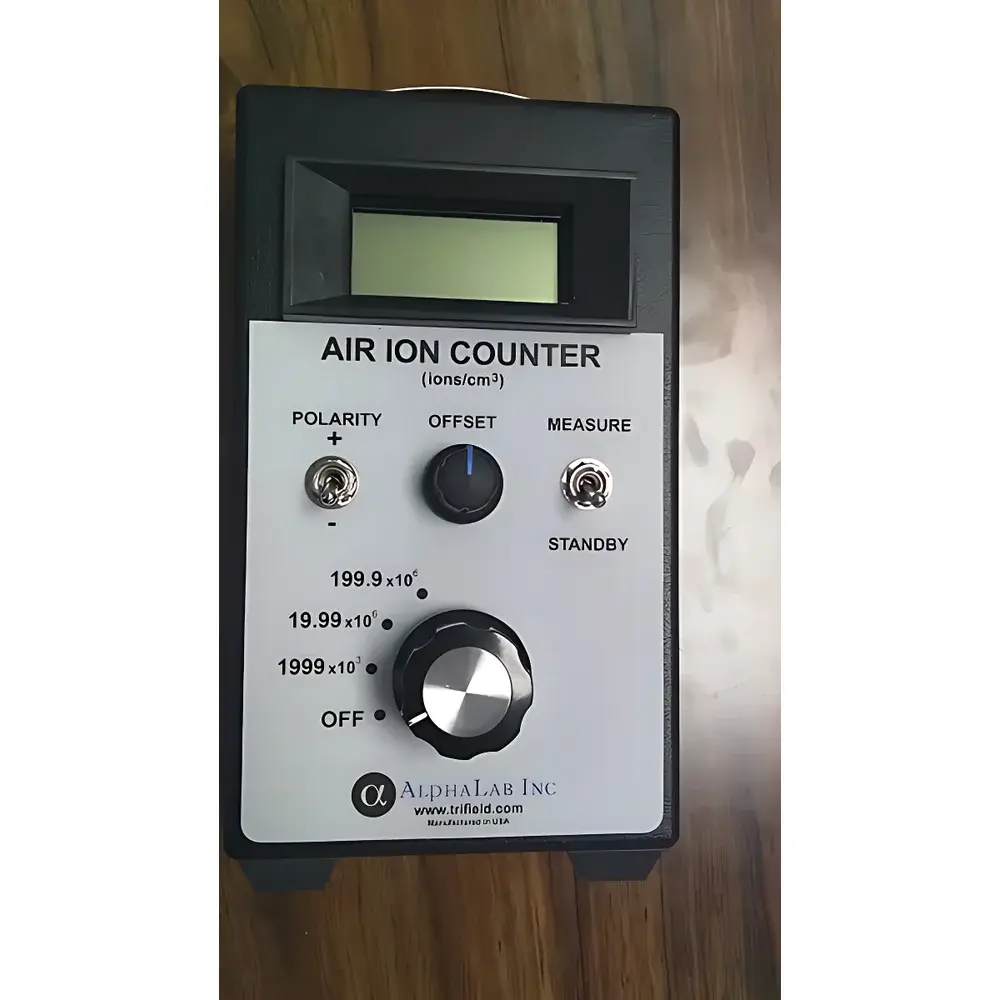
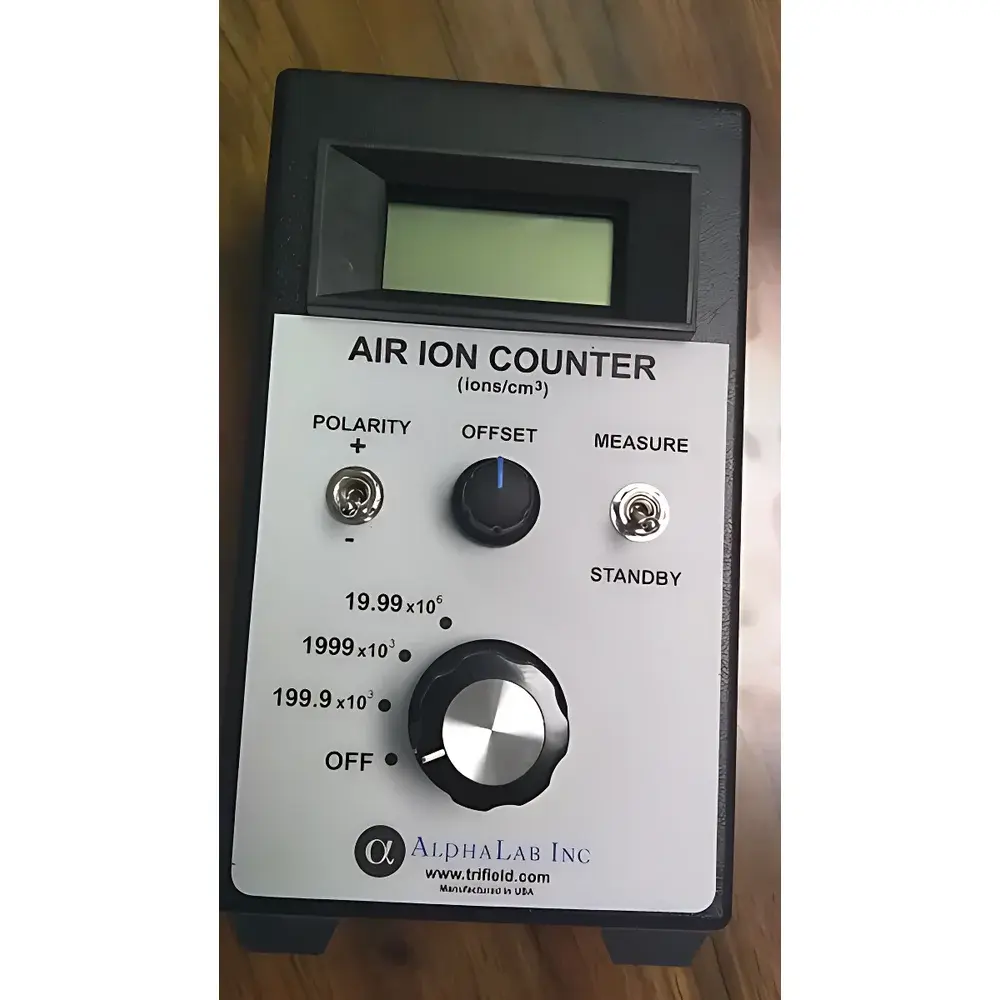
AIC20MJ Air Negative Ion Detector
| Origin | USA |
|---|---|
| Manufacturer Type | Authorized Distributor |
| Origin Category | Imported |
| Model | AIC20MJ |
| Price Range | USD 700 – 1,400 |
Overview
The AIC20MJ Air Negative Ion Detector is a portable, field-deployable electrometer-based instrument engineered for quantitative measurement of unipolar and bipolar air ion concentrations in ambient and controlled environments. It operates on the principle of parallel-plate corona-assisted ion collection: ambient air is drawn at a calibrated volumetric flow rate (200 cm³/s) through a precisely defined 4-mm aperture into a polarization chamber where outer electrodes maintain a fixed electric field gradient of 1,000 V/m. Charged ions are directionally driven toward oppositely polarized collector plates; the central linear detection electrode measures induced current proportional to ion flux. This Coulombic detection method—traceable to fundamental charge quantization—enables direct, real-time enumeration of both positive and negative ions without chemical modification or radioactive sources. Designed for scientific rigor and operational robustness, the AIC20MJ delivers reliable ion density data across diverse environmental matrices including outdoor atmospheres, indoor workspaces, forested microclimates, and material surface emission studies.
Key Features
- True bipolar ion detection: Simultaneous, independent quantification of positive and negative ion concentrations
- Wide dynamic range: 100 to 2 × 10⁷ ions/cm³ with linear response across three user-selectable sensitivity ranges (Low / Medium / High)
- Fast response time: <10 seconds for stable reading acquisition under steady-state conditions
- Integrated airflow control: Precision fan-driven sampling at 200 cm³/s ensures consistent volumetric throughput and minimizes boundary-layer effects
- High-resolution digital display: Backlit LCD showing real-time ion concentration (ions/cm³), polarity status, and battery level
- Rugged portable design: Compact housing (165.1 × 93.98 × 76.2 mm), lightweight (420 g), and IP54-rated for dust and splash resistance
- Extended operational autonomy: Up to 60 hours standby or 5 hours continuous measurement on a single 9 V alkaline battery
Sample Compatibility & Compliance
The AIC20MJ is validated for direct measurement of gaseous ion populations in ambient air, HVAC exhaust streams, and near-surface emission zones. Its non-destructive electrostatic collection architecture permits characterization of ion generation from natural sources (e.g., waterfalls, pine forests), anthropogenic emitters (e.g., corona discharge devices, HVAC ionizers), and material surfaces—including mineral specimens (granite, tourmaline), textiles, and synthetic polymers—when placed within the instrument’s defined sampling zone. The device complies with IEC 61000-4-2 (ESD immunity) and meets basic electromagnetic compatibility (EMC) requirements per FCC Part 15 Class B. While not certified for regulatory compliance reporting under ISO 16000-30 or ASTM D8193, its measurement methodology aligns with established principles outlined in ISO/IEC 17025–accredited laboratories for method validation. Operating temperature range (−20 °C to +60 °C) and humidity tolerance (≤99 % RH, non-condensing) support deployment across temperate, arid, and tropical field conditions.
Software & Data Management
The AIC20MJ operates as a standalone, embedded-system instrument with no proprietary software dependency. All measurements are displayed and stored locally on-device memory (up to 99 logged sessions). Data export is supported via optional RS-232 serial interface (cable sold separately), enabling integration with third-party logging platforms compliant with GLP/GMP audit trail requirements. Timestamped readings include polarity flag, concentration value, and measurement mode. Firmware supports user-configurable auto-zero calibration cycles and sensor drift compensation algorithms based on internal reference stability monitoring. For laboratory QA/QC workflows, raw output files conform to ASCII CSV format, facilitating import into statistical analysis tools (e.g., JMP, MATLAB, Python pandas) and LIMS systems.
Applications
- Environmental health assessment: Correlation of negative ion levels with particulate matter (PM₂.₅/PM₁₀), ozone, and VOC concentrations in urban and rural settings
- Indoor air quality (IAQ) auditing: Validation of ionizer efficacy in offices, hospitals, and cleanrooms per ASHRAE Standard 62.1
- Materials science research: Quantifying surface ion emission from piezoelectric minerals, photocatalytic coatings, and electrostatic dissipative fabrics
- Eco-physiological studies: Field monitoring of biogenic ion production in forest canopies, coastal zones, and high-altitude ecosystems
- Product development testing: Performance benchmarking of commercial air purifiers, wearable ion emitters, and HVAC-integrated ionization modules
- Educational use: Hands-on instruction in atmospheric electricity, gas-phase charge transport, and instrumentation physics at undergraduate and graduate levels
FAQ
Does the AIC20MJ require periodic calibration with certified ion sources?
Yes—while factory-calibrated against NIST-traceable reference ion generators, users should perform annual verification using a secondary standard source or inter-laboratory comparison protocol.
Can it measure ions in moving air (e.g., wind tunnels or duct flows)?
It is optimized for static or low-turbulence sampling; for dynamic airflow, mounting must ensure laminar entry through the 4-mm aperture—velocity exceeding 40 cm/s may induce turbulent diffusion errors.
Is the device suitable for explosive or hazardous atmospheres?
No—it lacks ATEX, IECEx, or UL HazLoc certification and must not be deployed in Class I Division 1 or Zone 0/1 environments.
What is the minimum detectable ion concentration and its uncertainty?
The lower limit of quantification is 100 ions/cm³; typical measurement uncertainty at this level is ±15 % (k=2) under controlled lab conditions, increasing to ±25 % in high-humidity field settings.
How does humidity affect measurement accuracy?
Relative humidity >85 % RH may promote ion clustering and reduce mobility; the instrument compensates empirically but recommends concurrent RH monitoring for data interpretation.







