
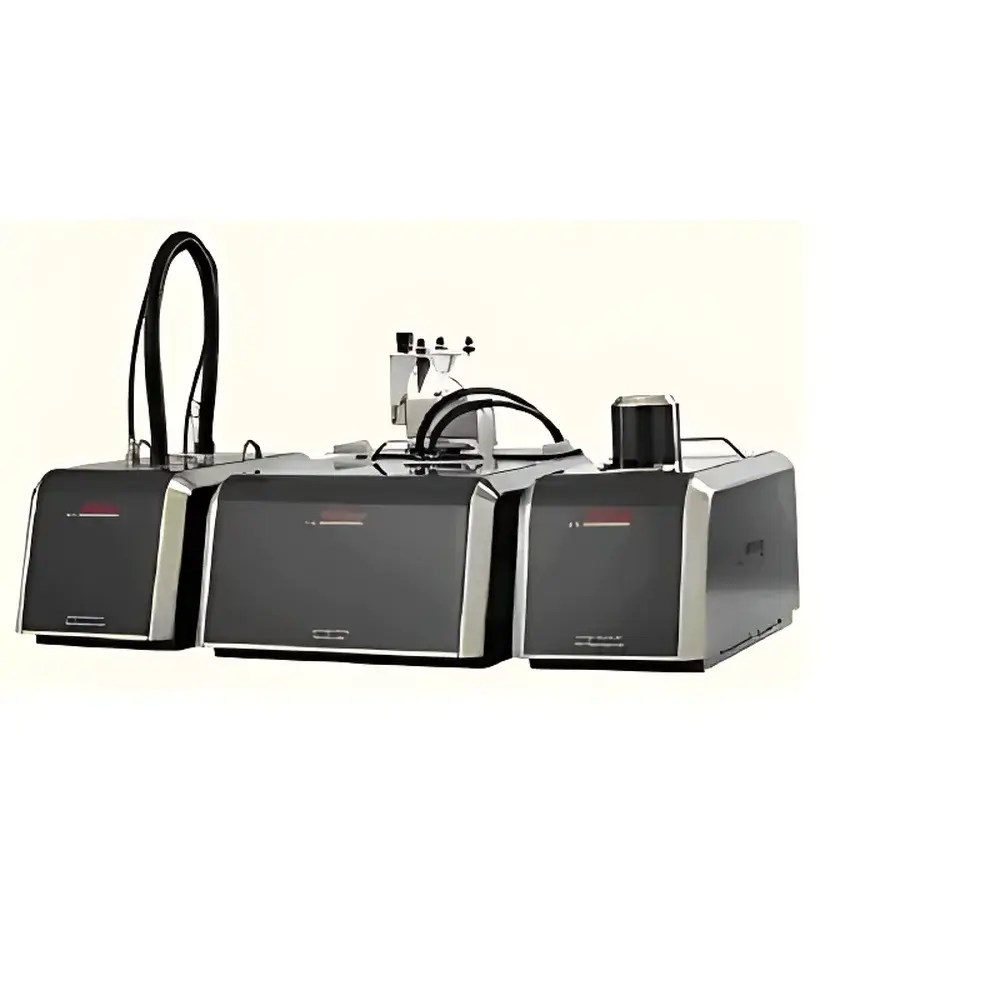
Analysette 22 Micro Tec Plus Laser Particle Size Analyzer by FRITSCH
| Brand | FRITSCH |
|---|---|
| Origin | Germany |
| Manufacturer | FRITSCH GmbH |
| Type | Laboratory Laser Diffraction Particle Size Analyzer |
| Measurement Range | 0.01–2000 µm |
| Repeatability | <0.5% |
| Measurement Time | 5–10 s (per single measurement) |
| Dispersion Method | Dry & Wet |
| Optical Design | Inverse Fourier Configuration with Movable Detector Module |
| Laser Sources | 532 nm (green) and 940 nm (infrared) |
| Detection Channels | 108 |
| Sample Loop Volume | 300–500 mL (software-selectable) |
| Ultrasonic Probe | Adjustable Power & Frequency |
| Compliance | ISO 13320:2020 |
| Software | FRITSCH MaS v5.x (compliant with FDA 21 CFR Part 11 audit trail requirements) |
Overview
The Analysette 22 Micro Tec Plus is a high-precision, dual-wavelength laser diffraction particle size analyzer engineered by FRITSCH GmbH in Idar-Oberstein, Germany. It operates on the fundamental principle of Fraunhofer diffraction and Mie theory—optimized via inverse Fourier optical configuration—to deliver accurate, reproducible size distribution data across an exceptionally broad dynamic range (0.01–2000 µm). Unlike conventional single-laser systems, its integrated dual-laser architecture (532 nm green and 940 nm infrared) enables simultaneous optimization for both fine sub-micron particles and coarse aggregates, eliminating the need for instrument switching or hardware reconfiguration. The system’s modular cartridge-based measuring unit allows rapid optical path recalibration and cross-platform compatibility with FRITSCH’s NanoTec detection module, ensuring metrological continuity from nanoscale to millimeter-scale analysis. Designed explicitly for R&D laboratories, QC departments, and regulatory-compliant manufacturing environments, the Micro Tec Plus meets the stringent performance benchmarks defined in ISO 13320:2020 for laser diffraction methodology.
Key Features
- Dual-laser optical system (532 nm + 940 nm) enabling extended sensitivity across ultrafine (1000 µm) fractions without compromise
- Inverse Fourier optical layout with motorized, position-adjustable detector module for real-time alignment verification and long-term optical stability
- 108-channel high-resolution photodetector array with adaptive signal amplification and background noise suppression
- Modular cartridge-style measurement cell—field-replaceable in under 90 seconds with no optical recalibration required
- Independent wet dispersion unit featuring software-controlled radial pump (flow rate: 0.5–4.0 L/min), adjustable ultrasonic probe (20–60 W, 20 kHz), and programmable sonication duration
- Three selectable sample loop volumes (300 / 400 / 500 mL) managed directly via MaS software interface to match suspension viscosity and particle loading density
- Optimized for aqueous media and common organic solvents including isopropanol, ethanol, and xylene—no mechanical stirrer required due to laminar-flow hydrodynamic design
- Integrated temperature monitoring (±0.2 °C resolution) and ambient light shielding to minimize environmental interference
Sample Compatibility & Compliance
The Micro Tec Plus accommodates dry powders (via optional dry dispersion module) and liquid suspensions across diverse material classes: metal oxides, pharmaceutical actives, battery cathode precursors, ceramic slurries, polymer emulsions, and mineral tailings. Its wet dispersion system complies with ISO 13320 Annex B guidelines for dispersion validation, supporting method transfer between instruments. All measurement protocols—including sonication energy input, flow velocity, and refractive index assignment—are fully documented and exportable as PDF reports. The system adheres to GLP/GMP documentation standards: MaS software provides electronic signatures, user access levels, full audit trails, and 21 CFR Part 11–compliant data integrity controls (including immutable raw scattering patterns and timestamped parameter logs).
Software & Data Management
FRITSCH MaS (Measurement & Analysis Software) v5.x serves as the central control, acquisition, and evaluation platform. It supports real-time visualization of raw scattering patterns, automatic baseline correction, and multi-modal deconvolution using proprietary iterative algorithms. Users can define custom SOPs with embedded pass/fail criteria, generate comparative overlay plots across batches or instruments, and export results in ASTM E2927-21–compatible CSV, XML, or PDF formats. Raw data files (.frd) are stored in a relational SQLite database with SHA-256 checksum validation; backup and versioning are automated via configurable network paths. Remote diagnostics and firmware updates are supported over secure TLS-encrypted connections.
Applications
- Pharmaceutical development: API crystallization monitoring, excipient grading, and inhaler formulation validation per USP & EP monographs
- Advanced materials R&D: Nanoparticle synthesis optimization, slurry rheology correlation, and electrode coating uniformity assessment
- Quality assurance in ceramics & abrasives: Batch-to-batch consistency verification against internal specifications and ISO 13320 reference materials
- Environmental testing labs: Sediment grain-size classification per ASTM D422 and ISO 14688-1
- Food & beverage: Emulsion stability profiling, starch granule sizing, and cocoa powder agglomeration analysis
- Academic research: Fundamental studies of particle breakage, aggregation kinetics, and interfacial phenomena in colloidal systems
FAQ
Does the Micro Tec Plus require annual factory recalibration?
No—its self-diagnostic optical alignment routine and NIST-traceable reference standards enable in-house verification. Factory recalibration is recommended only after physical impact or major component replacement.
Can the system analyze opaque or highly absorbing particles?
Yes—the 940 nm infrared laser significantly reduces absorption artifacts in carbon black, iron oxide, or pigment dispersions, while Mie modeling with user-defined complex refractive indices ensures accuracy.
Is method validation support available for regulated industries?
FRITSCH provides IQ/OQ documentation templates, validation protocol examples aligned with ICH Q5A and ASTM E2927, and on-site qualification support upon request.
How does the system handle high-concentration suspensions?
The adjustable loop volume (300–500 mL), variable pump speed, and dual-laser attenuation compensation collectively maintain optimal obscuration (8–12%) across concentrations up to 40 vol% for non-aggregating systems.
What maintenance intervals are recommended for the wet dispersion unit?
Ultrasonic probe tips should be inspected quarterly; pump seals and tubing are rated for ≥10,000 cycles and documented in the preventive maintenance log within MaS software.



