
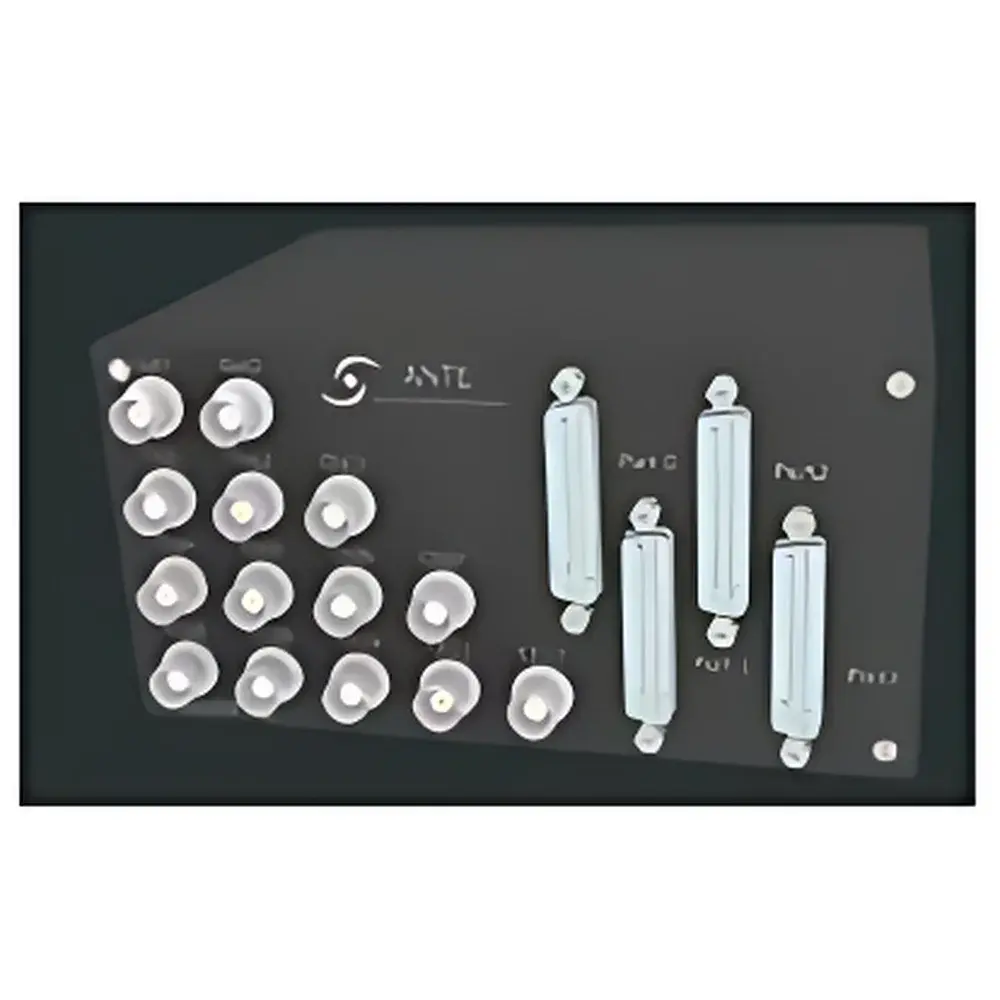
Ante Neutron Scattering System NS-1
| Origin | Austria |
|---|---|
| Manufacturer Type | Authorized Distributor |
| Origin Category | Imported Instrument |
| Model | NS-1 |
| Pricing | Available Upon Request |
Overview
The Ante Neutron Scattering System NS-1 is a modular, high-performance data acquisition and control platform engineered for time-of-flight (TOF) neutron scattering instrumentation at pulsed neutron sources. It operates on the fundamental principle of neutron time-of-flight spectroscopy—measuring the arrival time distribution of neutrons after scattering from a sample to determine their energy transfer (ΔE) and momentum transfer (Q), enabling quantitative analysis of atomic and magnetic structures, phonon and magnon dispersions, and diffusive dynamics in condensed matter systems. Designed for integration with modern spallation neutron sources—including those operating at megawatt-class beam power—the NS-1 system supports high-flux, high-resolution experiments across a broad range of scientific domains: quantum materials characterization, soft-matter dynamics, protein conformational studies, battery electrode evolution, and nuclear cross-section validation. Its architecture prioritizes low-latency event timestamping, deterministic synchronization with accelerator RF clocks, and scalable I/O for multi-detector arrays.
Key Features
- High-precision Time-of-Flight (TOF) event recording with sub-nanosecond timing resolution, synchronized to external 10 MHz or RF reference signals from the neutron source.
- Dual-mode beam monitoring capability: real-time intensity normalization via fission chamber or scintillator-based monitors integrated into the data stream.
- LisToF unit: FPGA-based event processing engine supporting configurable trigger logic, dead-time correction, and on-the-fly histogramming for single-detector or small-array configurations.
- LisTDC unit: 32-channel high-density time-to-digital converter module optimized for position-sensitive detectors (e.g., multi-wire proportional counters, microchannel plate detectors), delivering 3D spatial encoding (X, Y, Z) alongside TOF stamps.
- Modular event recording architecture: supports plug-in acquisition modules with customizable buffer depth, ring-buffer streaming, and lossless data capture at sustained rates exceeding 500 kHz per channel.
- Integrated spectrometer control interface: programmable motion control (motorized goniometers, cryostat stages), environmental parameter logging (temperature, magnetic field, pressure), and hardware-triggered experiment sequencing compliant with EPICS and TANGO control frameworks.
Sample Compatibility & Compliance
The NS-1 system imposes no intrinsic constraints on sample composition, geometry, or environment—it interfaces transparently with standard neutron sample environments including closed-cycle refrigerators (4 K–300 K), superconducting magnets (up to 12 T), and high-pressure cells (up to 10 GPa). All firmware and driver software comply with IEC 61508 SIL-2 functional safety requirements for industrial control systems. Data acquisition workflows adhere to ISO/IEC 17025:2017 guidelines for testing laboratories, and timestamp provenance meets traceability requirements for GLP-compliant neutron experiments. The system supports audit-ready metadata embedding (sample ID, operator, beamline parameters, calibration history) directly into HDF5-formatted raw data files, ensuring full FAIR (Findable, Accessible, Interoperable, Reusable) compliance.
Software & Data Management
The NS-1 ships with Ante’s proprietary LisControl Suite—a cross-platform (Linux/Windows) application suite built on Qt and Python 3.9+, featuring a modular plugin architecture. Core components include LisConfig (hardware configuration and calibration management), LisAcquire (real-time acquisition GUI with live histogram overlays and detector efficiency correction), and LisReduce (batch processing pipeline compatible with Mantid Framework v6.x+). All software modules implement full 21 CFR Part 11-compliant electronic signatures, role-based access control, and immutable audit trails for every parameter change, file export, or calibration update. Raw data is written in NeXus/HDF5 format using the NXevent_data and NXdetector conventions, enabling seamless ingestion into major neutron analysis platforms including DAWN, SasView, and ESS Data Reduction Pipeline.
Applications
- Quantitative magnetic structure refinement using polarized neutron diffraction on single crystals and thin films.
- In-situ operando studies of Li-ion battery cathode phase transitions under electrochemical cycling.
- Protein hydration shell dynamics measured via quasielastic neutron scattering (QENS) on backscattering and cold-neutron spectrometers.
- Phonon dispersion mapping in topological insulators and correlated electron oxides using triple-axis and time-of-flight techniques.
- Validation of nuclear data libraries (e.g., ENDF/B-VIII.0) through high-accuracy neutron total cross-section measurements on isotopically enriched targets.
FAQ
Is the NS-1 compatible with existing neutron beamlines at ESS, SNS, or J-PARC?
Yes—the system implements standard NMX and EPICS IOC interfaces and has been validated on instruments including V20 (HZB), CORELLI (ORNL), and AMOR (PSI). Custom beamline integration support is available under NDA.
Does the LisTDC unit support multi-hit capability per channel?
Yes—each TDC channel supports up to 4 simultaneous hits within a 1 µs window, with timestamp resolution of 250 ps RMS and linearity better than ±50 ps over 100 ns range.
Can the system operate in stand-alone mode without a central control network?
Yes—local operation is fully supported via embedded Linux runtime; all modules retain full functionality including real-time histogramming, beam monitor feedback, and local data storage to NVMe SSD.
What calibration standards are provided with the NS-1?
NIST-traceable timing calibration kits (including delay lines and pulsed LED references), detector gain/offset maps, and TOF zero-delay verification procedures are included with initial commissioning.
Is remote maintenance and firmware update supported?
Yes—secure SSH-based remote access with dual-factor authentication is enabled by default; firmware updates are delivered as signed Debian packages with SHA-256 hash verification and rollback capability.







