
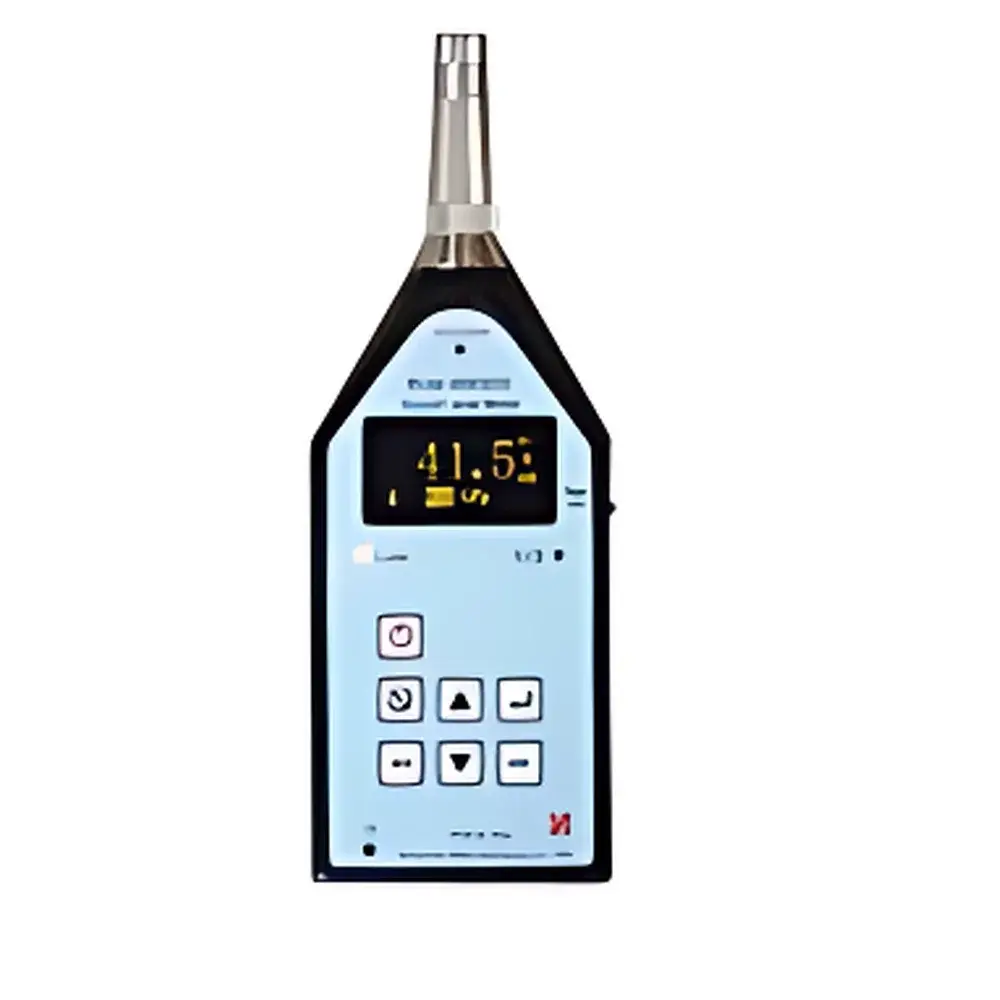
AWA5636 Series Digital Sound Level Meter
| Origin | Jiangsu, China |
|---|---|
| Manufacturer Type | Authorized Distributor |
| Origin Category | Domestic (PRC) |
| Model | AWA5636 |
| Pricing | Available Upon Request |
| Compliance | IEC 61672:2002 Class 2, GB/T 3785–2010 Class 2 |
| Frequency Weighting | A, C, Z |
| Time Weighting | F, S, I, Peak |
| Frequency Range | 20 Hz – 12.5 kHz |
| Measurement Upper Limit | >130 dB |
| Self-Noise | <25 dBA (AWA5636-1/2/3/4) |
| Display | 128×64 dot-matrix LCD |
| A/D Sampling Rate | 32 kHz |
| Output Interfaces | AC (3-level adjustable), DC, RS-232 (optional or standard per variant), USB (optional or standard per variant) |
| Data Storage | Up to 8,000 measurement sets (AWA5636-1/3/4) |
| Integration Times | Manual or preset intervals from 1 s to 24 h |
| Key Metrics | L<sub>p</sub>, L<sub>eq,t</sub>, L<sub>peak</sub>, L<sub>max</sub>, L<sub>min</sub>, SEL, E, L<sub>ex,8h</sub>, TWA, DOSE, L<sub>5</sub>–L<sub>95</sub>, SD, Lex, Volt, Timestamp, Energy |
| Statistical Analysis | Optional software-enabled (L<sub>5</sub>, L<sub>10</sub>, L<sub>50</sub>, L<sub>90</sub>, L<sub>95</sub>, Standard Deviation) |
| Operating Temperature | –20 °C to +50 °C (model-dependent) |
| Watchdog Circuit | Integrated |
Overview
The AWA5636 Series Digital Sound Level Meter is a modular, microprocessor-controlled acoustic measurement instrument engineered for precision environmental and occupational noise assessment in compliance with international metrological standards. Based on digital signal processing (DSP) architecture and real-time digital detection algorithms, the AWA5636 eliminates mechanical range switching—enabling seamless, high-fidelity measurement across its full dynamic span. Its core transduction system utilizes a pre-polarized condenser microphone (e.g., AWA14421), calibrated traceably to national acoustic standards, and operates under strict adherence to IEC 61672:2002 Class 2 and GB/T 3785–2010 Class 2 requirements. Designed for field robustness and laboratory-grade repeatability, the instrument delivers stable performance across industrial, municipal, transportation, and occupational health applications—including machinery noise characterization, community sound mapping, workplace hearing conservation programs, and regulatory compliance monitoring per ISO 1996, ISO 9612, and OSHA 29 CFR 1910.95.
Key Features
- DSP-based digital detection architecture ensures wide dynamic range (>105 dB), high linearity, and immunity to analog drift—eliminating manual range selection and reducing operator error.
- Modular configuration allows users to select variants (AWA5636-0 through -4) optimized for specific use cases—from basic spot measurements to extended-duration integrated dosimetry and statistical analysis.
- Extended operational temperature range (–20 °C to +50 °C, depending on model) supports deployment in diverse climatic conditions, including outdoor environmental monitoring and unconditioned industrial facilities.
- Integrated watchdog circuitry enhances long-term reliability during unattended operation, critical for 24-hour noise logging in environmental impact assessments.
- Three-level AC output (with user-selectable amplitude) and DC output enable direct connection to external data loggers, spectrum analyzers, or SCADA systems for continuous monitoring networks.
- Comprehensive time-weighting options (Fast, Slow, Impulse, Peak) and frequency weightings (A, C, Z) satisfy both regulatory reporting requirements (e.g., A-weighted Leq for community noise) and engineering diagnostics (e.g., C-weighted peak for impulsive events).
Sample Compatibility & Compliance
The AWA5636 is compatible with standardized 1/2-inch condenser microphones conforming to IEC 61094, including the factory-calibrated AWA14421. It supports measurement of airborne sound pressure levels in gaseous media (primarily ambient air) under standard atmospheric conditions (101.3 kPa, 23 °C, 50% RH). All variants meet IEC 61672:2002 Class 2 accuracy specifications for sound level meters, including permissible tolerances for frequency response, time weighting, linearity, and self-noise. The instrument’s design facilitates traceable calibration using certified acoustic calibrators (e.g., Class 1 pistonphones per IEC 60942), and supports documented calibration history management when used with optional PC software. While not intrinsically rated for hazardous locations, it may be deployed in conjunction with explosion-proof microphone extensions where required by local safety regulations (e.g., ATEX Zone 2 or IECEx Zone 2).
Software & Data Management
Optional Windows-based configuration and analysis software enables full instrument control, data download, report generation, and advanced post-processing. When licensed, the software unlocks statistical analysis functions—including percentile calculations (L5, L10, L50, L90, L95), standard deviation, and time-history plotting. Data export is supported in CSV, TXT, and XML formats for integration into enterprise LIMS or environmental management systems. Stored datasets include full metadata: date/time stamps, measurement parameters (weighting, time constant, integration duration), raw metrics, and user-defined notes. The RS-232 and USB interfaces support bidirectional communication compliant with standard serial protocols, enabling automated batch calibration verification and firmware updates. Audit trail functionality—recording operator ID, parameter changes, and calibration events—is configurable to align with GLP and internal QA procedures.
Applications
- Environmental noise monitoring: Community noise mapping, construction site compliance, wind turbine noise assessment, airport noise contouring.
- Occupational hygiene: Eight-hour time-weighted average (Lex,8h) and noise dose (DOSE) calculation per ISO 9612 and OSHA guidelines.
- Product noise certification: Testing of household appliances, power tools, HVAC equipment, and automotive components against ISO 3744, ISO 3746, or EN ISO 11201.
- Acoustic research and education: Fundamental acoustics labs, vibration–acoustics coupling studies, and teaching of metrological principles in physics and engineering curricula.
- Municipal enforcement: Field verification of local noise ordinances, complaint investigations, and pre- and post-mitigation evaluation.
FAQ
What standards does the AWA5636 comply with?
It conforms to IEC 61672:2002 Class 2 and GB/T 3785–2010 Class 2 for sound level meters, ensuring metrological validity for regulatory reporting in China and internationally recognized jurisdictions.
Can the AWA5636 perform 24-hour continuous noise logging?
Yes—models AWA5636-1, -3, and -4 support programmable integration times up to 24 hours, with automatic timestamping and internal storage of up to 8,000 measurement records.
Is statistical analysis (e.g., L10, L90) built-in or software-dependent?
Statistical functions require optional software licensing; the hardware captures raw time-series data, and post-processing is performed via PC application.
Does the instrument support external trigger or synchronization?
No native hardware trigger input is provided; however, time-synchronized multi-instrument deployments can be achieved via GPS-referenced timestamps when used with compatible external timing modules.
How is calibration traceability maintained?
Each unit ships with a factory calibration certificate referencing national primary standards; periodic recalibration is recommended annually or per ISO/IEC 17025-accredited laboratories using IEC 60942-compliant calibrators.







