
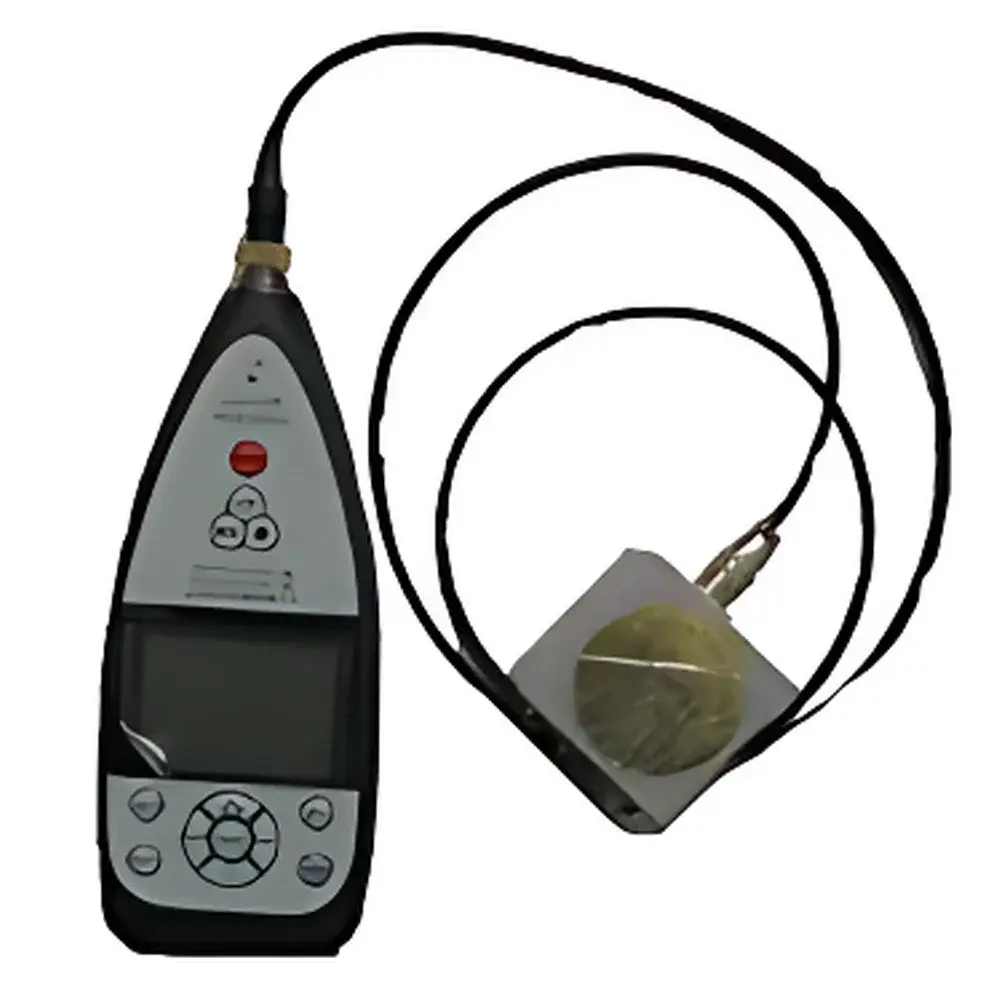
AWA6256B+ Environmental Vibration Analyzer
| Origin | Jiangsu, China |
|---|---|
| Manufacturer Type | Authorized Distributor |
| Model | AWA6256B+ |
| Pricing | Upon Request |
Overview
The AWA6256B+ Environmental Vibration Analyzer is a precision digital instrument engineered for compliant, high-stability measurement of human-body-weighted and unweighted vibration in environmental and occupational settings. It implements real-time digital signal processing (DSP) to perform parallel frequency weighting—W.B.z (whole-body vertical), W.B.x-y (whole-body horizontal), and flat (linear) response—alongside exponential (1 s and 8 s time constants) and linear time averaging. Designed in strict accordance with GB/T 10071–1988 *Methods for Measurement of Environmental Vibration* and ISO 8041:1990 *Human Response to Vibration — Instrumentation*, the AWA6256B+ meets the metrological requirements for field-deployable vibration assessment where regulatory conformance and long-term repeatability are critical. Its DSP-based architecture eliminates analog drift, extends dynamic range, and ensures future readiness for evolving national standards aligned with ISO 8041:2005—making it suitable for municipal environmental monitoring agencies, industrial hygiene laboratories, railway and construction noise/vibration impact studies, and third-party compliance verification.
Key Features
- Digital implementation of all frequency weightings (W.B.z, W.B.x-y, flat) and time-weighting functions (1 s/8 s exponential, linear), ensuring superior stability and reproducibility over temperature and time
- Integrated triaxial-capable piezoelectric acceleration sensor with 40 mV/(m·s⁻²) sensitivity and 550 g mass, optimized for low-frequency structural vibration coupling
- Measurement range of 48 dB to 158 dB (re: 10⁻⁶ m/s²), with three selectable input ranges (48–138 dB, 58–148 dB, 68–158 dB) to maintain >90 dB linearity across operating conditions
- High-resolution 240 × 160 dot-matrix LCD with electroluminescent backlight and 0.01 dB display resolution for on-site readability under variable ambient lighting
- Configurable integration periods from 1 second to 24 hours, plus user-defined intervals; statistical sampling at 0.1 s resolution supports robust percentile analysis (VL₅, VL₁₀, VL₅₀, VL₉₀, VL₉₅)
- Onboard 64 kB Flash memory stores up to 128 complete measurement sessions—including instantaneous VL, VLmax, VLmin, VLeq, standard deviation (SD), and time-history metadata
- RS-232 serial interface supports direct connection to thermal printers for field reporting or PC-based data export via proprietary configuration software
- Embedded real-time clock with ≤1 minute/month drift; built-in GB2312-compliant Chinese character set enables bilingual site labeling (e.g., “Bridge Abutment – Pile Driving Zone”)
Sample Compatibility & Compliance
The AWA6256B+ is validated for use with standard seismic-grade mounting fixtures (e.g., magnetic bases, stud mounts, or concrete anchors) and operates within a certified frequency band of 1 Hz to 80 Hz—covering the dominant energy range of transportation-induced ground-borne vibration, building service equipment, pile driving, and blasting. Its W.B.z and W.B.x-y weightings conform to ISO 5349-1 (hand-arm), ISO 2631-1 (whole-body), and GB/T 13441.1–2007 (China’s national implementation of ISO 2631). While not a Class 1 sound level meter per IEC 61672, its vibration transducer calibration traceability follows JJG 676–2019 (Chinese national metrological verification regulation for vibration analyzers). The device supports GLP-aligned data integrity through timestamped, non-erasable internal storage and audit-ready output logs.
Software & Data Management
Data retrieval and post-processing are performed using the manufacturer’s Windows-compatible desktop application, which imports ASCII-formatted .CSV or proprietary binary files via RS-232. The software enables spectral validation checks, comparative overlay of multiple measurement sets, automated report generation (PDF/Excel), and annotation of geotagged measurement locations. All stored records include full metadata: date/time stamp, sensor ID, weighting mode, integration duration, battery status, and operator-entered site descriptors. No cloud upload or remote telemetry functionality is embedded—ensuring full data sovereignty and alignment with ISO/IEC 17025 laboratory information management system (LIMS) requirements for offline validation workflows.
Applications
- Environmental impact assessment (EIA) for infrastructure projects (railways, highways, urban transit systems)
- Compliance monitoring near residential zones adjacent to industrial facilities, ports, or construction sites
- Baseline vibration characterization prior to commissioning of heavy machinery or HVAC systems
- Forensic vibration analysis in building damage investigations (e.g., cracking correlated with nearby excavation)
- Research-grade data acquisition for ISO 2631-2 (building vibration) and ISO 5349 (hand-transmitted vibration) method development
- Calibration verification of permanent monitoring networks using portable reference instrumentation
FAQ
Does the AWA6256B+ meet current ISO 8041:2005 requirements?
It is fully compatible with ISO 8041:1990 and designed with firmware-upgradable DSP architecture to support future alignment with ISO 8041:2005 upon official adoption of revised national standards.
Can the internal memory be expanded?
No—the 64 kB Flash memory is fixed and non-expandable; however, its capacity supports 128 full-session records with metadata, sufficient for multi-day field campaigns.
Is external power operation supported during continuous logging?
Yes—5 V DC external power input enables uninterrupted 24-hour measurements without battery depletion, while maintaining full sensor performance and real-time clock accuracy.
What is the calibration interval recommendation?
Annual calibration against a traceable reference vibration calibrator (e.g., B&K 4294 or equivalent) is recommended per JJG 676–2019 and ISO/IEC 17025 clause 6.5.
Does the instrument provide real-time FFT analysis?
No—it performs weighted RMS detection and statistical analysis only; spectral decomposition requires post-processing of time-series data exported to external software such as MATLAB or Python SciPy.







