
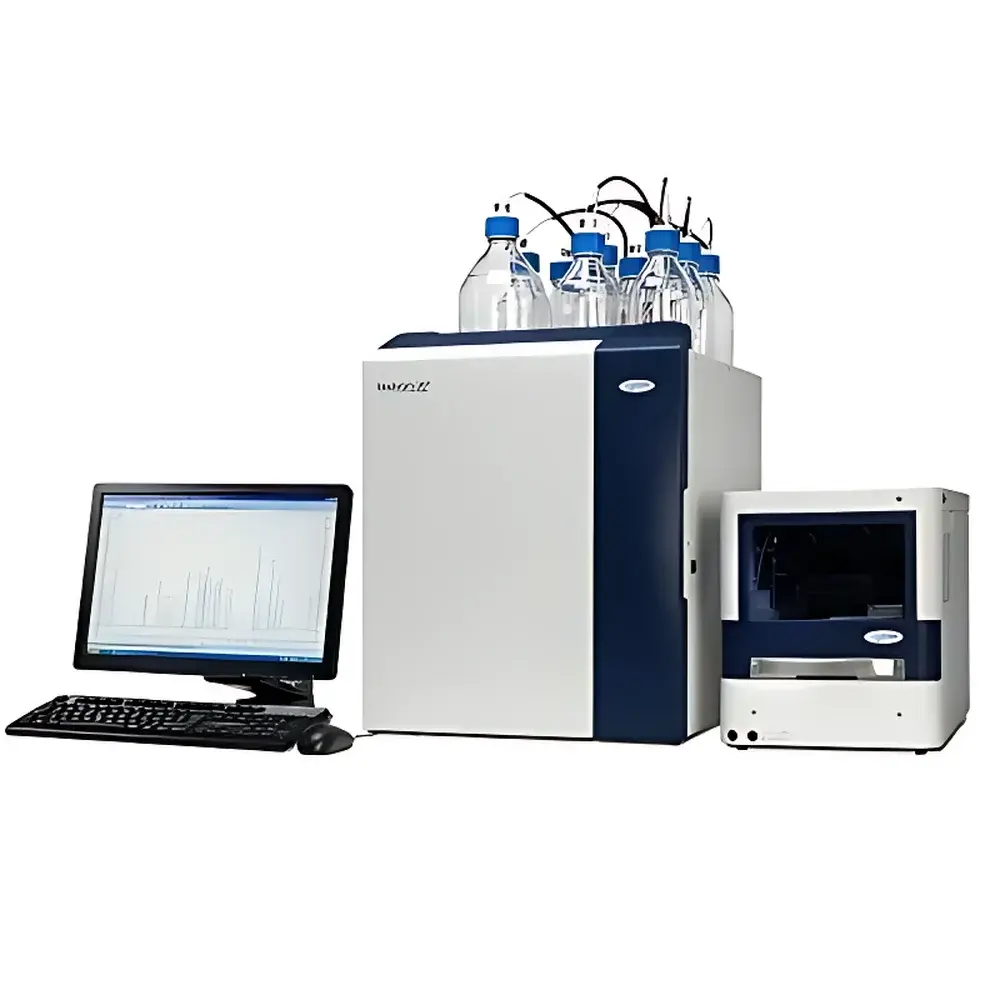
Biochrom 30+ Amino Acid Analyzer
| Brand | Biochrom |
|---|---|
| Origin | United Kingdom |
| Model | Biochrom 30+ |
| Instrument Type | Post-Column Derivatization Amino Acid Analyzer |
| Pump Flow Rate | 0.01–9.99 mL/min |
| Maximum Pump Pressure | 45 MPa |
| Autosampler Injection Volume | 1–5000 µL |
| Autosampler Temperature Control | 5 °C to ambient |
| Post-Column Reactor Temperature Range | 40–150 °C |
| Detection Wavelengths | 570 nm and 440 nm |
| Flow Cell Volume | 8 µL |
| Detection Limit (Ninhydrin) | 2.5 pmol (S/N = 2) |
| Typical Sensitivity | 9 pmol (average across all amino acids) |
| Precision | 0.5% CV at 10 fmol |
| Column Packing | 8 µm Cation-Exchange Resin |
| Column Temperature Control | Peltier, 20–99 °C |
| Derivatization Temperature | 145 °C |
| Buffer Delivery | Dual-pump system (buffer + ninhydrin), ceramic piston pumps with automated pump-head wash |
| Nitrogen Protection | 5 bar high-purity N₂ for buffer stabilization |
| Sample Capacity | 84 positions |
| Sample Tray Cooling | Down to 4 °C |
| Resolution | >95% average peak resolution |
Overview
The Biochrom 30+ Amino Acid Analyzer is a dedicated, high-performance post-column derivatization (PCD) system engineered for precise, reproducible quantification of proteinogenic and non-proteinogenic amino acids in complex biological matrices. Based on classical ion-exchange chromatography coupled with thermal ninhydrin derivatization and dual-wavelength photometric detection, the instrument delivers robust separation of all 20 standard amino acids—including cystine, hydroxyproline, and taurine—within a single 90–120 minute run. Its core architecture integrates two independently controlled ceramic piston pumps (one for buffer gradient delivery, one for ninhydrin reagent), a Peltier-regulated analytical column oven (20–99 °C), and a precisely temperature-stabilized post-column reactor (40–150 °C, optimized at 145 °C for complete derivatization). The system operates under nitrogen blanket (5 bar high-purity N₂) to prevent oxidation of sensitive buffers and reagents—eliminating the need for nitrogen-driven fluidics while ensuring long-term baseline stability and reagent shelf-life.
Key Features
- Dual-ceramic-pump architecture with automated pump-head cleaning cycles ensures consistent flow accuracy and minimizes carryover between runs.
- Integrated Peltier-based column oven enables precise, programmable temperature control (±0.1 °C) critical for retention time reproducibility across daily and multi-week analyses.
- Post-column reaction coil maintained at 145 °C guarantees quantitative conversion of primary and secondary amines to chromophores detectable at 570 nm (primary amines) and 440 nm (imino acids such as proline).
- 8 µL low-dead-volume flow cell and dual-wavelength photometer provide high signal-to-noise ratio, achieving a detection limit of 2.5 pmol (S/N = 2) and typical working sensitivity of 9 pmol per amino acid.
- Autosampler supports up to 84 vials with programmable injection volumes (1–5000 µL) and refrigerated sample tray cooling (down to 4 °C) to preserve labile analytes during extended unattended operation.
- Buffer management system includes real-time level monitoring and pre-depletion alerts; automatic system rinse and water flush upon shutdown protects the reactor and column from salt crystallization or reagent residue buildup.
Sample Compatibility & Compliance
The Biochrom 30+ accommodates diverse sample types including hydrolyzed proteins, cell culture supernatants, plasma, urine, food extracts, and fermentation broths. Sample preparation follows AOAC 982.30 and ISO 13903 protocols for acid hydrolysis (6 M HCl, 110 °C, 22–24 h), with optional oxidation for cysteine/cystine analysis. The system complies with FDA 510(k) clearance (K122916), EU In Vitro Diagnostic Medical Device Directive 98/79/EC, ISO 13485:2016, and ISO 9001:2015. All reagents supplied—including certified ninhydrin solution, sodium acetate buffers, and lithium citrate eluents—carry Certificate of Analysis (COA) documentation covering identity, purity, water content, and trace metal impurities (n = 195 individual certifications). System validation supports GLP and GMP environments, with audit trails, electronic signatures, and user-access controls compatible with FDA 21 CFR Part 11 requirements when operated with compliant LIMS integration.
Software & Data Management
Control and data acquisition are managed via Windows-based ChromoLink software, offering intuitive method setup, real-time chromatogram visualization, peak integration with customizable baselines and retention time windows, and automated calibration curve generation (linear or quadratic). Raw data files (.chr) are stored in vendor-neutral formats compatible with third-party chemometrics platforms. Software supports IQ/OQ/PQ documentation templates aligned with ASTM E2500-13 and USP . Audit trail functionality records all user actions—including parameter changes, calibration events, and report generation—with timestamps and operator IDs. Data export options include CSV, PDF, and XML for laboratory information management system (LIMS) ingestion or regulatory submission packages.
Applications
The Biochrom 30+ serves as a reference-grade platform in pharmaceutical quality control (e.g., amino acid composition verification of therapeutic peptides and recombinant proteins), clinical nutrition laboratories (plasma/urine amino acid profiling for inborn errors of metabolism), food science (protein digestibility, nutritional labeling compliance per FDA 21 CFR 101.9), and bioprocess development (monitoring amino acid depletion in fed-batch cultures). Its validated performance supports release testing under ICH Q5E and comparability studies per ICH Q5C. Routine use includes quantification of branched-chain amino acids (BCAAs), sulfur-containing residues (cysteine, methionine), and modified residues (hydroxyproline, γ-aminobutyric acid).
FAQ
What derivatization chemistry does the Biochrom 30+ employ?
It uses thermal ninhydrin-based post-column derivatization, optimized at 145 °C, generating Ruhemann’s purple for primary amines (detected at 570 nm) and a yellow chromophore for imino acids (detected at 440 nm).
Is the system compatible with oxidized cysteine analysis?
Yes—when paired with performic acid or hydrogen peroxide pre-oxidation, the system resolves cysteic acid and cystine with full recovery and linearity across 1–5000 pmol ranges.
Can the instrument be integrated into a 21 CFR Part 11-compliant environment?
Yes—when deployed with validated ChromoLink software, networked authentication, and external LIMS or ELN systems supporting electronic signatures and audit trails.
What maintenance intervals are recommended for routine operation?
Pump seals require replacement every 12 months; reactor tubing every 6 months; analytical column lifetime exceeds 2000 injections under standard hydrolyzate conditions with proper buffer filtration and system flushing.
Does the system support gradient elution?
Yes—dual-buffer capability enables linear or stepwise pH/ionic strength gradients using up to six pre-programmed buffer reservoirs, facilitating resolution of co-eluting isomers such as leucine/isoleucine and valine/threonine.
Related Products




