
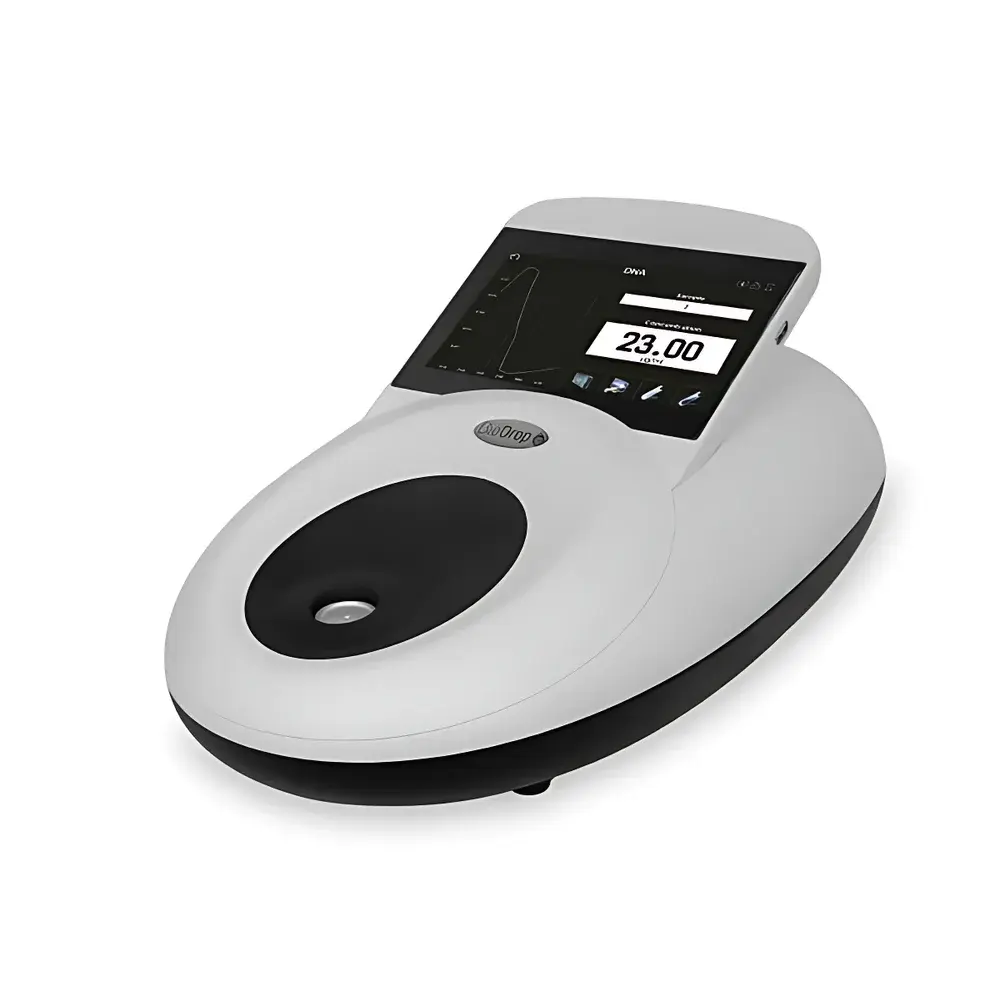
Biochrom BioDrop DUO+ Ultra-Micro Spectrophotometer
| Brand | Biochrom |
|---|---|
| Origin | USA |
| Model | BioDrop DUO+ |
| Spectral Bandwidth | 5 nm |
| Wavelength Accuracy | ±2 nm |
| Wavelength Range | 190–1100 nm |
| Cuvette Pathlength | 10 mm |
| Sample Volume (min) | 0.5 µL |
| Fixed Microvolume Pathlength | 0.5 mm ± 5 µm |
| Absorbance Range | –0.3 to 2.5 A |
| Stray Light | <0.5% T at 220 nm & 340 nm (NaNO₂) |
| Detector | 1024-pixel CCD array |
| Light Source | Pulsed Xenon Lamp (3-year warranty) |
| Display | 7-inch capacitive color touchscreen |
| Dimensions | 410 × 280 × 190 mm |
| Weight | 3.55 kg |
Overview
The Biochrom BioDrop DUO+ Ultra-Micro Spectrophotometer is an engineered solution for quantitative nucleic acid and protein analysis in life science laboratories where sample conservation, measurement reproducibility, and operational efficiency are critical. Based on single-beam UV-Vis absorbance spectroscopy, the instrument integrates two complementary optical pathways within a single platform: a fixed 0.5 mm pathlength microvolume measurement stage and a standard 10 mm cuvette compartment. This dual-mode architecture eliminates mechanical pathlength adjustment—removing a primary source of variability in microvolume instruments—and ensures intrinsic photometric stability across repeated measurements. The pulsed xenon lamp delivers broad-spectrum illumination from 190 nm to 1100 nm with high intensity and minimal thermal load, enabling reliable detection of aromatic amino acids (280 nm), nucleic acid bases (260 nm), and turbidity or dye-based assays (e.g., Bradford, BCA) without lamp warm-up or spectral drift. Its optical design complies with fundamental photometric principles defined in ISO 8579 and ASTM E275, ensuring traceable performance in regulated environments.
Key Features
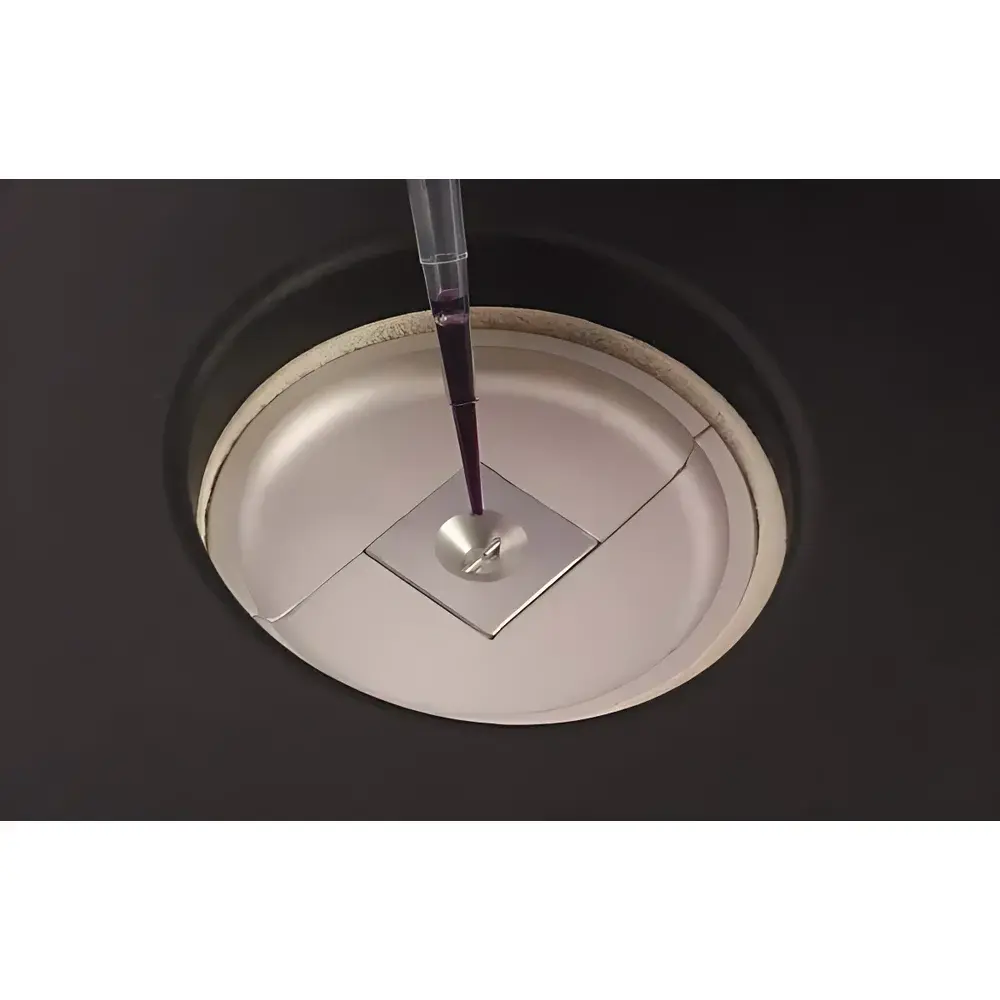
- Fixed 0.5 mm microvolume pathlength with ±5 µm tolerance—no moving parts, no recalibration required between samples
- Integrated 10 mm cuvette holder supporting conventional spectrophotometric workflows and optional BioDrop 125 microvolume adaptor for extended dynamic range
- 7-inch capacitive color touchscreen with intuitive, icon-driven interface—operational sequence for dsDNA quantification completed in ≤4 screen taps and <4 seconds
- Onboard software with preconfigured, validated methods for DNA, RNA, oligonucleotides, fluorescent dyes, protein (A280 and colorimetric), and melting temperature (Tm) calculation
- 1024-pixel linear CCD detector providing high signal-to-noise ratio (RMS noise: 0.002 A) and wavelength reproducibility of ±1 nm
- USB port for direct data export to flash drive or connection to host PC; supports both standalone and PC-controlled operation via Biochrom Resolution software
- Optional integrated thermal printer for GLP-compliant hard-copy reporting with timestamp, user ID, and method metadata
Sample Compatibility & Compliance
The BioDrop DUO+ accommodates diverse sample types without dilution or transfer artifacts: native or purified nucleic acids (dsDNA, ssDNA, RNA, oligos), proteins (including membrane-associated or low-solubility variants), and dye-labeled conjugates. Its microvolume stage accepts 0.5–2.0 µL volumes with minimal surface tension dependency due to hydrophobic sample retention geometry. For cuvette-based measurements, compatibility extends to standard 10 mm quartz, glass, or plastic cuvettes—including semi-micro and low-volume formats. The system meets key regulatory expectations for analytical instrumentation: absorbance accuracy (±0.01 A or 1.5% of reading, whichever is greater, at 546 nm) and stray light performance (<0.5% T at 220 nm and 340 nm per NaNO₂ test) align with USP and EP 2.2.25 requirements. Audit trail functionality, electronic signatures, and method locking are available through Resolution software under FDA 21 CFR Part 11 configuration.
Software & Data Management
Two software layers support flexible deployment: embedded firmware enables fully autonomous operation with multilingual UI (English, French, German, Spanish, Italian, Japanese, Chinese), while Biochrom Resolution software provides advanced post-acquisition analysis—baseline correction, spectral deconvolution, kinetic modeling, and custom curve fitting. All onboard data are stored with full metadata (date/time, operator ID, method name, pathlength, dilution factor). Export formats include CSV, PDF, and XML for LIMS integration. Resolution supports automated report generation compliant with ISO/IEC 17025 documentation standards, including uncertainty estimation per GUM guidelines. Instrument calibration logs, wavelength validation records, and performance verification reports are retained internally and exportable for QA/QC review.
Applications
- High-throughput nucleic acid quantification in NGS library preparation and qPCR assay setup
- Routine QC of CRISPR gRNA, siRNA, and antisense oligonucleotides
- Protein concentration determination in purification workflows (A280, Bradford, Lowry, BCA)
- Purity assessment via A260/A280 and A260/A230 ratios for RNA integrity screening
- Enzyme kinetics monitoring using chromogenic or fluorogenic substrates in cuvette mode
- Verification of nanoparticle synthesis (e.g., gold nanosphere plasmon resonance at ~520 nm)
- Educational labs requiring robust, low-maintenance UV-Vis instrumentation with pedagogical method templates
FAQ
Does the BioDrop DUO+ require regular wavelength calibration?
No—its pulsed xenon source and fixed optical path eliminate routine wavelength recalibration. Annual verification using holmium oxide or didymium filters is recommended for ISO 17025 compliance.
Can the microvolume stage be cleaned between samples?
Yes—the stainless-steel pedestal and quartz window are chemically inert and accessible for wipe cleaning with >70% ethanol or mild detergent; no disassembly required.
Is the 0.5 mm pathlength adjustable?
No—it is mechanically fixed to ensure metrological stability; pathlength variation is specified as ±5 µm, not ±5 mm (a typographical error in some legacy documentation).
What is the minimum detectable dsDNA concentration?
At 0.5 µL volume and 0.5 mm pathlength, the limit of detection is 1 ng/µL (equivalent to 1 ng/mm²), verified per CLSI EP17-A2 guidelines.
Does the instrument support Good Manufacturing Practice (GMP) workflows?
Yes—when configured with Resolution software, it supports 21 CFR Part 11-compliant user access control, electronic signatures, and immutable audit trails for production environments.
Related Products





