
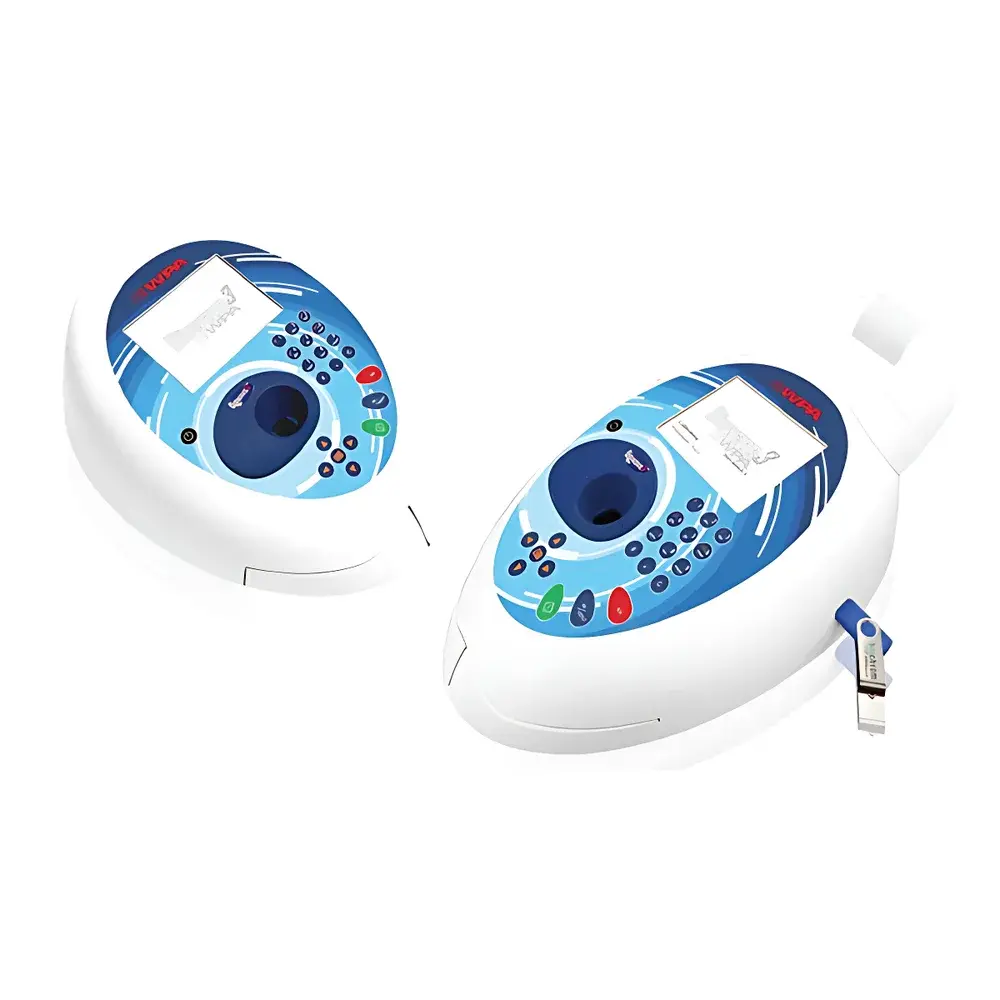
Biochrom Biowave 3 UV-Vis Spectrophotometer
| Brand | Biochrom |
|---|---|
| Origin | USA |
| Model | Biowave 3 |
| Optical System | Pseudo-double-beam |
| Detector | CCD array |
| Wavelength Range | 190–1100 nm |
| Wavelength Accuracy | ±2.0 nm |
| Wavelength Repeatability | ±1.0 nm |
| Spectral Bandwidth | 3 nm or 5 nm (selectable) |
| Stray Light | ≤0.5% at 220 nm and 340 nm |
| Absorbance Range | –0.3 to 2.5 A |
| Light Source | Xenon flash lamp |
Overview
The Biochrom Biowave 3 UV-Vis Spectrophotometer is a dedicated life sciences instrument engineered for precision nucleic acid, protein, and cell culture density quantification in molecular biology and biopharmaceutical laboratories. Built upon a pseudo-double-beam optical architecture with a high-intensity xenon flash lamp and a high-resolution CCD detector array, the Biowave 3 delivers stable photometric performance across the full ultraviolet-to-visible spectrum (190–1100 nm). Unlike traditional single-beam systems, its reference-path design compensates for source drift and environmental fluctuations—ensuring high reproducibility during extended measurement sessions. The instrument implements diode-array detection, enabling full-spectrum acquisition in under one second without mechanical wavelength scanning. This architecture supports rapid kinetic monitoring, spectral scanning, and multi-point concentration analysis—all critical for routine QC of purified biomolecules, transfection efficiency assessment, and bioreactor sampling.
Key Features
- Integrated life sciences software suite with pre-programmed methods for DNA, RNA, oligonucleotide, and protein quantification (BCA, Bradford, Biuret, Lowry)
- Full-spectrum scan mode with real-time display of absorbance profiles from 190–1100 nm—enabling simultaneous evaluation of A260/A280, A260/A230, and spectral shape for nucleic acid purity assessment
- Selectably narrow spectral bandwidth (3 nm standard; 5 nm optional) for enhanced resolution in overlapping absorption bands—particularly valuable for distinguishing protein secondary structure signatures or impurity peaks near 230 nm
- Automated kinetics module with slope-based rate calculation: user-defined time intervals, automatic linear regression, correlation coefficient reporting, and configurable conversion factors for direct enzymatic activity (e.g., ΔA/min → U/mL)
- Dedicated cuvette holder with integrated storage compartment—designed to protect low-volume UV-grade quartz or disposable cuvettes during transport and storage
- Flexible connectivity: USB 2.0 interface for data export and remote control; optional Bluetooth 4.2 module for wireless operation with Windows/macOS hosts; optional built-in thermal printer for GLP-compliant hardcopy generation
Sample Compatibility & Compliance
The Biowave 3 accommodates standard 10-mm pathlength cuvettes—including UV-transparent quartz, high-clarity plastic, and micro-volume disposable cells (down to 50 µL). Its optical design minimizes stray light (≤0.5% at 220 nm and 340 nm), ensuring reliable quantification of dilute nucleic acid samples and turbid cell suspensions. The instrument meets core requirements for laboratory compliance frameworks: absorbance linearity validation aligns with ISO 6060 and ASTM E275; wavelength accuracy and repeatability conform to USP spectrophotometric system suitability criteria; and optional Bluetooth/printer configurations support audit-trail-enabled workflows compatible with FDA 21 CFR Part 11 Annex 11 principles when paired with validated LIMS or ELN platforms. All pre-installed assays are documented per Good Laboratory Practice (GLP) standards, including method references, uncertainty estimates, and calibration traceability to NIST-traceable standards.
Software & Data Management
LightWave 3 software—embedded in the Biowave 3 firmware—provides an intuitive, menu-driven interface optimized for bench scientists. It supports method creation, parameter locking, user-level access control (administrator/operator modes), and timestamped data logging with embedded metadata (operator ID, sample ID, date/time, instrument serial number). Raw spectra, kinetic traces, and concentration tables export natively as CSV or XML for integration into statistical analysis tools (e.g., GraphPad Prism, R, Python pandas). When connected to a networked PC, the software enables remote method deployment, batch processing of multi-sample runs, and automated report generation compliant with internal SOPs. Optional audit trail modules record all user actions—including method edits, calibration events, and result deletions—with immutable timestamps and digital signatures.
Applications
- Nucleic acid purity verification via dual-ratio analysis (A260/A280 and A260/A230)—critical for detecting guanidine salt carryover or phenol contamination in RNA preps
- Protein assay cross-validation: simultaneous comparison of BCA, Bradford, and Lowry results on identical dilutions to identify matrix interference
- Cell culture OD600 monitoring with temperature-stabilized cuvette positioning and auto-zero referencing against sterile medium blanks
- Enzyme kinetics: real-time monitoring of NADH/NADPH oxidation at 340 nm with adjustable integration time and baseline correction
- UV-Vis characterization of novel bioconjugates (e.g., antibody-drug conjugates), where spectral deconvolution aids in assessing dye loading ratios
FAQ
What is the difference between “pseudo-double-beam” and true double-beam optics?
The Biowave 3 uses a time-shared reference beam path rather than a split-beam configuration. A single xenon pulse illuminates both sample and reference positions sequentially within milliseconds—eliminating the need for mechanical beam splitters while maintaining drift compensation equivalent to conventional double-beam instruments.
Can the Biowave 3 perform quantitative analysis below 200 nm?
Yes—its optimized optical train and high-output xenon lamp deliver sufficient photon flux down to 190 nm, enabling reliable quantification of peptide bonds (205 nm), disulfide bonds (250 nm), and aromatic amino acids (280 nm) without purging or vacuum operation.
Is the 3 nm bandwidth option required for routine nucleic acid work?
While 5 nm bandwidth suffices for most A260-based quantitation, the 3 nm configuration significantly improves resolution of the 230 nm region—essential for detecting residual chaotropic salts or organic solvents that compromise downstream applications like RT-qPCR or NGS library prep.
How does the Biowave 3 handle high-absorbance samples?
Its wide dynamic range (–0.3 to 2.5 A) and adaptive gain control allow direct measurement of concentrated lysates or undiluted PCR products without manual attenuation—reducing pipetting error and improving throughput.
Are method files transferable between Biowave 3 units?
Yes—LightWave 3 methods are stored in portable .lwm format and can be imported/exported via USB drive or network share, ensuring consistent assay execution across multiple instruments in core facilities or GMP environments.




