
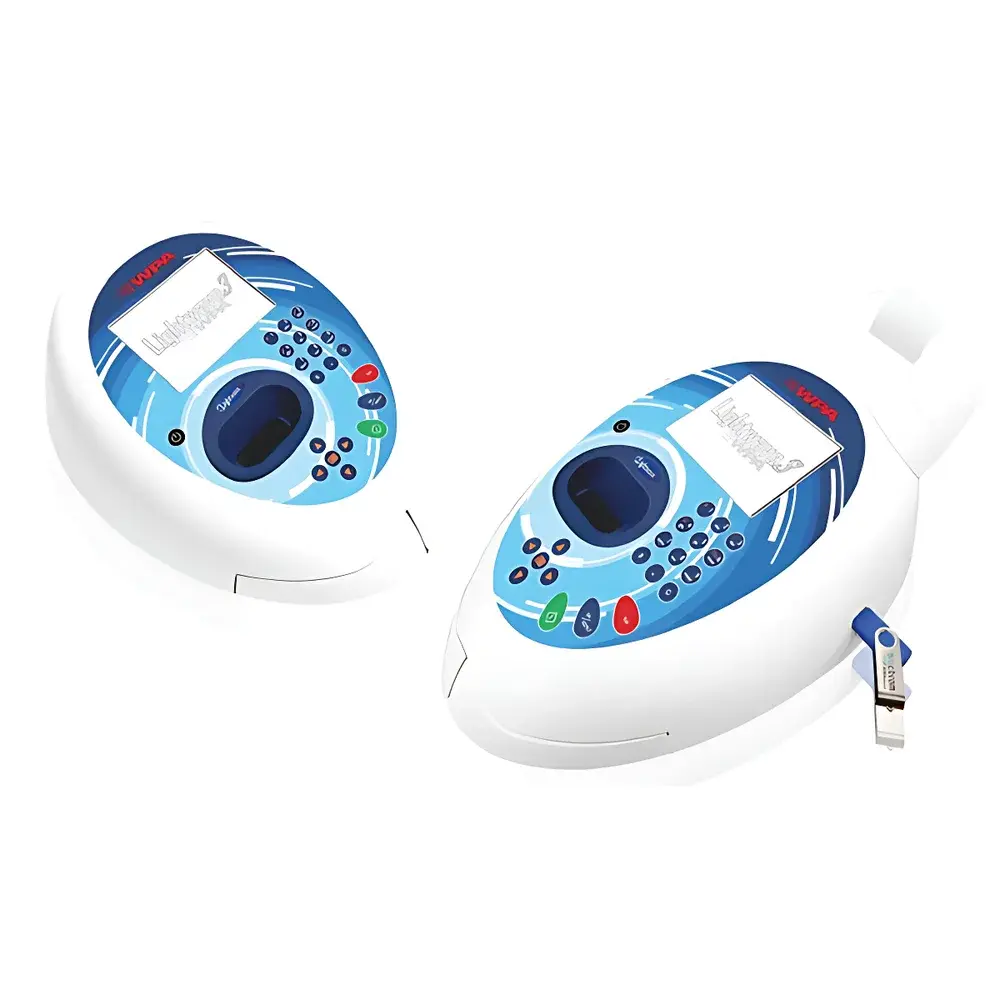
Biochrom Lightwave 3 UV-Vis Spectrophotometer
| Brand | Biochrom |
|---|---|
| Origin | USA |
| Model | Lightwave 3 |
| Optical Design | Single-beam with diode array detection |
| Wavelength Range | 190–1100 nm |
| Spectral Bandwidth | 5 nm (3 nm optional) |
| Wavelength Accuracy | ±2.0 nm |
| Wavelength Repeatability | ±1.0 nm |
| Stray Light | ≤0.5% at 220 nm and 340 nm |
| Detector | CCD array |
| Light Source | Long-life xenon lamp |
| Absorbance Range | –0.3 to 2.5 A |
| Measurement Modes | Scanning, Fixed-wavelength, Kinetics, Concentration (factor, single-point, multi-standard calibration, multi-wavelength ratio) |
Overview
The Biochrom Lightwave 3 UV-Vis Spectrophotometer is a compact, single-beam diode array spectrophotometer engineered for precision, reliability, and ease of use in routine laboratory environments. Utilizing a fixed Gifford optical architecture—free of moving parts—it delivers high photometric stability and long-term wavelength fidelity without mechanical wear. The instrument employs a high-intensity, long-life xenon lamp as its broadband light source, enabling consistent spectral output across the full 190–1100 nm range. Unlike traditional scanning monochromators, the Lightwave 3 captures the entire spectrum simultaneously via its integrated CCD detector array, eliminating time-dependent drift during acquisition and supporting rapid spectral acquisition (<1 second per full scan). Its design targets laboratories requiring regulatory-compliant absorbance measurements for QC, education, environmental testing, and pharmaceutical raw material verification—where reproducibility, traceability, and method portability are essential.
Key Features
- Gifford optical system: Fixed-path, aberration-corrected optics with no moving components, ensuring mechanical robustness and long-term alignment stability.
- Xenon lamp illumination: Delivers high photon flux across deep UV to near-IR, supporting sensitive detection down to 190 nm without deuterium lamp replacement cycles.
- Simultaneous full-spectrum acquisition: CCD-based detection enables real-time spectral capture without sequential wavelength stepping—critical for kinetic studies and transient sample monitoring.
- Intuitive 7-inch color touchscreen interface: Onboard software supports method storage (up to 90 user-defined protocols), spectral overlay, peak identification, and baseline correction without external PC dependency.
- Flexible cuvette handling: Integrated cuvette holder accommodates standard pathlengths (10 mm, 20 mm, 40 mm) and materials (quartz, glass, disposable plastic) with positive alignment stops and secure positioning.
- Expandable connectivity: Optional Bluetooth 5.0 module enables wireless data streaming and remote instrument control; USB 2.0 port supports direct file export to flash drives or PC synchronization.
Sample Compatibility & Compliance
The Lightwave 3 accepts standard rectangular cuvettes (10 × 10 mm cross-section) with optical path lengths of 10 mm, 20 mm, or 40 mm—enabling direct measurement of dilute or highly absorbing samples without manual dilution or pathlength adjustment. Quartz cuvettes are recommended for measurements below 240 nm; glass or polystyrene cuvettes are suitable for visible-range applications. The instrument complies with ISO 6059 (water quality analysis), ASTM E275 (spectrophotometer performance verification), and USP (UV-Vis spectrophotometry for pharmaceuticals). When operated with audit-trail-enabled software (via optional PC integration), it supports GLP/GMP workflows aligned with FDA 21 CFR Part 11 requirements for electronic records and signatures.
Software & Data Management
Onboard firmware provides native support for absorbance, transmittance, and concentration calculations using factor-based, single-point, multi-point linear/non-linear (e.g., quadratic, cubic) calibration models. Multi-wavelength ratio mode permits ratiometric quantitation (e.g., A260/A280 for nucleic acid purity assessment) with automatic background subtraction. All spectra and results are timestamped and stored internally (≥10,000 scans) or exported as CSV, PDF, or JCAMP-DX files. Optional PC software (Lightwave Connect™) adds advanced features including method validation reports, instrument qualification logs (IQ/OQ), spectral library matching, and automated compliance reporting for regulated environments.
Applications
- Quantitative analysis of biomolecules (proteins, nucleic acids, enzymes) using established extinction coefficients or calibration curves.
- Chemical kinetics monitoring: Real-time tracking of reaction progress via time-resolved spectral acquisition at user-defined intervals.
- Quality control of solvents, reagents, and excipients per pharmacopeial monographs (e.g., EP 2.2.25, JP 2.05).
- Environmental water testing: Nitrate, phosphate, and COD determination using standardized colorimetric methods.
- Educational laboratories: Teaching spectral interpretation, Beer–Lambert law validation, and instrument calibration principles.
- Materials science: Characterization of thin-film transmittance/absorbance and bandgap estimation via Tauc plot analysis.
FAQ
What is the difference between the Lightwave 3 and Lightwave 3+ models?
The Lightwave 3+ includes enhanced software capabilities (e.g., extended calibration models, spectral library search, and GLP audit trail generation), upgraded firmware for improved stray light rejection, and factory-installed 3 nm spectral bandwidth optics as standard.
Can the Lightwave 3 perform kinetic measurements with variable time intervals?
Yes—users can define custom time intervals (100 ms to 60 min) between successive spectra, with up to 1,000 time points per run and automatic derivative calculation for rate analysis.
Is the xenon lamp replaceable by the end user?
Yes—the lamp is field-replaceable with no optical realignment required; typical lifetime exceeds 2,000 hours under standard usage conditions.
Does the instrument support compliance with FDA 21 CFR Part 11?
When used with Lightwave Connect™ PC software and configured with role-based access control, electronic signatures, and immutable audit trails, it meets core technical requirements for Part 11 compliance.
What calibration standards are recommended for routine verification?
NIST-traceable holmium oxide (HoO3) and didymium filters are recommended for wavelength accuracy verification; potassium dichromate solution (0.04 g/L in 0.005 M H2SO4) is used for photometric linearity and absorbance accuracy checks per ASTM E275.
Related Products





