
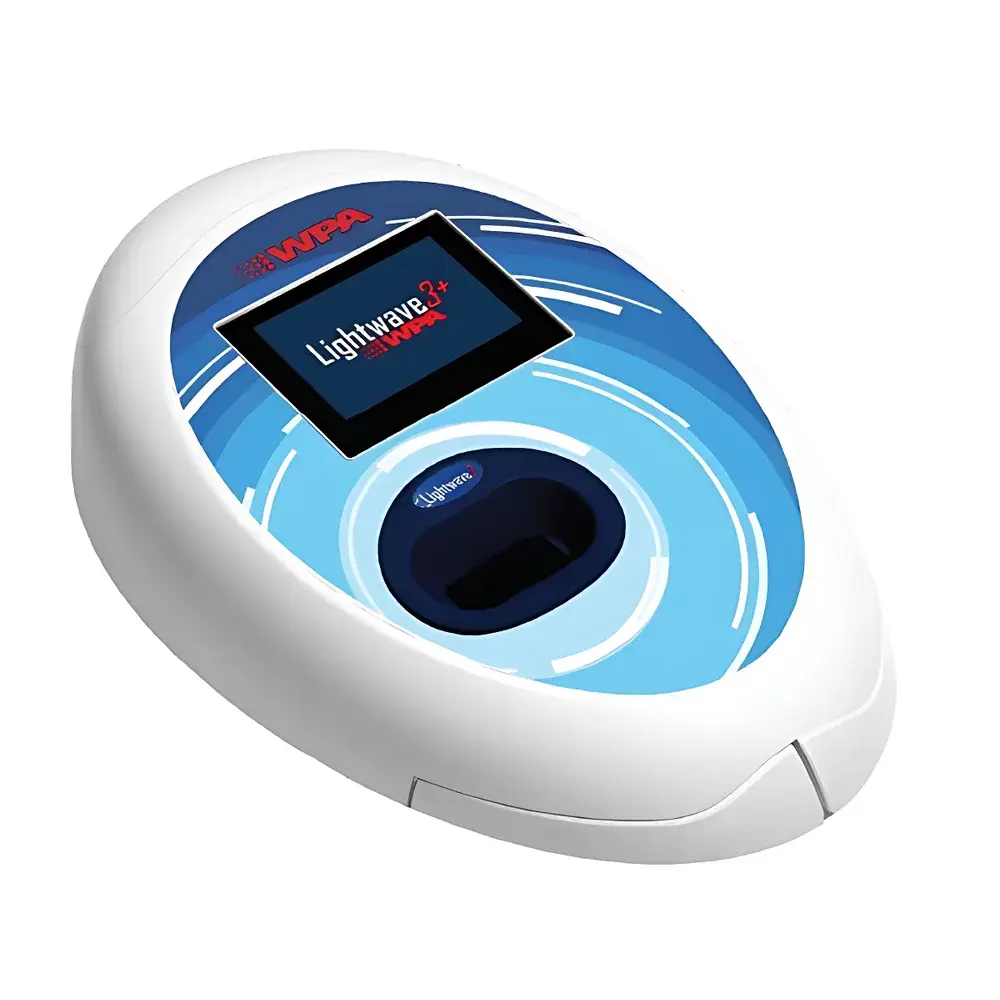
Biochrom Lightwave 3+ UV-Vis Spectrophotometer
| Brand | Biochrom |
|---|---|
| Origin | USA |
| Model | Lightwave 3+ |
| Optical Design | Single-beam |
| Detector Type | CCD Array |
| Wavelength Range | 190–1100 nm |
| Wavelength Accuracy | ±2 nm |
| Spectral Bandwidth | 3 nm |
| Stray Light | <0.5% T at 340 nm |
| Display | 5-inch color touchscreen |
| Absorbance Range | –0.3 to 2.5 A |
| Cuvette Compatibility | Up to 40 mm pathlength |
| Automation | Motorized wavelength scanning |
| Light Source | Xenon flash lamp |
Overview
The Biochrom Lightwave 3+ UV-Vis Spectrophotometer is a single-beam, diode array-based spectrophotometric instrument engineered for precision absorbance measurement across the ultraviolet, visible, and near-infrared spectral regions (190–1100 nm). Unlike traditional scanning monochromator systems with moving gratings or slits, the Lightwave 3+ employs a fixed grating and high-resolution CCD detector array to capture full spectra in milliseconds—enabling rapid acquisition without mechanical wavelength scanning delays. Its xenon flash lamp provides stable, low-noise broadband illumination with minimal thermal drift and extended lifetime compared to deuterium/tungsten dual-lamp configurations. Designed for routine and research-grade applications, the instrument delivers high photometric reproducibility (<0.002 A RSD over 24 h) and robust baseline stability—critical for kinetic assays, multi-point calibration, and regulatory-compliant QC workflows in pharmaceutical, environmental, and academic laboratories.
Key Features
- Full-spectrum acquisition in under 1 second using a 2048-pixel linear CCD array detector
- 5-inch capacitive color touchscreen interface with pinch-to-zoom, spectral trace overlay, and real-time peak identification
- Motorized wavelength positioning for automated method execution and sequential multi-wavelength measurements
- Integrated cuvette holder accommodating standard 10 mm, semi-micro (5 mm), and long-path (up to 40 mm) quartz or UV-transparent plastic cells
- Pre-calibrated wavelength and photometric validation protocols compliant with ASTM E275 and ISO 6059 standards
- Onboard data storage (≥10,000 spectra) with timestamped metadata, user ID tagging, and export via USB 2.0 or optional Bluetooth 4.2 module
Sample Compatibility & Compliance
The Lightwave 3+ supports liquid-phase analysis of aqueous, organic, and buffered solutions across life science, industrial hygiene, and environmental monitoring domains. It accommodates cuvettes with optical path lengths from 1 mm to 40 mm—enabling direct quantification of highly diluted biomolecules (e.g., nucleic acids, proteins) as well as concentrated industrial dyes or metal chelates without dilution. All firmware and measurement algorithms are validated per ICH Q2(R2) guidelines for analytical instrument qualification. Optional printer module (part #80-3007-48) provides GLP-compliant hardcopy reports with audit trail headers, including operator name, date/time stamp, method ID, and raw absorbance values at defined wavelengths. The system architecture supports 21 CFR Part 11 readiness when deployed with Biochrom’s optional SecureLink software suite, enabling electronic signatures, role-based access control, and immutable audit logs.
Software & Data Management
The instrument operates natively on embedded Linux firmware with intuitive graphical workflow navigation—no external PC required for basic operation. Advanced spectral processing—including baseline correction (Rubberband, polynomial), derivative spectroscopy, peak integration, and multi-component deconvolution—is accessible via optional LightWave Pro software (Windows-compatible, USB or Bluetooth-linked). Data export formats include CSV, XML, and JCAMP-DX for interoperability with LIMS platforms (e.g., LabWare, STARLIMS) and statistical tools (e.g., JMP, Python pandas). All spectral acquisitions are automatically time-stamped and annotated with instrument serial number, lamp usage hours, and calibration status flags—ensuring traceability in ISO/IEC 17025-accredited testing environments.
Applications
- Quantitative analysis of DNA/RNA (A260), protein (A280), and enzyme kinetics (NADH/NADPH at 340 nm)
- Pharmaceutical assay development and dissolution testing per USP & EP monographs
- Water quality assessment: nitrate (220 nm), phosphate (880 nm), and COD estimation via dichromate reduction
- Colorimetric endpoint assays (e.g., ELISA, BCA, Bradford) with multi-well plate compatibility via optional adapter
- Stability-indicating methods for oxidation, hydrolysis, or photolysis studies under controlled temperature and light exposure
- Teaching laboratories: spectral fingerprinting of transition metal complexes, organic chromophores, and semiconductor nanomaterials
FAQ
What is the difference between Lightwave 3 and Lightwave 3+?
The Lightwave 3+ introduces an upgraded 5-inch capacitive touchscreen, enhanced firmware with expanded kinetic sampling intervals (0.01–3600 s), improved stray light rejection (<0.5% T at 340 nm vs. 1.0% T in Lightwave 3), and native support for Bluetooth 4.2 and USB printing.
Does the Lightwave 3+ comply with FDA 21 CFR Part 11 requirements?
Out-of-the-box, the hardware meets technical prerequisites (audit trail logging, electronic signature support); full Part 11 compliance requires deployment with Biochrom SecureLink software and documented procedural controls per organizational SOPs.
Can the instrument perform quantitative analysis without a connected computer?
Yes—full method programming, sample measurement, calibration curve generation, and report export are supported directly from the onboard touchscreen interface.
Is the xenon lamp user-replaceable?
Yes; the flash lamp module is field-serviceable with no optical realignment required. Typical lifetime exceeds 1×10⁹ flashes (≈5 years at 100 scans/day).
What validation documentation is supplied with the instrument?
Each unit ships with a Factory Calibration Certificate (traceable to NIST SRM 2035), IQ/OQ protocol templates, and a Performance Verification Report covering wavelength accuracy, photometric linearity, and stray light performance.





