
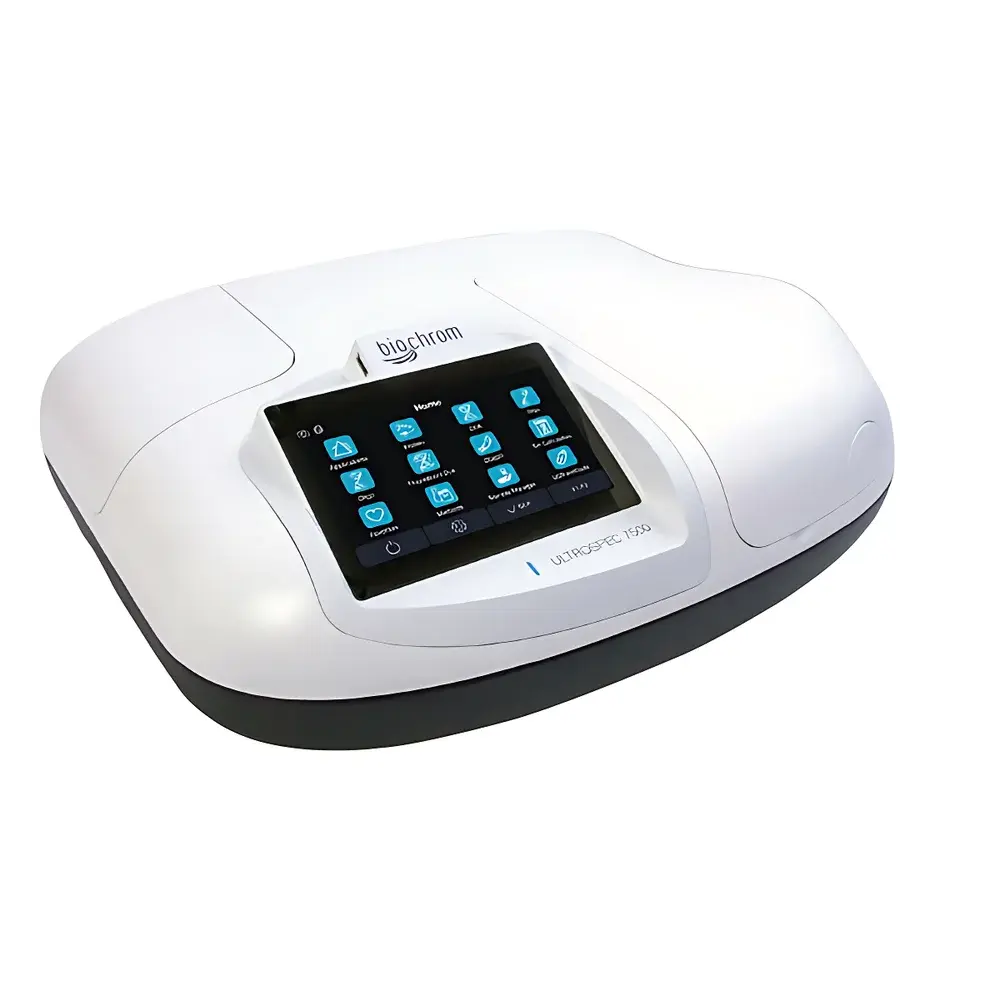
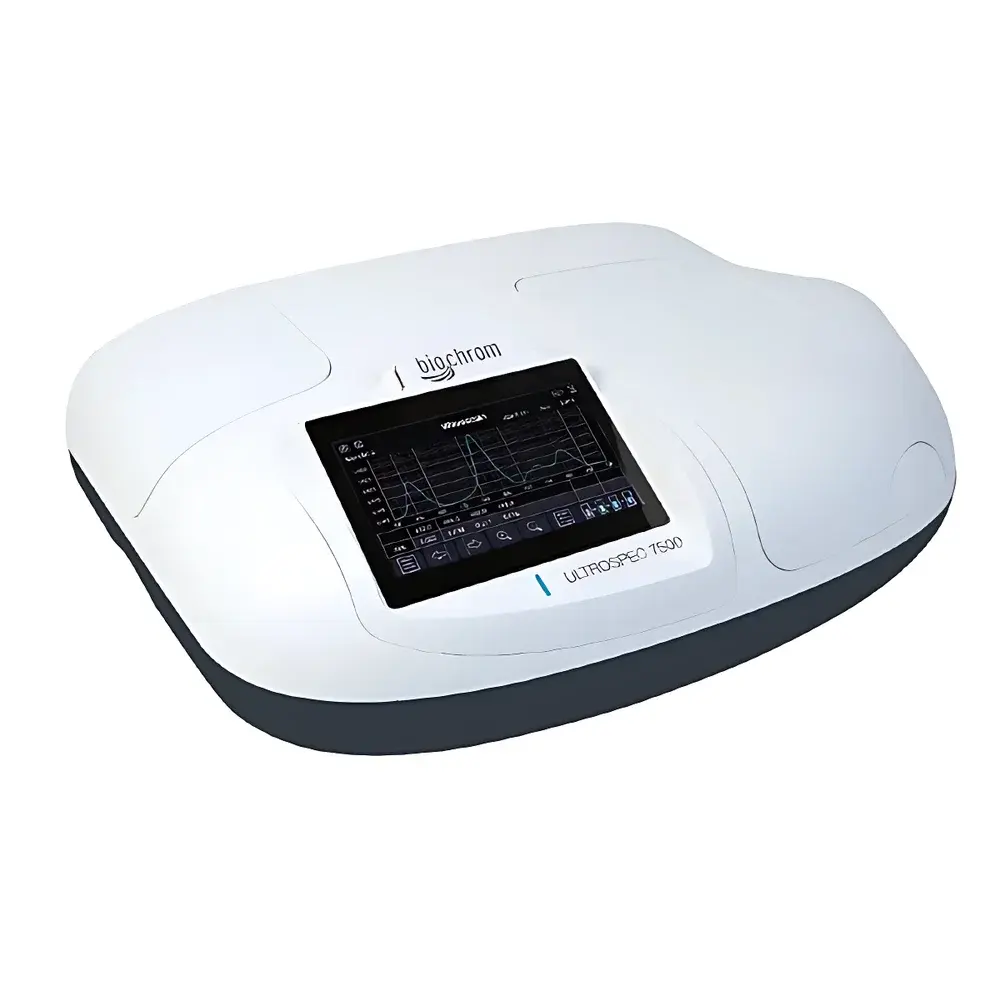
Biochrom Ultrospec 7500 Ultraviolet-Visible Spectrophotometer
| Brand | Biochrom |
|---|---|
| Origin | USA |
| Model | Ultrospec 7500 |
| Wavelength Range | 190–1100 nm |
| Wavelength Accuracy | ±1.0 nm |
| Wavelength Repeatability | ±0.5 nm |
| Spectral Bandwidth | <2 nm |
| Stray Light | <0.05 %T at 220 nm (NaI) or 340 nm (NaNO₂), <0.10 %T at 380 nm (NaNO₂) |
| Automation | Automatic Wavelength Scanning |
| Compliance | Optional 21 CFR Part 11 Software Module (Resolution™) |
Overview
The Biochrom Ultrospec 7500 is a high-performance, double-beam ultraviolet-visible (UV-Vis) spectrophotometer engineered for precision absorbance and transmittance measurements across the full spectral range of 190–1100 nm. Based on proven optical architecture incorporating a high-stability tungsten-halogen and deuterium lamp source, holographic grating monochromator, and low-noise silicon photodiode detector, the Ultrospec 7500 delivers robust photometric stability and high signal-to-noise ratio essential for quantitative analysis in regulated and research environments. As the latest evolution of the Ultrospec platform—introduced by Biochrom in 1982—the 7500 model builds upon the reliability and widespread scientific adoption of its predecessors (including the Ultrospec 2100), integrating modern optical design, enhanced thermal management, and intuitive touchscreen control to support reproducible, traceable, and audit-ready measurements.
Key Features
- Double-beam optical configuration with real-time reference beam correction, minimizing drift from lamp instability or environmental fluctuations.
- High-resolution color touchscreen interface with icon-driven navigation—enabling rapid method selection, instrument setup, and data review without keyboard input.
- Pre-installed application methods for nucleic acid quantification (A260/A280 ratios, extinction coefficients), protein concentration (Bradford, Lowry, BCA, A280), and microbial growth monitoring (OD600).
- Standard 8-position automatic sample changer with programmable cuvette positioning and auto-zero capability.
- USB 2.0 port for direct export of spectra, reports, and method files; supports screen capture and CSV-formatted data logging.
- Optional accessories include Peltier-controlled temperature module (±0.1 °C stability), automated liquid handler integration, thermal printer, and extended pathlength cells.
Sample Compatibility & Compliance
The Ultrospec 7500 accommodates standard 10-mm square quartz, glass, or plastic cuvettes (pathlengths from 1 mm to 100 mm with optional holders), as well as microvolume platforms via compatible adapters. It meets key international performance benchmarks including ASTM E275 (spectrophotometer verification), ISO 9001-aligned manufacturing protocols, and supports laboratory compliance with GLP and GMP requirements through optional Resolution™ software. When configured with the 21 CFR Part 11-compliant software module, the system provides electronic signatures, role-based user access control, full audit trail logging (including method changes, calibration events, and result modifications), and secure data archiving—facilitating FDA-regulated workflows in pharmaceutical QC, biologics development, and clinical research labs.
Software & Data Management
The onboard firmware includes Biochrom’s proprietary Resolution™ software suite, which operates natively on the instrument’s embedded Linux platform. It enables full spectral scanning, kinetic time-course acquisition, multi-wavelength quantitation, and custom curve-fitting (linear, quadratic, cubic, and non-linear regression). Data export options include XML, CSV, and PDF report generation with embedded metadata (operator ID, timestamp, instrument serial number, calibration status). For enterprise integration, the Ultrospec 7500 supports network connectivity via Ethernet (optional), enabling remote monitoring and centralized data aggregation into LIMS or ELN systems. All software updates are delivered via signed firmware packages verified against SHA-256 checksums to ensure integrity and version traceability.
Applications
The Ultrospec 7500 serves as a foundational analytical tool across academic, industrial, and regulatory laboratories. Its validated performance supports routine and advanced applications including: quantification of DNA, RNA, and oligonucleotides using molar absorptivity or comparative A260 standards; determination of protein concentration via direct A280 measurement or colorimetric assays; enzyme kinetics (e.g., NADH/NADPH oxidation at 340 nm); purity assessment of purified proteins (A260/A280, A260/A230); bacterial culture density monitoring at OD600; dissolution testing in pharmaceutical formulation development; and quality control of dyes, pigments, and UV filters in chemical manufacturing. Its broad wavelength coverage also permits characterization of nanomaterials (e.g., gold nanoparticles via surface plasmon resonance) and organic chromophores in synthetic chemistry.
FAQ
What is the minimum detectable absorbance for the Ultrospec 7500?
The instrument achieves an absorbance noise level of ≤0.0003 AU at 500 nm (1 s response time, 1 nm bandwidth), enabling reliable detection down to ~0.001 AU under optimal conditions.
Can the Ultrospec 7500 be integrated into a laboratory automation system?
Yes—via RS-232, USB HID, or optional Ethernet, the instrument supports SCPI command sets and can be controlled by third-party scripting environments (e.g., Python, LabVIEW) or robotic liquid handling platforms.
Is wavelength calibration traceable to NIST standards?
Yes—factory calibration uses NIST-traceable holmium oxide and didymium oxide filters; users may perform periodic verification using certified reference materials compliant with ISO/IEC 17025 guidelines.
Does the system support variable pathlength measurements?
While the base configuration uses fixed-pathlength cuvettes, optional pathlength extension cells (2.5 mm, 5 mm, 20 mm, 50 mm) and flow-through cells allow precise adjustment of effective optical path for highly concentrated samples.
How often does the instrument require lamp replacement?
The deuterium lamp has an average lifetime of 1,000 hours; the tungsten-halogen lamp exceeds 2,000 hours. The system monitors lamp usage and alerts users prior to end-of-life to ensure uninterrupted operation and photometric consistency.




