
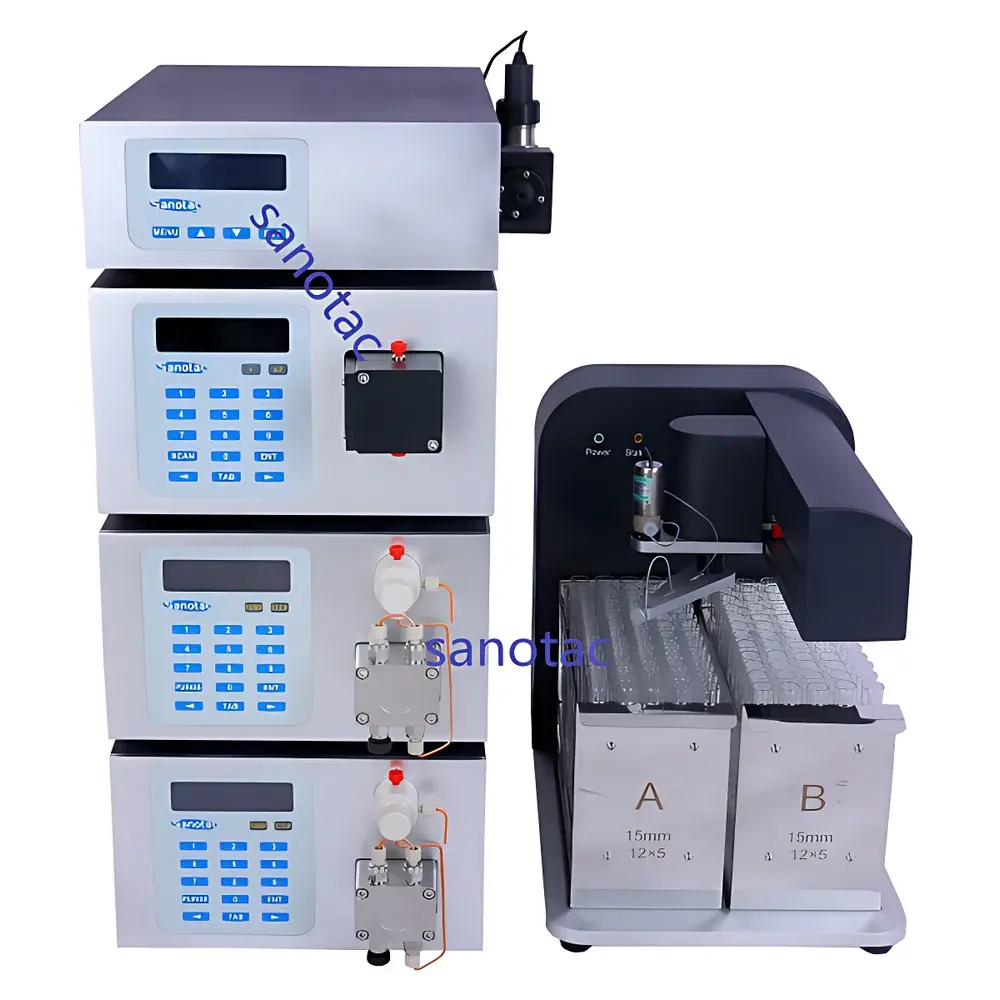
Biolot 100 Protein Purification System
| Brand | Sanotac |
|---|---|
| Origin | Shanghai, China |
| Manufacturer Type | Original Equipment Manufacturer (OEM) |
| Product Category | Domestic Instrument |
| Model | Biolot 100 |
| Purification Principle | Gel Filtration Chromatography (GFC) |
| Detector Types | UV-Vis Absorbance Detector, Conductivity Detector, pH Detector |
| Wavelength Range | 190–800 nm |
| Flow Rate Range | 0.01–100 mL/min |
| Pressure Range | 0–20 MPa |
| Gradient Accuracy | ±0.5% ABS (dual-pump system) |
| Conductivity Range | 0–999.9 mS/cm |
| pH Range | 0–14 |
| Fraction Collector Capacity | 2 × 60 tubes (15 mm × 150 mm) |
| Software Compliance | CFDA GxP & FDA 21 CFR Part 11 |
Overview
The Biolot 100 Protein Purification System is a modular, medium-pressure liquid chromatography platform engineered for reproducible and scalable purification of proteins, peptides, antibodies, and nucleic acids across research, process development, and early-stage manufacturing environments. Built on the principles of size-exclusion chromatography (SEC), also known as gel filtration chromatography (GFC), the system separates biomolecules based on hydrodynamic volume under non-denaturing conditions—preserving native conformation and biological activity. Its dual-pump gradient architecture enables precise mobile-phase composition control, supporting both isocratic and complex multi-step gradient elution protocols. Designed for compatibility with standard analytical to semi-preparative columns (e.g., 10–25 mm ID), the Biolot 100 bridges the gap between analytical characterization and pilot-scale purification, delivering consistent retention time stability and peak resolution across repeated runs.
Key Features
- High-precision PEEK solvent delivery pumps with flow accuracy of ±0.5% and pressure capability up to 20 MPa—optimized for biocompatibility and low carryover.
- Dual-wavelength UV-Vis detector featuring auto-switching deuterium and tungsten lamp sources; simultaneous dual-channel absorbance monitoring at 190–800 nm with ±1 nm wavelength accuracy and linear dynamic range of 0–2 AU.
- Integrated conductivity and pH detection modules enabling real-time monitoring of buffer composition and ion exchange equilibration—critical for method transfer and column regeneration validation.
- Automated fraction collector with programmable collection modes (sequential, loop, trigger-based), supporting two 60-position racks of standard 15 mm × 150 mm test tubes.
- PEEK-based fluidic path throughout—including pump heads, valves, and flow cells—ensuring chemical inertness, low protein adsorption, and resistance to common aqueous and mild organic solvents.
- Self-cleaning pump head function minimizes salt crystallization and buffer residue accumulation, extending maintenance intervals and improving long-term baseline stability.
- Modular valve manifold configurable for sample injection, column switching, and bypass operations—facilitating multi-column setups and orthogonal purification strategies.
Sample Compatibility & Compliance
The Biolot 100 accommodates a broad range of biomolecular samples, including monoclonal antibodies (mAbs), recombinant enzymes, viral vectors, plasmid DNA, and synthetic peptides. Its flow path design supports both low-viscosity aqueous buffers (e.g., PBS, Tris-HCl) and moderate-strength denaturants (e.g., urea up to 6 M, guanidine HCl ≤ 4 M) when used with appropriate column chemistries. All hardware components comply with ISO 9001:2015 quality management standards. The BioView software platform is validated for compliance with regulatory requirements applicable to pharmaceutical R&D and manufacturing, including CFDA GxP guidelines and FDA 21 CFR Part 11—supporting electronic signatures, audit trails, role-based access control, and secure method/data archiving.
Software & Data Management
BioView is a Windows-based chromatography data system (CDS) developed specifically for biomolecule purification workflows. It provides integrated instrument control, method editor with gradient programming (linear, step, or custom profile), real-time chromatogram overlay, peak integration using tangent skim or valley-to-valley algorithms, and customizable report templates compliant with GLP/GMP documentation practices. Raw data files are stored in vendor-neutral formats (.csv, .pdf) alongside metadata-rich .xml logs containing full instrument configuration, user actions, and timestamped audit trail entries. The software supports multi-user deployment with password-protected profiles, permission tiers (operator, supervisor, administrator), and export-ready output for submission to regulatory reviewers.
Applications
- Native SEC analysis and purification of therapeutic proteins and antibody fragments.
- Buffer exchange and desalting of concentrated protein solutions prior to formulation or structural studies.
- Removal of aggregates, fragments, and host-cell proteins during downstream process development.
- Method scouting and optimization for ion exchange, hydrophobic interaction, and affinity chromatography—using the same hardware platform via column and detector reconfiguration.
- Supporting QbD (Quality by Design) initiatives through robust parameter mapping and DoE (Design of Experiments)-driven gradient optimization.
- Academic and industrial labs conducting CRISPR-Cas9 ribonucleoprotein (RNP) complex purification or mRNA-LNP intermediate isolation.
FAQ
Is the Biolot 100 compatible with HPLC-grade columns from third-party vendors?
Yes—the system uses standard 1/4″-28 UNF and 10-32 fittings and supports column IDs from 4.6 mm to 25 mm, provided backpressure remains within the 20 MPa operational limit.
Can BioView software be deployed on virtual machines or networked workstations?
Yes—licensed installations support domain-joined Windows Server environments and remote desktop access under validated configurations per internal IT security policies.
Does the system support automated method transfer between different Biolot models?
Method files (.bvm) are backward-compatible across the Biolot series; however, flow rate and pressure limits must be manually verified against each model’s specifications before execution.
What validation documentation is supplied with the system?
Each shipment includes Factory Acceptance Test (FAT) reports, IQ/OQ protocol templates aligned with ASTM E2500 and EU Annex 11, and a complete software validation package for 21 CFR Part 11 compliance.
How often does the UV lamp require replacement?
Deuterium lamps have an average service life of 1,000–1,500 hours; tungsten lamps exceed 10,000 hours. BioView displays cumulative lamp usage and triggers alerts at 90% of rated lifetime.



