
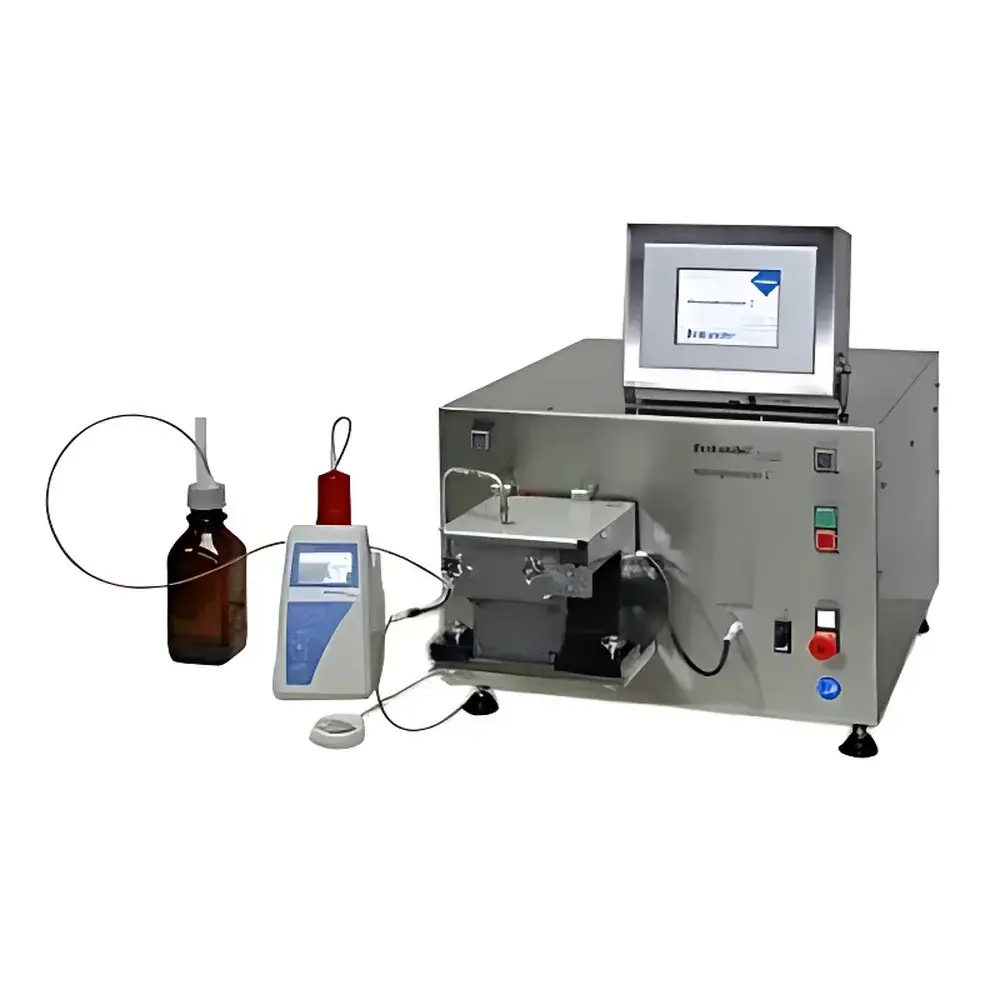
Brabender C-Type Carbon Black Absorptometer
| Brand | Brabender |
|---|---|
| Origin | Germany |
| Model | C-Type Carbon Black Absorptometer |
| Compliance | ASTM D2414 (Methods B & C) |
| Torque Measurement Resolution | ≤ 0.01 mN·m |
| Dropping Accuracy | ±0.02 mL per step |
| Mixing Chamber Volume | 35 mL nominal |
| Temperature Control Option | Optional jacketed chamber (±0.5 °C stability) |
| Software Platform | Windows-based 32-bit control & analysis suite |
| Data Export | CSV, PDF, XML |
| Audit Trail | GLP-compliant event logging (user, timestamp, parameter changes, torque curve metadata) |
Overview
The Brabender C-Type Carbon Black Absorptometer is a precision-engineered instrument designed for the quantitative determination of oil absorption capacity—specifically paraffin oil or dibutyl phthalate (DBP)—in carbon black and inorganic filler materials. It operates on the fundamental principle of torque rheometry under controlled liquid addition: as oil is incrementally dosed into a rotating powder bed within a thermostatically stabilized mixing chamber, real-time torque response reflects evolving physical states—free-flowing dispersion, incipient agglomeration, and final paste formation. The inflection point corresponding to 70% of maximum torque (per ASTM D2414 Method C) or the peak torque (Method B) is algorithmically identified to yield the standardized oil absorption number (OAN), a critical indicator of aggregate structure, surface area, and reinforcement potential in rubber compounding.
Key Features
- High-fidelity torque transduction system with resolution ≤ 0.01 mN·m, enabling detection of subtle phase transitions during wetting dynamics.
- Programmable micro-dosing unit delivering oil at precisely regulated rates (0.05–0.5 mL/s), synchronized with real-time torque acquisition at 10 Hz sampling frequency.
- Dedicated mixing geometry: stainless-steel chamber with optimized blade profile and rotational symmetry to ensure homogeneous shear distribution and eliminate wall effects.
- Optional temperature-controlled jacket (−10 °C to +80 °C) for evaluating thermal dependence of oil uptake kinetics—essential for process-relevant simulation.
- Modular design supporting interchangeable mixing chambers; enables rapid method switching between carbon black grades or filler types without recalibration.
- Self-calibrating torque and volumetric subsystems—no external reference standards required prior to routine operation.
Sample Compatibility & Compliance
The C-Type Absorptometer accommodates standard carbon black samples (e.g., N110, N220, N330, N550) as well as silica, calcium carbonate, and other non-polar fillers used in elastomer formulations. All measurements conform strictly to ASTM D2414 (Standard Test Method for Oil Absorption of Pigments and Extenders), including both Method B (peak torque) and Method C (70% maximum torque). Instrument firmware and software enforce mandatory procedural constraints—such as minimum sample mass (5.0 g ± 0.05 g), specified rotor speed (60 rpm ± 1 rpm), and defined oil addition intervals—to guarantee inter-laboratory reproducibility. Full traceability aligns with ISO/IEC 17025 requirements for testing laboratories, and audit trail functionality satisfies FDA 21 CFR Part 11 electronic record integrity criteria.
Software & Data Management
The included 32-bit Windows-compatible software provides complete instrument orchestration: automated titration control, torque curve acquisition, polynomial smoothing (3rd-order least-squares fit), inflection point detection, OAN calculation, and statistical reporting (mean, SD, CV%, n ≥ 5 replicates). Default parameter sets are preloaded per ASTM D2414 subsections, but users may modify droplet volume, pause duration, rotation speed, or termination criteria for method development or internal SOP alignment. Raw torque vs. volume data is stored with full metadata (operator ID, date/time stamp, chamber ID, calibration certificate ID). Export formats include CSV (for LIMS integration), PDF (signed reports), and XML (for enterprise data lakes). All user actions—including parameter edits, manual overrides, and report generation—are time-stamped and logged in an immutable audit trail.
Applications
This instrument delivers actionable data across R&D, QC, and production environments: predicting scorch time and cure rate in sulfur-cured rubber compounds; qualifying carbon black batches against supplier specifications; optimizing filler dispersion protocols in masterbatch extrusion; correlating OAN with Payne effect magnitude in dynamic mechanical analysis; supporting formulation adjustments when substituting high-structure blacks with lower-OAN alternatives; and validating surface treatment efficacy (e.g., silane grafting on silica) via comparative oil uptake profiles. Its robustness makes it suitable for daily use in ISO 17025-accredited rubber testing labs and Tier-1 tire manufacturing QA departments.
FAQ
What ASTM standards does the Brabender C-Type Absorptometer support?
It fully implements ASTM D2414 Methods B and C, including automatic identification of the 70% maximum torque point and compliance with all procedural tolerances for sample mass, rotation speed, and oil addition rate.
Is temperature control mandatory for routine testing?
No—ambient-temperature operation is standard—but the optional jacketed chamber is recommended for method transfer studies, aging simulations, or when comparing materials with strong thermal sensitivity in oil absorption behavior.
Can the same mixing chamber be used for both carbon black and silica?
Yes, provided thorough cleaning (acetone rinse + nitrogen purge) is performed between dissimilar materials to prevent cross-contamination; chamber interchangeability is supported for dedicated material-specific configurations.
How is measurement repeatability ensured across multiple operators?
Through hardware-level torque and volumetric calibration traceable to NIST standards, combined with software-enforced parameter locks and operator-authenticated login sessions that restrict access to critical settings.
Does the system support 21 CFR Part 11 compliance for pharmaceutical-grade excipient testing?
Yes—electronic signatures, role-based permissions, and tamper-evident audit logs meet FDA requirements for regulated environments, though application validation must be performed per site-specific IQ/OQ protocols.
Related Products






