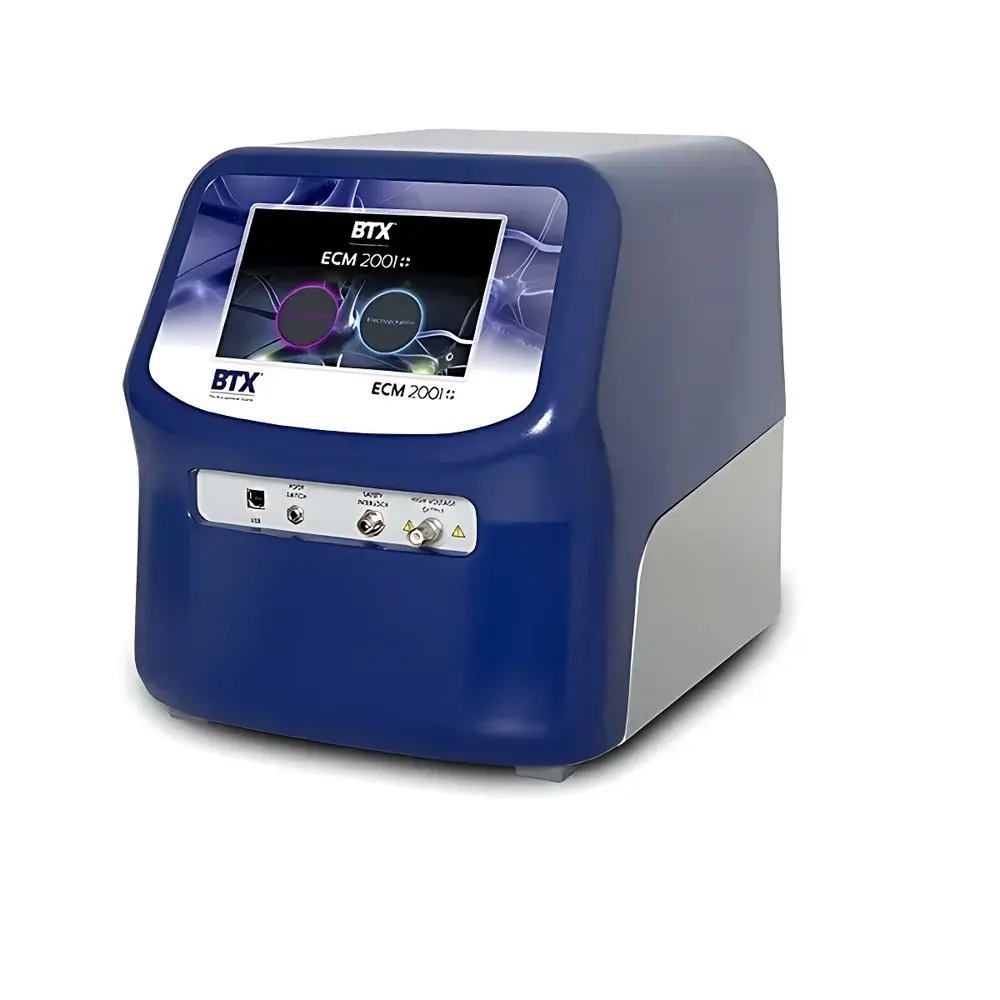
BTX ECM2001+ Electroporator and Electrofusion System
| Brand | BTX |
|---|---|
| Origin | USA |
| Model | ECM2001+ |
| Pulse Types | AC sine wave and DC square wave |
| High Voltage Range | 505–3000 V |
| Low Voltage Range | 5–500 V |
| Pulse Duration (DC) | 10 µs–999 ms |
| AC Frequency | 0.2–2.0 MHz |
| AC Voltage | 5–75 V |
| AC Pulse Time | 0–99 s |
| Capacitance | 2200 µF |
| Internal Resistance | 8 Ω |
| Max Discharge Cycles | 0–100 |
| Discharge Time | 7 s |
| Display | 7-inch color touchscreen |
| Preloaded Protocols | Cell fusion, somatic cell nuclear transfer (SCNT), hybridoma generation, electroporation for primary/stem cells |
Overview
The BTX ECM2001+ Electroporator and Electrofusion System is a dual-mode, laboratory-grade instrument engineered for high-precision electro-manipulation of biological cells. It operates on two distinct electrophysiological principles: alternating current (AC) dielectrophoresis for contactless cell alignment and orientation, and direct current (DC) square-wave electroporation for transient membrane permeabilization. This synergistic combination enables controlled, reproducible electrofusion of mammalian cells—including hybridoma formation, somatic cell nuclear transfer (SCNT), and embryonic manipulation—as well as high-efficiency transfection of challenging cell types such as primary neurons, hematopoietic stem cells, and non-adherent lymphocytes. Unlike monofunctional electroporators, the ECM2001+ integrates real-time waveform switching (AC-to-DC transition within ≤30 ms), enabling sequential application of alignment and fusion pulses under defined impedance conditions. Its architecture complies with IEC 61010-1 safety standards for laboratory electrical equipment and supports GLP-compliant experimental documentation when used with validated software workflows.
Key Features
- Dual-mode operation: Independent and combinable AC sine-wave (0.2–2.0 MHz, 5–75 V) and DC square-wave (5–3000 V, 10 µs–999 ms) pulse generation
- Precision voltage control: HV range (505–3000 V) adjustable in 1-V increments; LV range (5–500 V) with 1-V resolution
- High temporal fidelity: DC pulse width resolution of 1 µs (HV mode) and 1 ms (LV mode); AC pulse timing resolution of 1 s
- Multi-step protocol sequencing: Up to 19 programmable AC steps before and after DC pulses, supporting complex fusion maturation protocols
- Optimized thermal management: Dedicated 2 mL and 9 mL fusion chambers with integrated heat dissipation design reduce Joule heating, improving post-fusion viability by >40% versus standard cuvettes (per BTX internal validation data)
- 7-inch capacitive touchscreen interface with preloaded, editable SOPs for hybridoma generation, SCNT, and stem cell electroporation
- Low-impedance compatibility: Stable operation at sample resistances ≥60 Ω (LV, 100 ms), and ≥40 Ω (HV, ≤600 ms)
Sample Compatibility & Compliance
The ECM2001+ is validated for use with suspension and adherent mammalian cells, plant protoplasts, oocytes, zygotes, and early-stage embryos. Its electrode configurations—including microslide electrodes (0.5 mm, 1.0 mm, and 3.2 mm gap widths), meander fusion chambers, flat-plate electrodes, and disposable electroporation cuvettes (1 mm, 2 mm, 4 mm gaps)—support scalable applications from single-cell manipulation to bulk population transfection. The system meets ISO 13485-aligned manufacturing controls and conforms to ASTM F2179-02 (Standard Guide for Electroporation of Mammalian Cells) and USP (Cellular and Gene Therapy Products). When operated with audit-trail-enabled software (e.g., BTX FusionPro Suite v3.2+), it satisfies FDA 21 CFR Part 11 requirements for electronic records and signatures in regulated environments.
Software & Data Management
The embedded firmware supports full parameter logging—including voltage, pulse duration, capacitance, resistance, and timestamped protocol execution—stored locally on internal flash memory (≥10,000 protocol records). Optional FusionPro Software (Windows-based) enables remote configuration, batch protocol deployment, export of CSV/Excel-compatible datasets, and integration with LIMS via HL7 or REST API. All parameter changes are recorded with user ID, timestamp, and reason-for-change fields, fulfilling ALCOA+ (Attributable, Legible, Contemporaneous, Original, Accurate, Complete, Consistent, Enduring, Available) data integrity criteria. Protocol libraries include empirically optimized settings for CHO-K1, HEK293T, Jurkat, mouse embryonic fibroblasts (MEFs), and human induced pluripotent stem cells (iPSCs).
Applications
- Hybridoma development: AC-mediated lymphocyte–myeloma cell alignment followed by synchronized DC fusion, achieving >15% viable hybrid yield in 96-well format
- Somatic cell nuclear transfer (SCNT): Enucleation-assisted oocyte fusion using sub-100 µs HV pulses and post-fusion AC stabilization
- Primary cell transfection: Delivery of CRISPR-Cas9 ribonucleoproteins, siRNA, or plasmid DNA into CD34+ hematopoietic progenitors with >65% transfection efficiency and >80% viability
- Plant protoplast fusion: Interspecific fusion of Nicotiana tabacum and Solanum tuberosum protoplasts using low-frequency AC (0.5 MHz) and 250 V DC pulses
- In vivo and ex vivo gene delivery: Intratumoral or intramuscular electroporation for DNA vaccine studies, compliant with ICH S6(R1) nonclinical safety guidelines
FAQ
What distinguishes the ECM2001+ from conventional electroporators?
It uniquely combines programmable AC dielectrophoresis and high-fidelity DC square-wave pulsing in a single platform, enabling true electrofusion—not just electroporation—with precise temporal coordination between alignment and membrane destabilization phases.
Can the ECM2001+ be used for CRISPR editing in primary T cells?
Yes. Its low-voltage, multi-pulse DC mode (e.g., 3 × 200 V, 20 ms) delivers Cas9 RNP with minimal apoptosis induction, supporting >70% editing efficiency in activated human CD8+ T cells per published protocols (Nature Protocols, 2021).
Is calibration traceable to NIST standards?
Voltage and time outputs are factory-calibrated against NIST-traceable references (Fluke 8508A, Keysight 53230A), with certificate of conformance supplied per unit.
Does the system support automated liquid handling integration?
Via optional RS-232/USB-serial TTL interface, the ECM2001+ accepts external trigger signals and reports completion status, enabling synchronization with robotic platforms (e.g., Tecan Freedom EVO, Hamilton STAR).
What safety certifications does the ECM2001+ hold?
IEC 61010-1:2010 (Ed.3), UL 61010-1, CSA C22.2 No. 61010-1, and CE marking under EU Directive 2014/30/EU (EMC) and 2014/35/EU (LVD).